
'Fear, then helplessness': Congolese students in Kenya reflect on the war back home
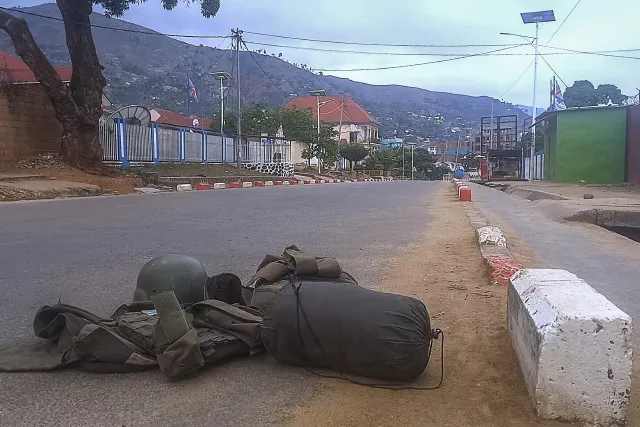
A bullet proof vest carrying a patch with the Democratic Republic of Congo (DRC) flag and a ballistic helmet are left abandoned with other personal belongings in a street in Uvira on December 11, 2025. Photo by- / AFP

Audio By Vocalize
The student, who has lived in Kenya for five years, says he immediately reaches for his phone to call home whenever he hears of fresh clashes, hoping to establish whether his family is safe.
His parents and siblings remain in Goma city in the eastern Democratic Republic of Congo (DRC), which fell to the March 23 Movement (M23) rebels in January 2025.
While Daniel attends classes at Daystar University, pursuing a master's degree in Diplomacy, Development and International Security, his thoughts often drift to the people he left behind.
"Fear first, then helplessness. When I hear 'fighting near Goma', I immediately start calling home. I am here in a classroom in Nairobi, and my family could be hiding under a bed," he says.
The uncertainty, he explains, has made it difficult to concentrate on his studies, particularly during examinations, when worrying about his family's safety becomes an additional burden.
For Daniel, the distance between Kenya and the DRC has not separated him from the conflict.
Instead, he has had to learn to follow developments through news reports and conversations with relatives, sometimes without knowing what is happening to the people closest to him.
He recalls the January 2025 fighting when communication networks and electricity were disrupted, leaving him unable to reach his family for days.
"There were days when the network and electricity were cut, and I could not reach my family. Those were some of the worst days of my life. I kept refreshing my phone and watching the news, not knowing if they were safe," he says.
The experience remains one of his most difficult memories of the conflict.
Daniel says his decision to study in Kenya was influenced by the insecurity in eastern DRC, where he felt it was increasingly difficult to plan for the future without worrying about whether universities would remain open or roads would be safe.
Goma, located in North Kivu province, near the Rwandan border, had experienced years of insecurity before the latest escalation.
M23's renewed offensive intensified in early 2025, with the group capturing Goma in January and Bukavu, the capital of neighbouring South Kivu, the following month.
The United Nations has continued to report fighting in both North and South Kivu, despite several diplomatic efforts aimed at ending the conflict.
In an October 1, 2026 report, the UN Secretary-General António Guterres said AFC/M23, supported by the Rwanda Defence Force, had expanded and reinforced positions in parts of the two provinces.
The report also noted continued fighting between the group and Congolese government forces, alongside the activities of other armed groups.
For Daniel, the situation has made returning home increasingly difficult. He last visited Goma in April 2026 and says travelling there has become more complicated.
Most of his family remains in the city, while some friends and relatives have been displaced more than once.
Although he recognises the importance of the ongoing peace initiatives, he says people living in affected communities are yet to experience meaningful improvements in their daily lives.
He wants Congolese leaders to prioritise civilian protection, dialogue, the return of displaced people and the restoration of government services in affected areas.
Daniel is also concerned about the limited participation of young people in decisions about the country's future.
"Young people are the majority in the DRC, but decisions are made by a small group of older politicians and armed men," he says.
He believes young Congolese should have a greater role in shaping political decisions, particularly those affecting their education, employment and security.
For another Congolese student living in Kenya, the conflict is equally concerning, although his personal circumstances are different.
Pete (who preferred to use a pseudonym) is from Lubumbashi in Haut-Katanga province and has lived in Kenya since 2017. Unlike Daniel, he did not leave the DRC because of the conflict in the east.
The 27-year-old says his parents' work largely influenced the family's decision to have him study in Kenya. At the time, Lubumbashi and the wider Haut-Katanga region were relatively peaceful compared with the eastern provinces, which had experienced years of armed conflict.
Before the latest escalation, Pete would travel home once or twice a year. He has not returned since the conflict intensified.
His family and friends, however, are spread across different parts of the country, including Goma, Bukavu and Beni.
He follows developments through international news channels, local Congolese media and regular conversations with relatives and friends.
When Goma fell in January 2025, the circulation of videos showing rebel fighters in the city brought the conflict closer to home.
"The capture of one of the largest Congo cities was distressing and it was known that friends and relatives were there and in the surrounding areas," he says.
"It brought the war into a close, personal way, even at a thousand kilometres of distance!"
Pete says communication with relatives in Goma and Bukavu was particularly difficult during the initial escalation, leaving him worried about their safety.
He has also noticed growing tension in Lubumbashi, including an increased military presence and a general sense of unease over the country's security situation.
However, he is careful to distinguish the tension in his home city from the actual fighting, noting that the major territorial advances reported by international organisations have been in North and South Kivu, not Lubumbashi.
Like Daniel, Pete is concerned about the country's political direction, particularly a new political-military movement.
Pete fears that politics through an armed movement could undermine the progress made towards establishing democratic transfers of power.
He says the current government has also failed to meet the expectations of many Congolese people, citing corruption, weak institutions and its handling of the conflict in the east.
For Pete, neither political dissatisfaction nor disagreements over leadership should justify pursuing power through armed struggle.
He believes a negotiated political settlement is necessary to end the conflict and restore government authority across the country.
His concerns also extend to the role of neighbouring countries and the international community.
The United Nations has documented support by the Rwanda Defence Force for AFC/M23, while Rwanda has disputed accusations concerning its involvement in the conflict.
Pete believes African countries should do more to put pressure on the parties involved and help secure a lasting political solution.
He is also concerned that the suffering of ordinary Congolese people receives less sustained international attention than other global crises.
"Congolese lives matter, most of all," he says, arguing that the value placed on human life should not depend on a person's nationality or where they come from.
Despite his disappointment with the country's political situation, Pete says he continues to find hope in ordinary Congolese people.
He remembers women who continued selling food and other merchandise in local markets even after their towns were taken over, as well as young men who defended their communities.
Their determination, he says, reminds him that the country still has a future despite the hardships its people have endured.
He draws inspiration from the message of Congolese musician Frère Patrice Ngoy, whose song carries the words "Congo ekobonga", meaning Congo will get better.
For Andy (who preferred anonymity), another Congolese student in Kenya, the conflict is a source of frustration, although he admits that he has not experienced its effects as directly as the other two.
Originally from Kinshasa, Andy moved to Kenya to pursue a bachelor's degree in an English-speaking country. He hopes to eventually continue his education in Japan, where he wants to study robotics or specialise in a related field.
His decision to study abroad was driven primarily by his childhood interest in technology and his ambitions rather than the political situation in the DRC.
He has not returned home since leaving and says he has not personally experienced communication disruptions when trying to reach relatives.
He also explains that he is not particularly close to his extended family and does not always know what individual family members are experiencing.
Nevertheless, he follows developments in the country through news outlets and updates circulating online.
What frustrates him most is seeing innocent people lose their lives because of political interests.
"It is frustrating to watch everything happening in your country without really having the means to take action or change things," he says.
Andy admits that politics is not something he particularly enjoys discussing, but he believes the people of eastern DRC deserve to live without constantly fearing for their lives.
His response also highlights the fact that young Congolese living abroad do not necessarily experience the conflict in the same way. Their concerns depend on where they come from, their family connections and how directly the violence has affected their lives.
The wider crisis, however, continues to affect communities across eastern DRC.
In its October report, the United Nations said continued fighting had contributed to further displacement and food insecurity, while armed groups remained active in several provinces.
The report also highlighted the regional dimension of the conflict, with relations between the DRC and Rwanda continuing to influence security and diplomatic efforts.
Several peace initiatives have been pursued, including the Washington process involving the DRC and Rwanda, the Doha talks between the Congolese government and AFC/M23, and African Union-led mediation.
However, the UN warned that continued fighting and delays in implementing commitments had exposed a gap between diplomatic progress and the realities facing people in conflict-affected communities.
For the three students in Kenya, those realities are not measured only through reports of territorial advances, political announcements or failed negotiations. They are also reflected in unanswered phone calls, concern for relatives, and the uncertainty of knowing when it will be safe to return home.
Despite their different experiences, they all hope to see a country where ordinary people can pursue their ambitions without the threat of violence.
Daniel draws hope from young Congolese people studying abroad and preparing to contribute to their country's future. He believes the determination of people who continue to rebuild their lives despite the conflict is reason enough to remain optimistic.
If he could speak to someone back home, he would urge them to take care of one another and keep their children in school.
"We who are outside have not forgotten you, and one day we will rebuild our country together," he says.
Pete, too, believes in the resilience of the Congolese people, while Andy holds on to a simple conviction.
"As long as there is life, there is hope," he says.
Join the Discussion
Share your perspective with the Citizen Digital community.
No comments yet
This discussion is waiting for your voice. Be the first to share your thoughts!