
EXPLAINER: Eastleigh building: What is a 'Pancake Collapse'?
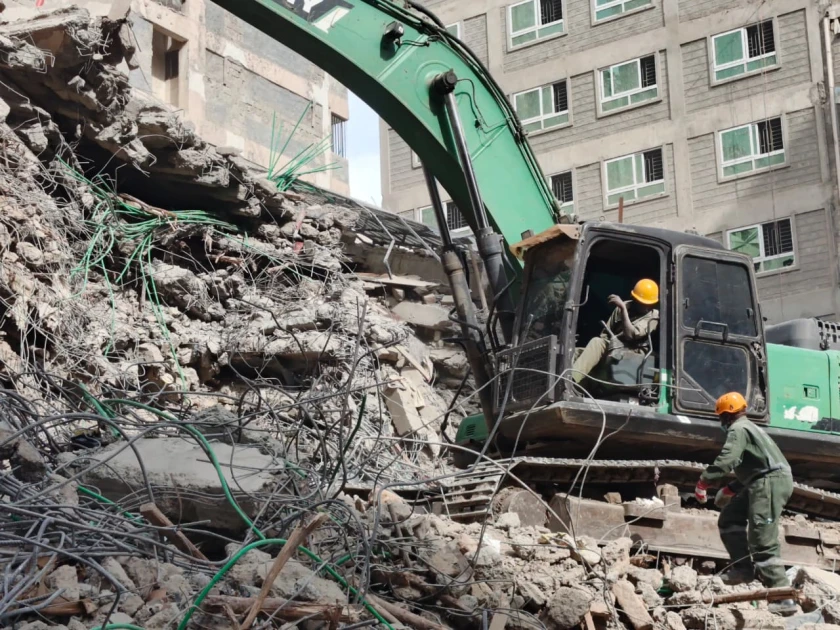
The debris from the Eastleigh building collapse on Friday, October 23, 2026. /BEN KIRUI

Audio By Vocalize
While explaining the technical nature of the structural failure, Engineer Ogallo initially used the standard engineering term, noting that they had been able to determine visually that it was a "pancake collapse."
Recognizing that the technical jargon might need translation for the broader audience watching at home, Lulu Hassan prompted him to break it down in Swahili.
With a quick smile, Ogallo translated the structural phenomenon into local parlance, describing it as "kuanguka kichapati" (falling like a chapati) - a humorous yet vivid analogy that triggered smiles and laughter among the crew and onlookers standing behind him.
Despite the gravity of the situation, the brief linguistic translation offered a human moment of clarity before refocusing on the serious implications of the structural failure.
What is a 'Pancake Collapse'?
In structural engineering and forensic failure analysis, a pancake collapse is a specific type of progressive structural failure.
It occurs when the upper floors of a multi-story building give way, simultaneously or sequentially, and drop vertically onto the floors below.
The process begins with an Initial Failure, where a critical structural element - such as a primary load-bearing column, wall, or floor slab connection - fails on a specific level due to overload, structural defects, poor material quality, or external trauma.
Following this, 'Loss of Support' occurs as the upper floor loses its vertical support and crashes down onto the floor directly beneath it.
This triggers a progressive impact, where the dynamic weight of the falling floor, compounded by gravity, overwhelms the structural integrity of the lower floor, causing it to collapse onto the next one in a cascading domino effect.
Ultimately, this results in the "Pancake" Result, where the floors stack flatly on top of one another like a stack of pancakes or a chapati, leaving very little vertical clearance or voids between the slabs.
This type of failure is particularly dangerous for two main reasons.
First, it creates zero survivability spaces; unlike other collapse types like a "lean-to" or "V-shape" collapse which often form triangular pockets of air and survival space for trapped occupants, a pancake collapse leaves minimal breathing room or gaps.
Second, it leads to complex rescue operations, making rescue and recovery immensely difficult because Urban Search and Rescue (USAR) teams cannot easily tunnel through solid, compressed layers of concrete floor slabs without heavy cutting equipment, specialized cranes, and meticulous shoring to prevent further shifting.
A prominent recent example occurred during the 2023 Kahramanmaraş earthquakes in southern Turkey, where thousands of multi-story residential blocks collapsed.
Structural engineers observed that soft-story designs - characterized by open ground floors for parking or retail - along with inadequate column-beam joints, caused hundreds of modern apartment buildings to pancake completely into multi-layer slabs.
A similar vulnerability was seen in the 1999 Izmit earthquake in Turkey, where thousands of residential structures failed in pancake modes due to non-ductile concrete details and poor-quality construction materials.
Join the Discussion
Share your perspective with the Citizen Digital community.
No comments yet
This discussion is waiting for your voice. Be the first to share your thoughts!