
Experts warn 85% of Nairobi buildings unsafe, demand action over South C building collapse
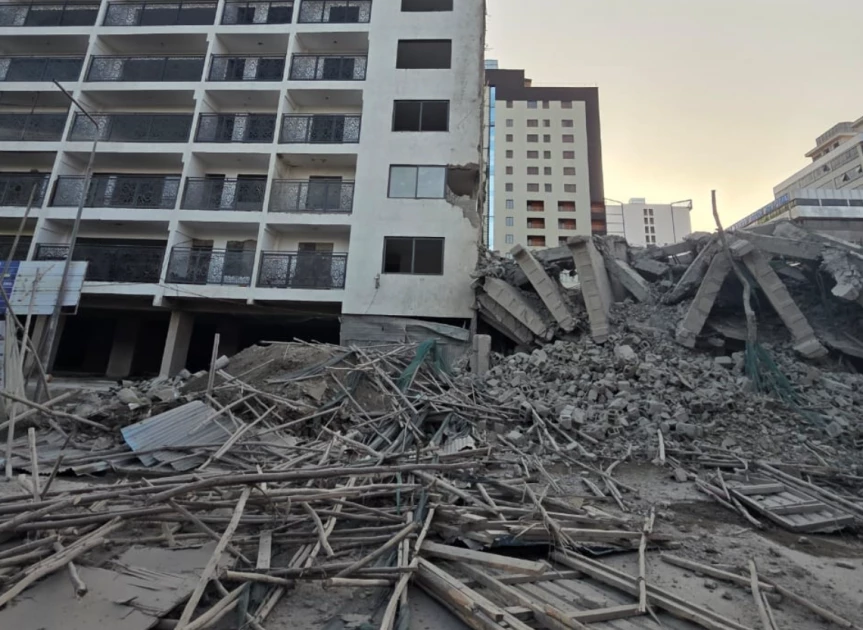
Collapsed South C building.

Audio By Vocalize
Professionals within the building and construction industry are now calling for a speedy investigation into the South C building collapse, saying those who approved the additional floors on the building should be held accountable for breach of the professional code of conduct.
The union painted a grim picture of the state of buildings
in the country, revealing that over 85% of buildings within Nairobi City are
unsafe for occupation.
In their address to the nation about a week after the collapse of the 16-storey building in South C in Nairobi the professionals, drawn from the Institution of Engineers of Kenya (IEK), The Architects Alliance (TAA) and the Kenya Institute of Planners (KIP), among others, called for immediate action against those who were central to the approvals of the construction of the building.
“The developer has that first duty of care of getting that consultant. The
contractor has the duty of care in terms of quality, processes and approvals,”
said TAA President Sylvia Kasanga.
IEK President Shammah Kiteme on his part said, “Who
was the responsible structural engineer? Is it the one in the NCA records? The
one on site?”
Architectural Association of Kenya (AAK) president George Ndede added, “It is not that you
add another floor because you got more tenants. It is a calculation that starts
from the foundation. If the foundation was not ready you can’t add later.”
The professionals termed the disaster a classic example of
systemic failures caused by corruption and greed.
“Can NCA blacklist all contractors who have issues? Make it public,” Kasanga
stated.
Kiteme added, “These are systemic issues which are
largely preventable.”
The association also lifted the lid on the state of
buildings in the country, revealing that about 85% of buildings in Nairobi
alone are unsafe for habitation.
“NBI took a sample of 15,000 buildings and only 15% of them were safe. You are
talking about all the others as being unsafe,” said Kiteme.
On his part, Ndede stated, “If a tremor, even on a
very low Richter scale, happened, many buildings would come down… If you have to
switch on your lights during the day, that is a problem. If there is a sewer
outside your house, that is a problem.”
Join the Discussion
Share your perspective with the Citizen Digital community.
No comments yet
This discussion is waiting for your voice. Be the first to share your thoughts!