
Engineers urged to end reliance on imported technology, embrace local expertise
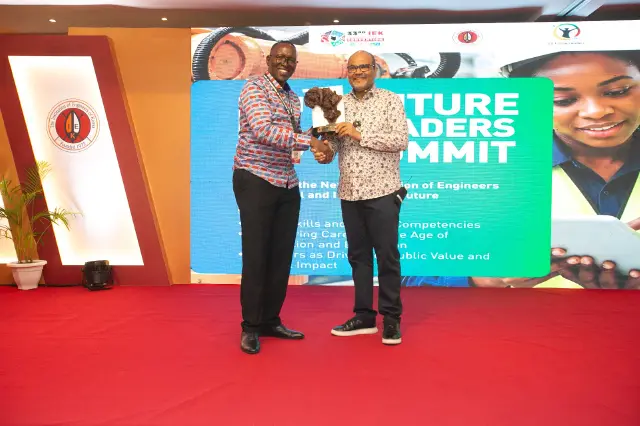
Principal Secretary for Science, Research and Innovation Prof. Shaukat Abdulrazak, gifted by IEK President Eng. Harrison Keter during the 5th Future Leaders Summit at the 33rd IEK International Convention in Mombasa.

Audio By Vocalize
Abdulrazak challenged engineers, particularly young professionals, to take a leading role in developing technologies that address the continent's development challenges, warning that continued dependence on innovations developed elsewhere risks leaving Africa on the margins of the global technological revolution.
He said engineering, research and innovation must become central to the country's economic development agenda, with greater emphasis on developing local expertise, manufacturing capacity and intellectual property.
"The question before Kenya and Africa at large is not whether we should embrace this transformation. The question is whether we will position ourselves to lead, innovate, create value, or remain the consumers of the technology that is developed somewhere else," he said.
The PS was speaking during the 5th Future Leaders Summit held alongside the 33rd Institution of Engineers of Kenya (IEK) International Convention in Mombasa.
He said Kenya had the human resource and intellectual capacity to become a major player in technological development but needed to deliberately invest in engineering education, research and the commercialisation of locally developed technologies.
Abdulrazak challenged engineers to move beyond traditional professional boundaries and become innovators, inventors, entrepreneurs and leaders capable of transforming industries.
He cited emerging technologies in nuclear energy, solar power, advanced transportation systems and medical equipment as some of the areas where Kenyan engineers could develop solutions that would reduce dependence on foreign technologies.
"I want to see solar-powered batteries made in Kenya. We would like to see how we can be able to have faster trains than in Kenya," he said, urging engineers to accelerate the development of technologies that could improve the country's industrial and infrastructure capacity.
He also pointed to developments in nuclear energy, noting that Kenya was positioning itself to expand its electricity generation capacity, with a proposed target of reaching 10,000 megawatts by 2032, including at least 3,000 megawatts from nuclear energy.
According to Abdulrazak, the country's ambitions in areas such as artificial intelligence, data centres and advanced manufacturing would remain difficult to realise without reliable and sufficient energy supply.
"You don't get it right with electricity, forget it. You don't get it right with energy, forget it. It's all about that first," he said.
He noted that engineering was central to virtually every pillar of the country's economic transformation agenda, including agriculture, healthcare, manufacturing, affordable housing and the digital economy.
He challenged Kenyan engineers to develop the capacity to design, manufacture and maintain such equipment locally instead of relying entirely on imported technologies.
IEK President Eng. Harrison Keter said Africa's growing population presented an opportunity for the continent to influence the direction of the global economy, but only if it invested in the skills and technologies required by future industries.
He noted that by 2030, an estimated 42 per cent of the world's youth would be living in Africa, making the continent an increasingly important source of the global workforce.
"What kind of workforce are we going to provide as Africa? That is the question we are trying to address in this government," Keter said.
He observed that the future of engineering would increasingly involve collaboration between human intelligence and machine intelligence, requiring young professionals to continuously upgrade their skills.
Keter challenged young engineers to take advantage of readily available learning resources and emerging technological tools to develop solutions that would address the continent's needs.
"Let us not wait to receive the one who depends on us to define how things happen," he said, urging young professionals to take responsibility for shaping the country's technological future.
Abdulrazak also called for stronger collaboration between government agencies, universities, research institutions and private-sector players to ensure innovations move from laboratories into the marketplace.
He said Kenya had more than 2,000 startups whose potential could be strengthened through improved mentorship, financing, business management skills and access to innovation support institutions.
He further challenged IEK to partner with the Kenya National Innovation Agency, the National Research Fund and the National Commission for Science, Technology and Innovation to support emerging innovators.
Join the Discussion
Share your perspective with the Citizen Digital community.
No comments yet
This discussion is waiting for your voice. Be the first to share your thoughts!