
Eliud Kipchoge: From winning in Melbourne to the upcoming Antarctica Challenge
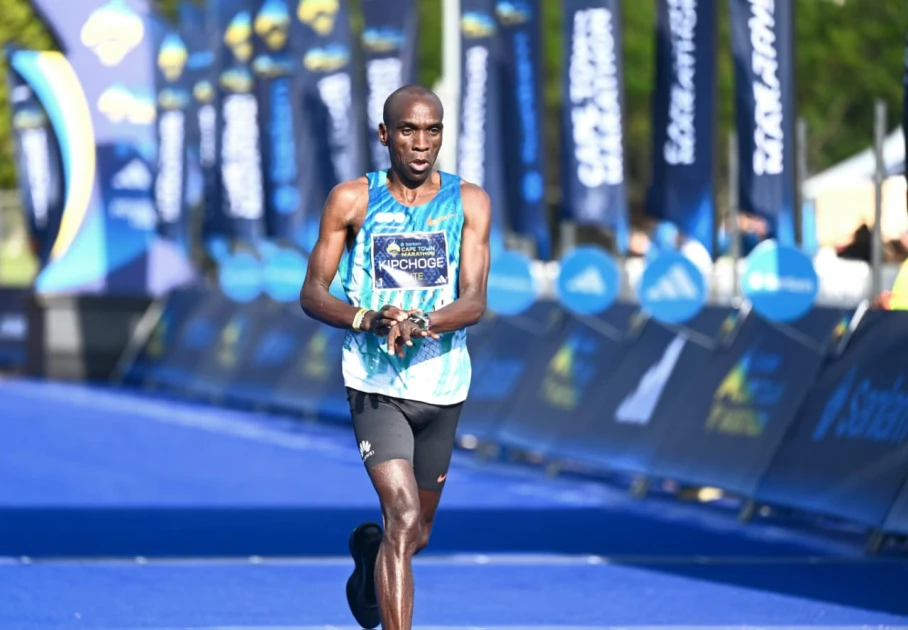
FILE: Kenyan marathon legend Eliud Kipchoge competing at the Cape Town Marathon on May 24, 2026. Photo/Handout.

Audio By Vocalize
At 41, when most distance runners have long hung up their racing flats or settled into quiet retirement, Kipchoge is embarking on what may well be the most ambitious chapter of his 24-year career: a world tour spanning all seven continents.
Having recently conquered the streets of Melbourne with a course record victory of 2:09:10 at the historic Melbourne Cricket Ground (MCG), Kipchoge’s journey has now received a major boost following a landmark partnership with financial giant ABSA Bank Kenya.
Yet, as he prepares to take on his most extreme challenge yet, running a marathon in Antarctica, the world’s greatest marathoner reveals that his drive is no longer about medals, but about humanity, discipline, and leaving an unshakeable legacy.
Why Triumphing at the MCG Meant More than Just Winning
For Kipchoge, winning in Australia was about far more than stopping the clock at 2:09:10. Stepping onto the turf of the Melbourne Cricket Ground carried profound historical symbolism.
"The Olympic Games took place at MCG in 1956. A 17-year-old named John Ian Wing told the people of Melbourne 'let us walk together' during the closing ceremony,” Kipchoge said during the announcement of his partnership in Nairobi on Tuesday afternoon.
"70 years later, I told the people there the exact same thing. It was a real feeling," Kipchoge reflected during the announcement of the partnership.
The Melbourne victory marked a key milestone in his seven-continent expedition, a campaign designed to prove that boundaries exist only in the mind. Unlike his years chasing world records in Berlin or Olympic gold in Rio and Tokyo, this tour demands a different kind of sacrifice.
"Training for the Olympics is about specific targets," he explained. "With these tours, I attend lots of clinics and press conferences to connect with people. It is actually harder than when I tried breaking the world record."
The Pioneer’s Blueprint: From Vienna to Antarctica
When Sabastian Sawe and Yomif Kejelcha ran sub-2-hour marathons in London earlier this year to become the first human beings in history to achieve that in a competitive race, it sent shockwaves through the athletics world.
But for Eliud Kipchoge—the original pioneer who shattered the psychological ceiling seven years ago in Vienna with his historic 1:59:40—it was a moment of profound joy rather than envy.
"The happiest man was myself because it took seven years for an athlete to run sub-2 hours," Kipchoge declared with a smile. "I showed them the way. It is about changing their minds. That is why I said at the beginning that I am happy I was able to show people that there are no limitations at all."
He added: "Those guys are 22 or 23 years old. Why should I not be happy when my own career has spanned 24 years?"
That same pioneering spirit that convinced a new generation to break the sub-2 barrier is what now drives Kipchoge toward Antarctica. To him, running on ice in sub-zero conditions is not just a personal quest—it is a mission to shatter another mental ceiling and redefine the global landscape of distance running.
"I am looking forward to Antarctica because it is cold. I want to show people that if you put your mind to achieving something, you can do it," Kipchoge said.
"On the extreme conditions, I am trying to sell this challenge to other people. It will be interesting to have a cross-country or even a road race during the Winter Olympics. What I do will convince people to do more research on that possibility."
Just as his sub-2 experiment in Vienna proved to young athletes that the human body can go where science once deemed impossible, Kipchoge’s frozen odyssey in Antarctica aims to prove that winter landscapes and extreme environments can become the next frontier for long-distance racing.
How Absa Partnership Will Help Kipchoge’s Cause
To power this grand expedition across seven continents, Kipchoge has officially partnered with ABSA Bank Kenya as the Official Financial Partner for his World Tour.
The collaboration bridges the gap between high-level athletic performance and corporate support for community-driven legacy projects.
Speaking candidly about the grueling physical journey that brought him to this point, Kipchoge quipped:
"This is a beautiful partnership. I always tell people that if you see my face and that of a Gen Z, you will see how life has beaten me! Not many can understand it, except the roads."
Kipchoge notes that his endurance today stems from foundational values established in the early 2000s, when he was a young runner striving to escape poverty.
"My honesty and being disciplined—those are things I cannot take for granted. Being honest with myself, integrity to myself and outside my toe," he said.
"I never knew it would happen this way. I did not know I would become the best athlete. I just wanted to go to Europe and put food on my family's table. But now, I want to bring people together and tell stories of what has been happening over the last 24 years on the road, because these roads understand me better than anyone else."
Why Kipchoge Was So Happy For Sebastian Sawe and Yomif Kejelcha
When Sebastian Sawe and Yomif Kejelcha recently broke the barrier to become the first athletes to run sub-2 hours in a competitive marathon in London, seven years after Kipchoge's historic INEOS 1:59 Challenge in Vienna, some wondered if the master felt eclipsed. Kipchoge strongly dismisses the notion.
"The happiest man was myself because it took seven years for an athlete to run sub-2 hours," Kipchoge declared with a smile. "I showed them the way. It is about changing their minds. That is why I said at the beginning that I am happy I was able to show people that there are no limitations at all."
He added: "Those guys are 22 or 23 years old. Why should I not be happy when my own career has spanned 24 years?"
What Keeps the 41-Year-Old Going?
For Kipchoge, retirement remains out of sight because his mission extends beyond sport. He views every milestone as merely a stepping stone.
"When you plant a seed, it must go down before it goes up," he emphasized. "What goes on behind the scenes is what matters—sacrifice, waking up every day even when tired, doing the right thing even when no one is seeing me.
“Winning is just championship character. What makes a human being is what really goes on behind the scenes."
His ultimate goal is to leave behind a mindset of relentless optimism and self-belief, particularly for his home country.
"I want people to see me and remind themselves that it is possible to push themselves to the limits. Be a good man. They say laws exist because people are negative.
“I want them to see me and be positive. 87 percent of Kenyans are negative; only 13 percent are positive, and most of those positive ones are women! Let us be positive in everything we do. Let us push our limits and let us push this country in a positive direction."
As he sets his sights on Antarctica and the final legs of his world tour, Eliud Kipchoge continues to prove that age is merely a statistic, and humanity’s potential remains limitless.
Join the Discussion
Share your perspective with the Citizen Digital community.
No comments yet
This discussion is waiting for your voice. Be the first to share your thoughts!