
Ebola: Ready or just greedy? Politicians say Kenya is ready, doctors warn we are not
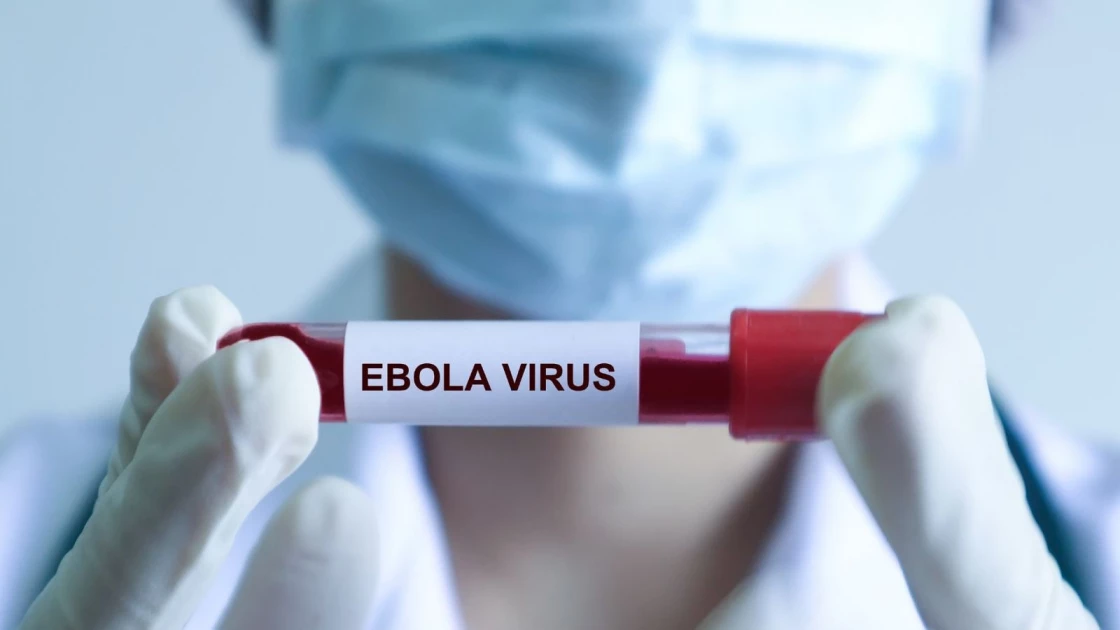
A medical vial containing blood and labelled "Ebola". PHOTO I FILE

Audio By Vocalize
The decision announced by US Secretary of State Marco Rubio in late May has been met by a resounding no from a majority of Kenyans, some of whom have taken to the streets, resulting in the death of one person.
Is Kenya ready? The government says yes. The doctors say no. The numbers say it's complicated.
Health Cabinet Secretary Aden Duale has been the face of the government's defence, insisting that the country is ready.
In a statement released on May 30, 2026, Duale argued that Kenya faces ongoing risks as a regional hub for trade and travel, thereby justifying Kenya's inclusion in any continental Ebola response architecture.
Speaking before the National Assembly, Duale listed Kenya's preparedness credentials: an 8-bed isolation and treatment unit at Kenyatta National Hospital, isolation units across 29 counties, four national reference laboratories operating around the clock, and a national preparedness assessment showing strong performance in contact tracing (100%), rapid response deployment (90%), and laboratory preparedness (87%).
"Kenya is ready. Kenya is capable. Kenya will continue to act responsibly in safeguarding both national and global health security," Duale declared.
Medical Services Principal Secretary Ouma Oluga went even further, telling the public that Kenya has "the highest isolation capacity" on the continent, and that KEMRI is "the fourth most prepared laboratory in the entire world."
KEMRI itself backed that position, with officials confirming that Kenya has "more than 40 people trained" to test for Ebola, and that the capacity to diagnose the virus exists right now.
President William Ruto, dismissing the wave of public concern, struck a similarly confident tone. "I can tell you without fear of any contradiction, and I can look everybody in the eye and tell you we know what we are doing," he said.
He framed the Laikipia facility as part of a wider national preparedness system of 23 similar centres across Kenya, aligned with existing hospital infrastructure including Kenyatta National Hospital, Moi Teaching and Referral Hospital, and Alupe Hospital.
The US Embassy in Nairobi also defended the arrangement, stating that the Laikipia facility "does not pose a risk to nearby communities" and that the partnership will ultimately "enhance Kenya's readiness and preserve Kenya's existing clinical resources to assist Kenyan citizens."
The US committed Ksh.1.7 billion ($13.5 million) toward Ebola preparedness in Kenya as part of the agreement.
The Kenya Medical Practitioners, Pharmacists and Dentists Union (KMPDU) does not share the government's confidence. Not even close.
KMPDU Secretary General Dr Davji Atellah has been blunt, demanding total transparency from the Kenyan government on why it agreed to take up the US offer, and asking a question that has resonated with many Kenyans: "What makes the US choose Kenya when the epicentre of the outbreak is in Congo?"
In a strongly worded statement, the Union, which represents more than 10,000 doctors in public and private hospitals, painted a picture of a health system that is far from ready to manage an Ebola quarantine for foreign nationals.
"Our public hospitals are structurally crippled. We lack basic diagnostic reagents, essential medicines, and functional intensive care infrastructure," the statement read.
KMPDU accused the government of engaging in backdoor negotiations without public participation and issued a 48-hour ultimatum demanding full disclosure of the terms of the Kenya-US agreement.
The Union also warned it would mobilise nationwide industrial action if the deal proceeded without transparency and without reforms to the healthcare system.
Atellah also questioned the moral logic of the arrangement: "We will not sit back and watch Kenya be treated as a containment colony for a lethal pathogen that we did not generate."
The doctor’s union argued that Kenya's priorities should be different.
"We should first have a robust healthcare system. Doctors should be employed, hospitals equipped, and ICUs revived before we start discussing quarantine arrangements for foreign citizens," Atellah said, noting that Kenya faces an estimated deficit of more than 100,000 health professionals, thousands of whom remain unemployed or under poor contractual terms.
"History has shown that weak preparedness, not the pathogen itself, is what turns public health threats into national crises," KMPDU added.
The government's own preparedness assessment, cited by CS Duale himself, reveals significant gaps beneath the confident rhetoric.
Infection prevention and control stands at only 56%. Logistics and operational support: 50%. Case management, arguably the most critical metric for an Ebola quarantine facility, sits at a worrying 36%. Readiness at ports of entry is at 60%.
The CS framed these figures as a transparent assessment rather than a failure. But independent experts were less diplomatic.
A CDC source told CNN that while Kenya has "very proficient colleagues," it is "hard to imagine the standard of care will be able to meet that of the treatment facilities that have been developed at great cost over many years in the US."
The Daily Nation further reported that Kenya has only three biosafety level 4 laboratories capable of confirming Ebola samples, that county-level isolation infrastructure remains uneven across the country, and that there is no approved vaccine or treatment for the Bundibugyo strain, the specific variant currently driving the outbreak.
Experts have also raised concerns that without proper containment measures, establishing the facility in Kenya risks triggering an Ebola outbreak in a country that currently has none.
Perhaps the most cutting critique came from Jeremy Konyndyk, who served as director of USAID's Office of US Foreign Disaster Assistance during the devastating 2014-2016 West Africa Ebola outbreak.
He noted that the US has spent years and significant resources building a network of highly capable domestic Ebola isolation and treatment facilities.
"Rather than having confidence in the capabilities we've built up here, we're sending them just literally anywhere else," Konyndyk said.
The controversy has moved beyond words. Kenya's High Court has extended conservatory orders blocking the establishment of any Ebola quarantine, isolation or treatment facility in the country, and barring the admission of individuals exposed to the virus.
The court also ordered the government to publicly release the full details of its agreement with the US, an order that, as of the time of writing, has not been fully complied with.
On the streets of Nanyuki, near the Laikipia Air Base, hundreds of residents took to the streets to protest.
One person was killed during those demonstrations, though the circumstances of his death remain unclear.
A leaked US Embassy cable obtained by the Daily Nation captured Washington's own alarm at the political fallout, noting that President Ruto may have "underestimated the depth and intensity of public opposition".
It also revealed that the anger over the Ebola facility was compounding other pressures on his government, including rising fuel prices and the looming anniversary of deadly anti-government protests in 2024.
The US Embassy in Nairobi has defended the arrangement, stating that the Laikipia facility "does not pose a risk to nearby communities" and that the partnership will ultimately "enhance Kenya's readiness and preserve Kenya's existing clinical resources to assist Kenyan citizens."
The core question of why Kenya and not another country, or indeed the United States itself, has not been answered to the satisfaction of the doctors, the courts, or the people of Nanyuki who took to the streets.
CS Duale's own preparedness data shows a health system with real and acknowledged gaps. KMPDU's account of hospitals without medicines and ICUs without functional infrastructure points to a system stretched thin on a normal day.
International experts question why a country with no Ebola cases, more than 1,500 miles from the epicentre, was chosen over countries with far superior medical infrastructure, including the US itself.
Is Kenya ready? The government says yes. The doctors say no. The numbers say it's complicated.
Join the Discussion
Share your perspective with the Citizen Digital community.
No comments yet
This discussion is waiting for your voice. Be the first to share your thoughts!