
EACC raises alarm over clearance of candidates with integrity concerns ahead of 2027 polls

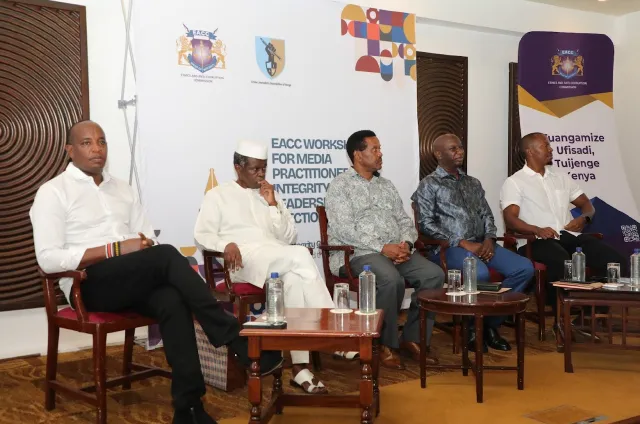
RMS Editorial Director Linus Kaikai, Prof. PLO Lumumba, EACC Commissioner Col. (Rtd) Alfred Mshimba, EACC Director of Ethics and Leadership Pascal Mweu, and EACC Head of Corporate Communication Stephen during a workshop on integrity in leadership and elections in Mombasa on November 23, 2026. PHOTO | COURTESY | EACC

Audio By Vocalize
EACC Commissioner Col. (Rtd) Alfred Mshimba said the commission had submitted 87 names with integrity concerns to the Independent Electoral and Boundaries Commission (IEBC) in 2017, but all were cleared to contest.
Speaking during a media practitioners’ workshop on integrity in leadership and elections in Mombasa on Monday, Mshimba added that the anti-graft body submitted integrity records of another 241 individuals, but only five were disqualified.
“These experiences raise an important question: Are we doing enough, as institutions and as a country, to ensure that integrity is given the attention it deserves when electing our leaders?” Mshimba posed.
EACC Regional Manager for Western Kenya Eric Ngumbi said political parties were among the institutions contributing to the enforcement challenges since they failed to consider candidates’ integrity and suitability during nominations.
While underscoring that political influence and popularity often took precedence, Ngumbi said some public officers fail to resign six months before elections as required under the Elections Act, with some returning to office after losing party nominations.
He also identified uncertainty in the interpretation of Articles 99(3) and 193(3) of the Constitution, alongside lengthy appeal and review processes, as obstacles to enforcing integrity requirements.
Other challenges included forged academic qualifications, branding public projects in personal names for political mileage, misinformation, narrative manipulation and failure to comply with wealth declaration requirements.
He called for a review of legislation governing integrity enforcement to address existing gaps and ambiguities.
“We must wholesomely push for timely determination of integrity-related cases in court and establish clear legal procedures and timelines for integrity verification of candidates seeking elective office,” Ngumbi said as he called for a review of legislation governing integrity enforcement to address existing gaps and ambiguities.
EACC CEO Abdi A. Mohamud on his part, clarified that the commission does not have the mandate to bar candidates from elections, saying that responsibility rests with the IEBC.
He explained that the commission submits recommendations on candidates’ suitability based on the Constitution and criteria agreed upon with the electoral commission.
“For avoidance of doubt, the mandate of the commission has never been to bar any candidates from the elections. This is a role that falls squarely under IEBC based on its constitutional mandate to register candidates for an election,” Mohamud said.
Mohamud said the commission had investigated 228 allegations of forged academic and professional certificates, recommending prosecution in 134 files forwarded to the Director of Public Prosecutions (DPP).
He said 50 cases had been concluded, resulting in 45 convictions and five acquittals, while Ksh.41.2 million acquired through forged certificates had been recovered.
The EACC also pledged to investigate voter bribery allegations reported during recent by-elections and cautioned public officers against engaging in political campaigns in violation of the Conflict of Interest Act.
Crime Journalists Association of Kenya (CJAK) Chairperson Joseph Muraya urged journalists to scrutinise candidates and public spending as the country heads towards the polls.
He said media houses should interrogate political promises, follow public resources and expose wrongdoing where evidence exists, while providing citizens with the context needed to make informed choices.
“Integrity is not an abstract idea. It is reflected in the daily choices made by leaders, institutions and citizens. For us in the media, it is reflected in how we gather facts, tell stories, handle pressure and remain accountable to the public,” Muraya said.
Mshimba further urged political parties, investigative agencies and the IEBC to work together to ensure integrity concerns are considered during the electoral process, warning against attempts to mobilise young people to intimidate opponents or disrupt public gatherings.
The commission said it would also undertake a national integrity awareness campaign targeting different segments of society, with a special focus on young people, ahead of the 2027 General Election.
Join the Discussion
Share your perspective with the Citizen Digital community.
No comments yet
This discussion is waiting for your voice. Be the first to share your thoughts!