
CS Kagwe unveils new KVB board as push for livestock sector transformation takes shape
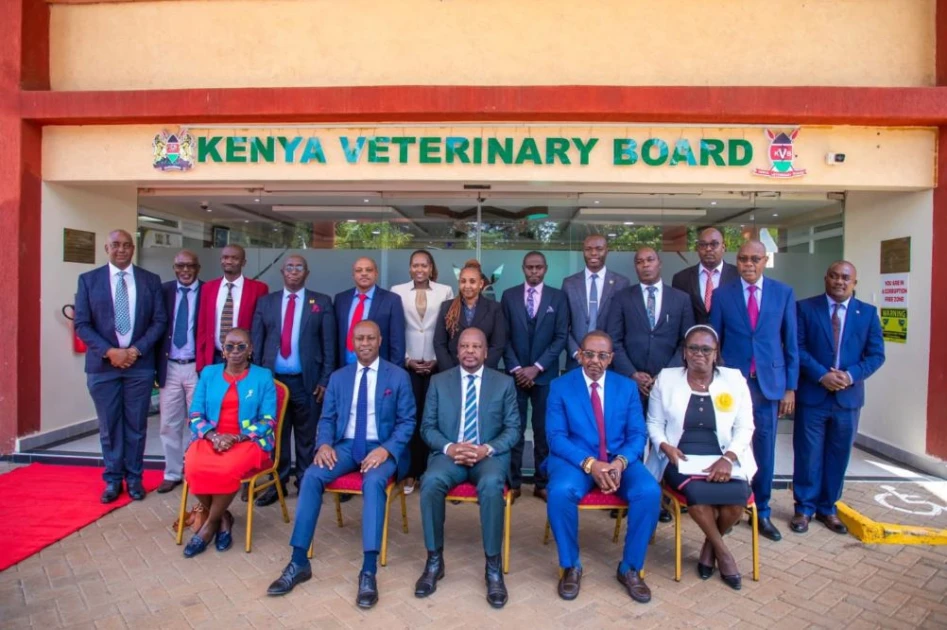
Agriculture Cabinet Secretary Mutahi Kagwe with the Kenya Veterinary Board (KVB) on March 30, 2026.

Audio By Vocalize
The event, presided over by Agriculture Cabinet Secretary Mutahi Kagwe, signaled a bold shift toward a data-driven, export-oriented livestock economy anchored on technology, youth empowerment and strict international standards.
CS Kagwe emphasized that Kenya’s ambitions in global livestock markets will now be defined by compliance and credibility, pointing to the rollout of the Animal Identification and Traceability System (ANITRAC) as non-negotiable.
“Moving forward, exporting animals to international markets must have traceability. That is why we have ANITRAC,” CS Kagwe said.
The CS noted that veterinary professionals are at the centre of this transformation, describing the profession as no longer confined to animal treatment but as a strategic pillar linking food security, trade, public health and national stability.
Newly appointed KVB Chair Dr. John Wilberforce Muchibi termed his appointment as a transition from academia to national responsibility, warning that the Board sits at a critical intersection of competing national priorities.
“You are sitting at the intersection of animal health, public health, food security and national stability,” he said.
Dr. Muchibi asserted that the Board’s role will be to safeguard livelihoods, protect communities from zoonotic diseases and drive national growth, while also creating space for innovation in a rapidly evolving sector.
He acknowledged the challenges ahead but signaled a reform-minded approach focused on impact, regulation and professional excellence.
The internship programme, now in its 10th cohort, saw the induction of over 1,300 graduates, adding to more than 7,500 trained since its inception — a critical workforce pipeline aimed at strengthening service delivery across the livestock value chain.
CS Kagwe urged the interns to rise to the occasion, reminding them that their role extends beyond clinics to shaping Kenya’s economic future.
Principal Secretary for Livestock Development Jonathan Mueke noted that investing in young professionals unlocks innovation and real impact, noting that the Ministry is committed to timely support, facilitation and structured career pathways.
“Transformation is not driven by policy alone — it is driven by you, the young people,” PS Mueke said. “Livestock is not just about animals — it is about data, international markets and innovation."
Director of Veterinary Services Dr. Allan Azegele stressed the urgency of adopting the One Health approach, a global framework that integrates human, animal and environmental health.
He warned that emerging threats — including zoonotic diseases, antimicrobial resistance and climate-related risks — require a multi-disciplinary, coordinated response.
“The veterinary profession continues to play a pivotal role in safeguarding public health and ensuring food safety,” Dr.Azegele said, calling for stronger collaboration across sectors.
The government has been making strides at achieving digitization of agriculture through platforms such as the Kenya Agricultural Digital and Information Centre (KADIC) and systems like ANITRAC, which are expected to transform disease surveillance, service delivery and market access.
CS Kagwe said the digital shift is not just a technological upgrade but a complete redefinition of veterinary practice, requiring new competencies in data, remote services and real-time decision-making.
The government is now linking veterinary services to export markets, with professionals expected to play a critical role in certification, compliance and value chain support.
Join the Discussion
Share your perspective with the Citizen Digital community.
No comments yet
This discussion is waiting for your voice. Be the first to share your thoughts!