
Kenya seeks horticultural competitiveness as sector pursues unified regional voice

Audio By Vocalize
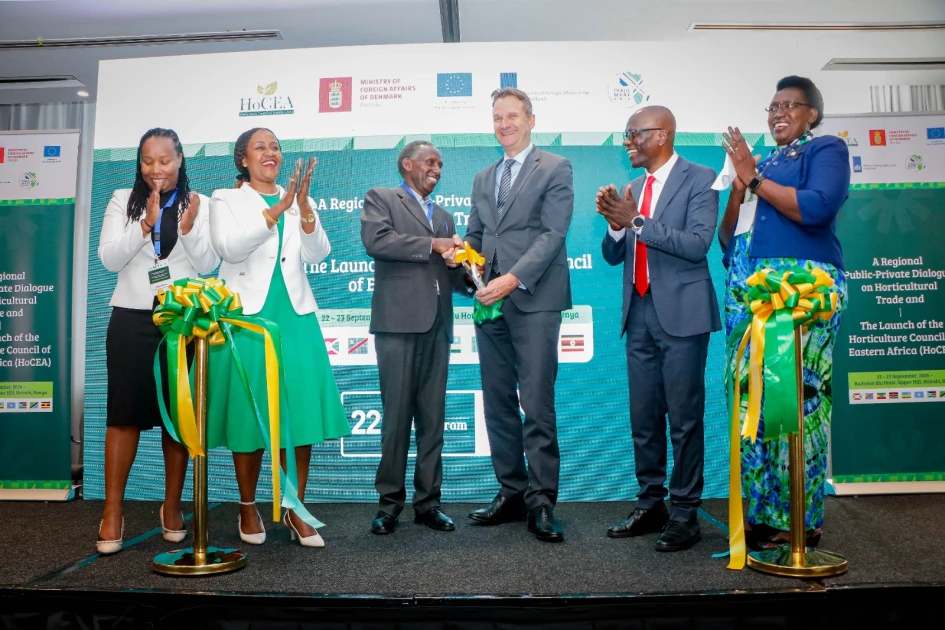
The Government of Kenya has called for intensified regional cooperation to unlock Eastern Africa’s horticultural trade potential during the official launch of the Horticulture Council of Eastern Africa (HoCEA) in Nairobi.
Speaking on behalf of the Principal Secretary for the State Department for Trade, Matthew Komen, Deputy Director for Internal Trade, emphasized that individual countries and businesses cannot tackle existing trade and logistics barriers alone, calling for coordinated public-private action across the region.
“These challenges cannot be resolved by any single country or firm acting alone. They demand
coordinated public-private action at the regional level," Komen said.
Horticulture remains a vital economic driver for Kenya, generating significant foreign exchange and providing employment, particularly for women and youth. Kenya exports roughly 467,000 metric tonnes of horticultural produce annually, valued at about US$1.143 billion.
To boost competitiveness, the Kenyan government outlined key priorities, including expanding cold-storage capacity along the Northern Corridor, strengthening single-window systems, expanding Authorised Economic Operator programs, and leveraging trade agreements like the EU-Kenya EPA and AfCFTA.
Komen also stressed retaining greater value through local processing, packaging, and branding.
HoCEA unites national horticulture associations across nine Eastern African nations to establish a collective regional voice.
HoCEA Chairperson Dr. Jacqueline Mkindi noted that while national platforms hold expertise, the Council provides the unified scale needed to address cross-border challenges, empower smallholders, and influence policy negotiations.
“Our national platforms bring considerable expertise; HoCEA gives us the collective voice to address challenges that cross our borders," she said.
On the other hand, HoCEA Secretary General Clement Tulezi outlined five core strategic priorities: market access and trade facilitation, cold-chain infrastructure, digital trade, inclusive value-chain development, and climate resilience.
International development partners, including TradeMark Africa, the Royal Danish Embassy, the European Union Delegation, and the Netherlands Embassy, strongly backed the initiative, citing the need to withstand global supply chain shocks and shift toward sustainable green logistics.
During the dialogue, Henk Jan Bakker, Ambassador of the Kingdom of the Netherlands to Kenya, highlighted the
complementarity between Eastern Africa’s horticultural production capacity and the Netherlands’
expertise in logistics and greenports.
Representing the European Union Delegation to Kenya, Rodrigo Romero Van Cutsem, Connectivity
Team/Investment Officer, also highlighted the importance of strengthening competitiveness across the
entire horticulture value chain.
On the other hand, Edwin Chachi, Programme Manager at the Royal Danish Embassy, stressed that green logistics,
effective cold chains and environmental considerations need to be incorporated into commercial
strategies from the outset.
The ongoing regional dialogue, involving delegates from across Eastern Africa, aims to streamline border processes and aggregate regional export volumes.
The ongoing regional dialogue, involving delegates from across Eastern Africa, aims to streamline border processes and aggregate regional export volumes.
The event concludes on September 23, 2026, with the validation of the Nairobi Horticulture Action Roadmap and the release of a Nairobi Communiqué detailing priority institutional responsibilities and implementation timelines.
Join the Discussion
Share your perspective with the Citizen Digital community.
No comments yet
This discussion is waiting for your voice. Be the first to share your thoughts!