
Condolences pour in as last Soviet leader Gorbachev dies at 91
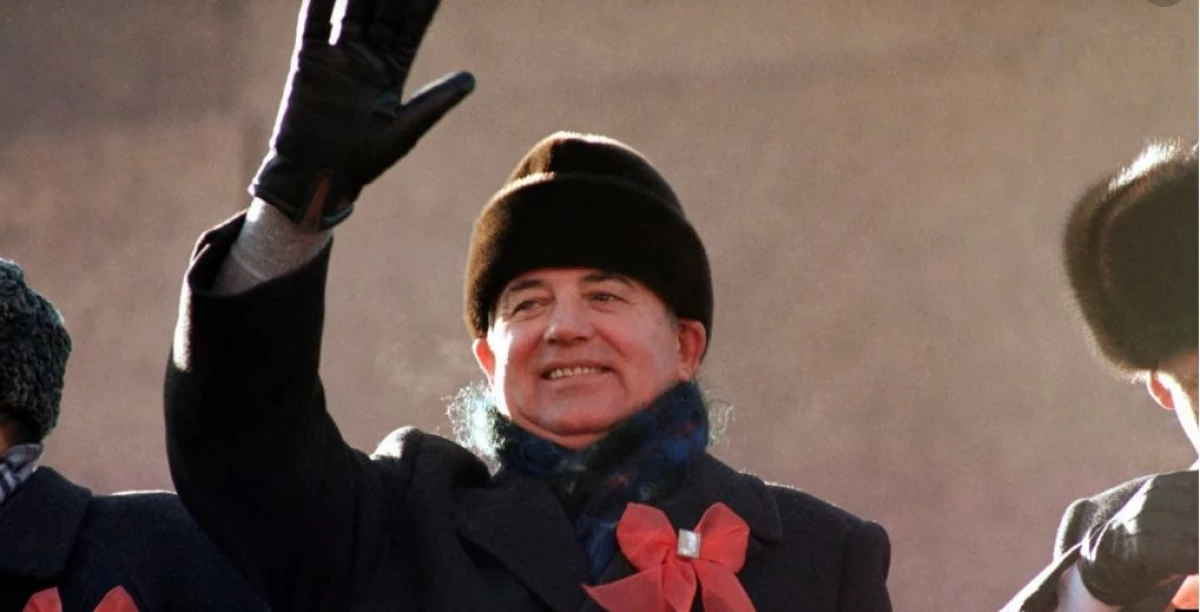
Soviet leader Mikhail Gorbachev waves from the parade review stand of the Lenin Mausoleum on Nov. 7, 1987 in Moscow's Red Square during the 70th anniversary of the Russian Revolution. PHOTO/COURTESY: VOA

Audio By Vocalize
Leaders and politicians around the world have
expressed their condolences as news spread that the last Soviet leader, Mikhail
Gorbachev, whose reforms helped end the Cold War and free Eastern Europe from
communism, but also led to the collapse of the Soviet Union, died overnight at
the age of 91.
Some in Russia and elsewhere took to social
media to criticize the man they blamed for making Russia a second-rate power, a
feeling that eventually led to the rise of President Vladimir Putin, who has
tried for the past quarter-century to restore Russia to its former glory and beyond.
Gorbachev died late on Monday "after a
serious and prolonged illness," the Central Clinical Hospital in Moscow
said.
The news triggered an immediate outpouring of
praise from global leaders far and wide for the man who helped trigger a a
pivotal turning point in world history.
Gorbachev was "a one-of-a-kind statesman
who changed the course of history. He did more than any other individual to
bring about the peaceful end of the Cold War," UN Secretary-General
Antonio Guterres said.
"The world has lost a towering global
leader, committed multilateralist, and tireless advocate for peace."
A trained lawyer by profession, Gorbachev
took over the Communist Party and Soviet leadership in 1985 and presided over
six turbulent years that saw the fall of the Iron Curtain, the reunification of
Germany, and ultimately the Soviet demise that Putin has since called "the
greatest geopolitical catastrophe" of the 20th century.
Gorbachev famously ushered in
"glasnost" and "perestroika" in an effort to keep the
struggling Soviet Union alive.
German Chancellor Olaf Scholz on August 31
hailed Gorbachev's role in reuniting Germany but lamented that his attempt to
establish an enduring democracy in Russia had "failed," a thinly
veiled criticism of Putin, who has been roundly criticized by the international
community for cracking down on civil society in recent years.
"The democracy movements in Central and
Eastern Europe benefited from the fact he was in power then in Russia,"
Scholz said. However, Gorbachev "died at a time in which democracy has
failed in Russia."
Added Britain's outgoing Prime Minister Boris
Johnson: "In a time of Putin's aggression in Ukraine, his tireless
commitment to opening up Soviet society remains an example to us all."
In a statement issued in the early hours of
Tuesday, U.S. President Joe Biden called Gorbachev a "rare leader -- one
with the imagination to see that a different future was possible and the
courage to risk his entire career to achieve it.
The result was a safer world and greater
freedom for millions of people."
French President Emmanuel Macron praised
Gorbachev as a "man of peace" whose decision opened a "path of
freedom" for Russians. "His commitment to peace in Europe changed our
common history," Macron said on Twitter.
China praised Gorbachev for his part in
improving ties between Beijing and Moscow in the 1980s and '90s after decades
of tensions over ideological differences and competing geopolitical interests.
"Mikhail Gorbachev made positive
contributions to the normalization of Sino-Soviet relations," Foreign
Ministry spokesman Zhao Lijian told a press conference, adding: "We mourn
his death and express our condolences to his family."
At home, however, Gorbachev's legacy was
being spoken of in a different tone.
The developments in Eastern Europe triggered
by Gorbachev helped fuel aspirations for democracy and autonomy among the 15
republics of the Soviet Union, which fell apart, sometimes violently.
In January 1991, Soviet troops killed 14
people at Lithuania's main TV tower in an attack that Gorbachev denied
ordering. In Latvia, five demonstrators were killed by Soviet special forces.
“Lithuanians will not glorify
Gorbachev," tweeted Lithuanian Foreign Minister Gabrielius Landsbergis,
the son of Vytautas Landsbergis, who led Lithuania’s independence movement in
the early 1990s.
"We will never forget the simple fact
that his army murdered civilians to prolong his regime’s occupation of our
country. His soldiers fired on our unarmed protesters and crushed them under
his tanks. That is how we will remember him,” he added.
Gorbachev was politically debilitated by a
hard-line coup in August 1991 that failed in large part due to a popular
resistance led by Boris Yeltsin.
A week later, Gorbachev resigned as Communist
Party general secretary.
In late December 1991, his resignation as
president of the Union of Soviet Socialist Republics effectively spelled the
end of the Soviet empire. Putin paid tribute to Gorbachev for his reform
efforts and humanitarian work.
"Mikhail Gorbachev was a politician and
statesman who had a tremendous influence on the course of world history,"
reads the condolence message to relatives released by the Kremlin on August 30.
Gorbachev led the country to a time of
"dramatic change" and recognized the great need for reform at the
time, Putin’s message said.
"I would like to particularly emphasize
the great humanitarian, charitable and educational activity that Mikhail
Sergeevitch Gorbachev carried out all these past years," it added.
Alexsey Navalny, the imprisoned Russian
opposition politician, praised Gorbachev for "peacefully" departing
from power.
Navalny, who is being held in a facility about
260 kilometers east of Moscow, made the statement on Twitter on August 31, most
likely via his team members.
Oleg Morozov, a member of Russia’s lower
house of parliament, or Duma, representing the ruling United Russia party,
called Gorbachev one of the “co-authors” of a new world order that he labeled
as “unjust” for Russia.
Morozov described Russia’s unprovoked war in
Ukraine as an attempt to alter the post-Soviet world order. He said he hoped
that in his last days Gorbachev felt “remorse” for the consequences of his
actions.
The Kremlin called Gorbachev "an
extraordinary politician" but said that his "romanticism" over
forging strong ties with the West "failed to be true."
Kremlin spokesman Dmitry Peskov, speaking at
an educational event in Moscow on August 31, said Gorbachev will be forever
remembered both at home and abroad for his statesmanship.
"Many argue about the role he played [in
history], but it is clear that he was extraordinary, a unique person,"
Peskov said, adding that the death of the Soviet leader is "a real loss
for us all."
"Gorbachev gave the impulse for the end
of the Cold War, and he sincerely wanted to believe that it will end and a
permanent romantic period of ties between a new Soviet Union and the collective
West would follow. That romanticism failed to be true. No romantic period or
honeymoon came," Peskov added, blaming the West for failing to further the
relationship.
Peskov said Putin had sent a telegram of
"condolences to Mikhail Gorbachev's relatives and loved ones," the
text of which appeared on the Kremlin's website.
"Mikhail Gorbachev was a politician and
statesman who had a huge impact on the course of world history. He led our
country during a period of complex, dramatic changes, large-scale political,
economic, and social challenges. He deeply understood that reforms were
necessary and strove to offer his own solutions to emerging problems,"
Putin's telegram says, adding Gorbachev was involved with "great
humanitarian, charitable, and educational activities" after the Soviet
Union was officially dissolved in December 1991.
The former Soviet leader is expected to be
buried at Moscow's Novodevichy Cemetery alongside his wife, Raisa, who died in 1999,
according to state media. However, Interfax reported that there wouldn't be a
state funeral for Gorbachev.
Join the Discussion
Share your perspective with the Citizen Digital community.
No comments yet
This discussion is waiting for your voice. Be the first to share your thoughts!