
Coalitions, power-sharing rackets; how marriage of convenience powers Kenyan elections
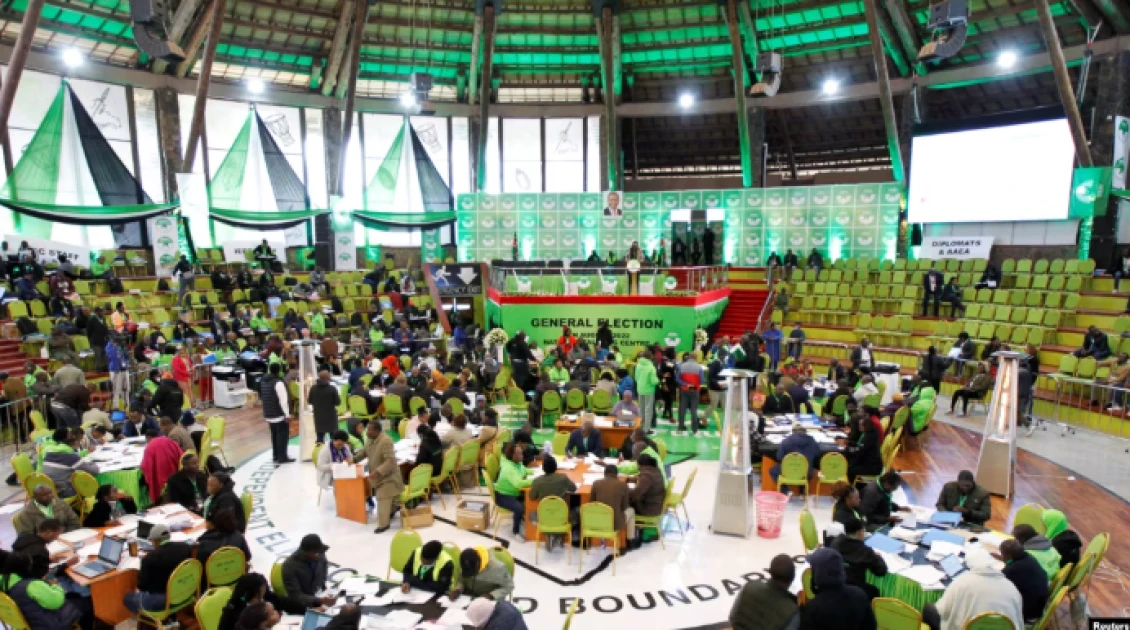
Various political parties' delegates and officials from the Independent Electoral and Boundaries Commission (IEBC) meet at the IEBC National Tallying centre at the Bomas of Kenya, in Nairobi, Aug. 13, 2022. Photo: Reuters

Audio By Vocalize
From the euphoria of 2002 to the blood-soaked chaos of 2007, through the "handshakes" of 2018 and the "broad-based government" of 2024, coalition-building has been both Kenya's great democratic innovation and its recurring political sickness.
As the country edges toward 2027 without, for the first time in a generation, the gravitational pull of Raila Odinga, it is worth asking what these alliances actually achieved, and what they cost.
2002: A 'Mother of Coalitions'
The National Rainbow Coalition (NARC) remains the gold standard of Kenyan coalition-building, and for good reason.
After 39 years of KANU rule under Jomo Kenyatta and then Daniel arap Moi, opposition parties that had spent a decade splitting the anti-KANU vote, and losing because of it, finally did the unthinkable. They merged into a single electoral vehicle.
NARC was a mass movement and coalition of various sectors that united purposefully to defeat KANU’s Uhuru Kenyatta in the 2002 election.
What made it different from everything that followed was the seriousness of the pact underpinning it.
NARC emerged from the merger of the National Alliance for Kenya, the People's Coalition, and the Liberal Democratic Party, and its constituent parties signed a memorandum of understanding governing how power and a new constitution would be handled after victory.
Crucially, the deal had a single, unambiguous objective binding it together: ousting KANU. There was no incumbent to appease, no state machinery to co-opt defectors, and a genuinely popular mandate for change that transcended any one ethnic bloc.
Mwai Kibaki won with a landslide 62 per cent of the vote, and NARC swept parliament.
The coalition's undoing came almost as fast as its triumph. Once in office, the MOU that had promised a powerful prime ministership and shared power unravelled, exposing NARC as, in the words of one academic study, an organization that changed the government but never developed real institutional substance of its own.
A retrospective on NARC's five years in power found that although it succeeded in changing the government, the coalition remained throughout an organization without any real political substance as a party.
The lesson embedded here is that coalitions built to win an election rarely survive the temptation of power once it is captured, and this fact would play out again and again.
2007: Winning the Count, Losing the State
If 2002 showed what coalitions could achieve, 2007 showed how catastrophically they could fail, even while apparently winning.
The Orange Democratic Movement, born out of the "No" campaign against Kibaki's 2005 constitutional referendum, entered the election as a genuine multi-ethnic opposition force, while Kibaki hastily assembled the Party of National Unity as his re-election vehicle.
On election day, ODM decisively won the parliamentary contest, taking 99 seats against PNU's 43, with ODM-K adding 16 more.
For much of the presidential vote-tallying, Raila Odinga held a commanding lead. Then, in the space of days, that lead evaporated amid what independent observers and even some election officials described as serious irregularities in the final tallying process.
Kibaki was hurriedly sworn in, ODM decried theft, and the country descended into the worst political violence since independence. Police recorded 1,133 deaths, although various human rights organizations and estimates place the number between 1,300 and 1,500 fatalities, while over 600,000 were displaced.
The structural failure of 2007 was not that a coalition lost; it was that coalition politics had, by then, become inseparable from ethnic bloc-arithmetic.
ODM and PNU were less programmatic parties than ethnic federations assembled for a single, winner-take-all contest, with no mechanism to manage a disputed outcome other than street mobilization.
It took the intervention of a former UN secretary-general, the late Kofi Annan, and a power-sharing deal, creating the prime ministerial post NARC had promised and abandoned five years earlier, to pull the country back from the brink.
That settlement produced the 2010 constitution, arguably Kenya's most consequential coalition-politics dividend, but it came at an unconscionable price.
Handshakes: Peace-Making or Power-Sharing Rackets?
Since 2007, Kenya has developed a peculiar reflex: when election disputes threaten to boil over, the answer is an elite pact, a "handshake" that folds the loser's camp into government. Kibaki's 2008 grand coalition with Odinga set the template.
Uhuru Kenyatta's 2018 handshake with Odinga, after a bitterly contested 2017 rematch, followed the same script, birthing the Building Bridges Initiative and a cabinet swollen with appointees drawn from both camps.
Ruto's 2024 "broad-based government" struck with Odinga's ODM in the aftermath of deadly Gen Z-led protests against a Finance Bill is simply the latest iteration.
Critics charge that these arrangements produce bloated, patronage-heavy governments rather than genuine reform, which is difficult to dismiss.
Each handshake has expanded the number of ministries, created new advisory and parastatal positions, and done so for political expediency rather than policy delivery.
Ruto's own justification for the 2024 deal was explicit about its political rather than technocratic logic. Ruto said forming the broad-based government was a deliberate decision, made after strong opposition to a Raila ally's appointment to a key finance role that had traditionally gone to politicians from Mount Kenya or the Rift Valley.
The arrangement was framed publicly as stabilization after the Gen Z-led unrest, but its architecture, dividing formal leadership roles roughly down the middle between former rivals, reads more like a truce between elites than a governing program.
Odinga negotiated roughly half of formal leadership positions for his side under the broad-based government, echoing the same power-sharing logic as his 2018 handshake with Kenyatta.
This pattern has a corrosive side effect that critics rightly flag: it hollows out the opposition. Every time a leading challenger is absorbed into government, voters who backed that challenger's reform agenda are left without institutional representation, and the cycle of personality-driven, transactional coalition-making resets rather than resolves.
The very device meant to prevent 2007-style breakdowns has, over time, entrenched a governing class that rotates seats among itself regardless of who technically "wins."
Lessons for 2027
Three lessons recur across twenty years of Kenyan coalition-making. First, unity built around a shared, urgent objective, as witnessed in 2002, can overcome ethnic fragmentation, but unity built around dividing spoils after the fact cannot.
Second, disputed results without credible, trusted arbitration mechanisms are combustible; the 2010 constitution's judiciary and electoral reforms have made repeat 2007-style chaos less likely but not impossible, as the 2017 Supreme Court annulment and 2022 court challenge both demonstrated.
Third, coalitions built purely on ethnic arithmetic are structurally unstable once their founding grievance, usually opposition to an incumbent, is removed, which is precisely the dynamic now facing Kenya's opposition today.
That instability is acute heading into 2027. It will be the first multiparty election in which Raila Odinga is absent not only from the ballot but from the political field itself, and for more than three decades he had remained the central organizing figure of Kenyan opposition politics, carrying reform memory and coalition-making experience that gave the anti-government field a single gravitational center.
Without him, analysts note, the field opposing Ruto is more open but also less disciplined, rich in grievance, thin on unifying leadership.
His absence creates more than a leadership gap inside ODM; it also creates a wider vacuum in the architecture of opposition politics, leaving anti-government sentiment without an obvious figure to convert it into a disciplined national electoral project.
Meanwhile, Ruto's own coalition has fractured along familiar ethnic-regional lines: the impeachment of his former running mate, Rigathi Gachagua, split Kenya Kwanza's Mount Kenya base, with Gachagua now channelling that bloc's discontent into a new anti-Ruto front.
Commentators increasingly argue that the broad-based government, far from being a stabilizing masterstroke, has functioned as political insurance for the incumbent, neutralizing his most formidable rival's machine while leaving newer, less predictable currents of anger to organize themselves.
Will Ethnicity Still Decide It?
This is where the generational story matters most. Kenya's median age is roughly 20, and voters aged 18 to 34 are set to be the largest bloc in 2027, a demographic that, by most accounts, is less tribally anchored, more digitally networked, and considerably more skeptical of elite bargains than its parents' generation. Kenyans aged 18 to 34 will number 17.8 million by 2027, underscoring the outsized role young voters will play in deciding the country's political direction.
The 2024 Finance Bill protests, organized almost entirely through social media rather than party or ethnic networks, offered the clearest evidence yet that this generation can mobilize nationally without a "big man" at the center.
Yet the picture is not one of simple generational rupture. The Gen Z youth emerged as a significant political force during the 2024 protests over their objection to the Financial Bill 2024/5. While the Gen Z did not expressly reject ethnic-based and elite-centred politics, their greatest strength, and simultaneously their greatest weakness, is their lack of cohesion.
Digital outrage has proven far easier to summon than electoral organization; turning street protest into a winning coalition still requires the kind of ground infrastructure that older ethnic-party machines have spent decades building.
Analysts are also careful not to overstate the death of ethnic voting. One political commentator argues Kenyans have not moved away from ethnic orientation in politics, even while acknowledging Gen Z's disruptive potential, noting that in multiethnic settings communities still tend to coalesce along ethnic lines before negotiating with other blocs.
Some of that older logic is even shifting geography, with traditional strongholds like ODM's Western-Nyanza axis unravelling as the broad-based government scrambles old loyalties.
The likeliest outcome for 2027, then, is not a clean triumph of digital-native, post-ethnic politics over the old coalition playbook, but a messier hybrid.
A fragmented opposition field trying to replicate 2002's disciplined unity of purpose; an incumbent using elite pacts to buy time and neutralize threats the way every president since Kibaki has; and a swelling, unpredictable youth vote that neither camp has yet learned to fully organize.
Whether that youth energy finds a genuine anti-establishment vehicle, gets fragmented across several ambitious contenders, or simply stays home again as it largely did in 2022, may determine whether Kenya's next coalition era looks more like the unifying promise of 2002, or the brittle, transactional bargains that have followed it ever since.
Join the Discussion
Share your perspective with the Citizen Digital community.
No comments yet
This discussion is waiting for your voice. Be the first to share your thoughts!