
Climate advocates urge Kenya to avoid new fossil fuel investments
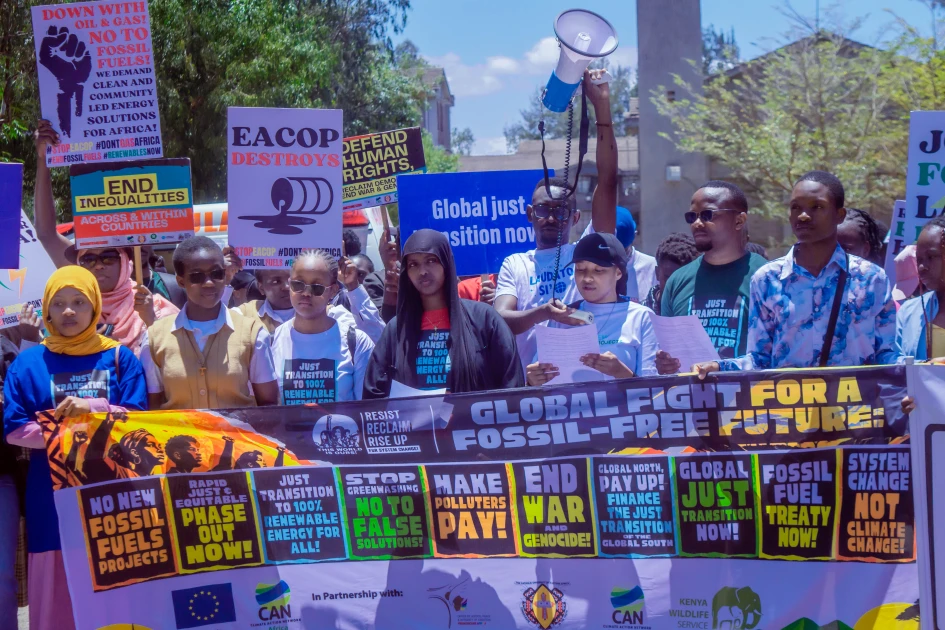
The call was made in Nairobi during a Climate Walk organised by Climate Action Network Africa (CAN Africa), the Office for Justice, Peace and Integrity of Creation (JPIC)–Franciscans Africa, Kenya Wildlife Service, the Catholic University of Eastern Africa and other partners.

Audio By Vocalize
The call was made in Nairobi during a Climate Walk organised by Climate Action Network Africa (CAN Africa), the Office for Justice, Peace and Integrity of Creation (JPIC)–Franciscans Africa, Kenya Wildlife Service, the Catholic University of Eastern Africa and other partners.
CAN Africa Campaign Lead Ajra Mohamed said Kenya’s strong renewable-energy base provides an opportunity to move towards 100 per cent clean electricity.
“New long-term fossil-fuel investments risk pulling in the opposite direction,” Mohamed said, urging governments to build on Africa’s renewable-energy potential.
The campaign comes as major oil projects advance in the region. The 1,443-kilometre East African Crude Oil Pipeline (EACOP) had reached 92.7 per cent completion by early September, according to the project company.
In Kenya, Nigerian businessman Aliko Dangote has proposed a $15–16 billion oil refinery in Lamu, with a planned capacity of 700,000 barrels per day.
The advocates argue that new fossil-fuel infrastructure could lock economies into long-term dependence on oil at a time when global investment is shifting towards cleaner energy.
According to data cited from the Energy and Petroleum Regulatory Authority, renewable sources accounted for 78.79 per cent of electricity supplied to Kenya’s national grid between July and December 2025, while renewables represented 80.60 per cent of installed generation capacity.
Geothermal power alone accounted for more than 40 per cent of electricity generation during the period.
The Climate Walk, which ended at CUEA, was followed by an artivism session where participants painted their vision of a clean-energy future, calling for “No New Fossil Fuels” and a fair transition to 100 per cent renewable energy.
Join the Discussion
Share your perspective with the Citizen Digital community.
No comments yet
This discussion is waiting for your voice. Be the first to share your thoughts!