
Clashes erupt at Jerusalem Holy Site, 152 Palestinians hurt

Audio By Vocalize
Palestinians clashed with Israeli police at
the Al-Aqsa mosque compound in Jerusalem before dawn on Friday as thousands
gathered for prayers during the holy month of Ramadan. Medics said that at
least 152 Palestinians were wounded.
The holy site, which is sacred to Jews and
Muslims, has often been the epicenter of Israeli-Palestinian unrest, and
tensions were already heightened amid a recent wave of violence. Clashes at the
site last year helped spark an 11-day war with Hamas militants in the Gaza
Strip.
The clashes come at a particularly sensitive
time. Ramadan this year coincides with Passover, a major weeklong Jewish
holiday beginning Friday at sundown, and Christian holy week, which culminates
on Easter Sunday. The holidays are expected to bring tens of thousands of
faithful into Jerusalem’s Old City, home to major sites sacred to all three
religions.
Hours after the clashes began, the police
announced that they had put an end to the violence and arrested “hundreds” of
suspects. They said the mosque was re-opened and that Friday’s midday prayers
would take place as usual. Tens of thousands of people were expected.
Israeli authorities said they had earlier
held negotiations with Muslim leaders to ensure calm and allow the prayers to take
place, but that Palestinian youths hurled stones at police, triggering the
violence. Palestinian witnesses, who spoke on condition of anonymity out of
security concerns, said a small group of Palestinians threw rocks at police,
who then entered the compound in force, setting off a wider conflagration.
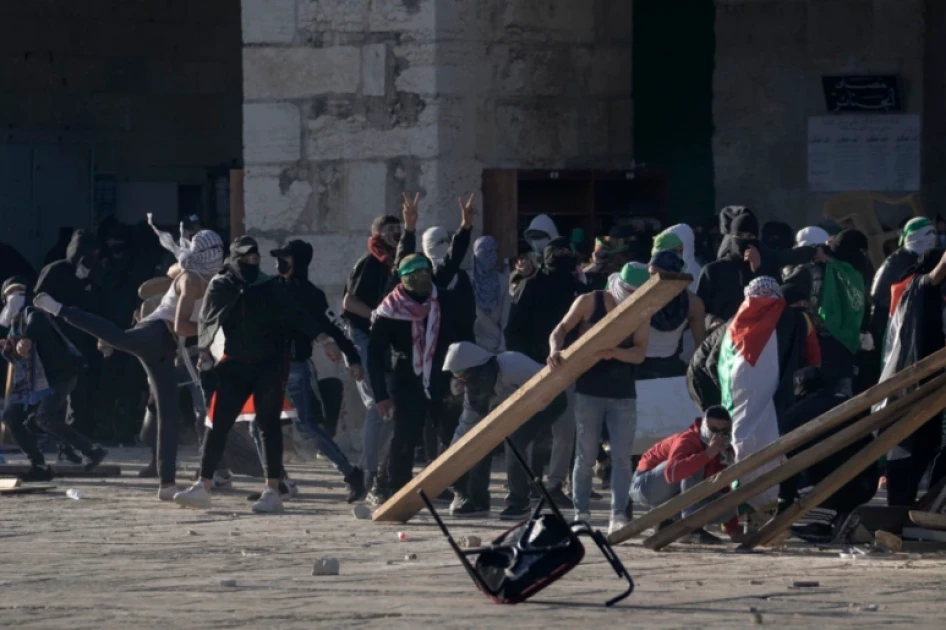
Videos circulating online showed Palestinians
throwing rocks and fireworks and police firing tear gas and stun grenades on
the sprawling esplanade surrounding the mosque. Others showed worshippers
barricading themselves inside the mosque.
Later in the morning, Israeli police entered
the mosque and were arresting people. Israeli security forces rarely enter the
building, and when they do it is seen by Palestinians as a major escalation.
The Palestinian Red Crescent emergency
service said it treated 152 people, many of them wounded by rubber-coated
bullets or stun grenades, or beaten with batons. The endowment said one of the
guards at the site was shot in the eye with a rubber bullet.
The Israeli police said three officers were
wounded from “massive stone-throwing,” with two evacuated from the scene for
treatment.
The Israeli Foreign Ministry said that dozens
of masked men carrying Palestinian and Hamas flags had marched to the compound
before dawn on Friday and gathered stones and other objects in anticipation of
unrest.
“Police were forced to enter the grounds to
disperse the crowd and remove the stones and rocks, in order to prevent further
violence,” it tweeted.
The police said they waited until prayers were
over and the crowds started to disperse. In a statement, it said crowds started
hurling rocks in the direction of the Western Wall, a nearby Jewish holy site,
forcing them to act.
Palestinians view any large deployment of
police at Al-Aqsa as a major provocation.
Israel’s national security minister, Omer
Barlev, who oversees the police force, said Israel had “no interest” in
violence at the holy site but that police were forced to confront “violent
elements” that attacked them with stones and metal bars. He said Israel was
committed to freedom of worship for Jews and Muslims alike.
The mosque is the third holiest site in
Islam. It is built on a hilltop in Jerusalem’s Old City that is the most sacred
site for Jews, who refer to it as the Temple Mount because it was the site of
the Jewish temples in antiquity. It has been a major flashpoint for
Israeli-Palestinian violence for decades and was the epicenter of the 2000-2005
Palestinian intifada, or uprising.
Israel captured east Jerusalem, home to
Al-Aqsa and other major holy sites, in the 1967 war and annexed it in a move
not recognized internationally. Palestinians want the eastern part of the city
to be the capital of a future independent state including the West Bank and
Gaza, which Israel also captured during the war nearly 55 years ago.
Tensions have soared in recent weeks
following a series of attacks by Palestinians that killed 14 people inside
Israel. Israel has carried out a wave of arrests and military operations across
the occupied West Bank, setting off clashes with Palestinians.
The Palestinian Health Ministry said a
17-year-old died early Friday from wounds suffered during clashes with Israeli
forces in Jenin, in the occupied West Bank, the day before.
At least 25 Palestinians have been killed in the
recent wave of violence, according to an Associated Press count, many of whom
had carried out attacks or were involved in the clashes, but also an unarmed
woman and a lawyer who appears to have been killed by mistake.
Weeks of protests and clashes in Jerusalem
during Ramadan last year eventually ignited an 11-day war with Hamas, the
Islamic militant group that rules the Gaza Strip.
Israel had lifted restrictions and taken
other steps to try and calm tensions ahead of Ramadan, but the attacks and the
military raids have brought about another cycle of unrest.
Hamas condemned what it said were “brutal
attacks” on worshippers at Al-Aqsa by Israeli forces, saying Israel would bear
“all the consequences.” It called on all Palestinians to “stand by our people in
Jerusalem.”
Earlier this week, Hamas and other militant
groups in Gaza had called on Palestinians to camp out at the Al-Aqsa mosque
over the weekend. Palestinians have long feared that Israel plans to take over
the site or partition it.
Israeli authorities say they are committed to
maintaining the status quo, but in recent years nationalist and religious Jews
have visited the site in large numbers with police escorts.
In recent weeks, a radical Jewish group had
called on people to bring animals to the site in order to sacrifice them for
Passover, offering cash rewards for those who succeeded or even tried. Israeli
police work to prevent such activities, but the call was widely circulated by
Palestinians on social media, along with calls for Muslims to prevent any
sacrifices from taking place.
Rabbi Shmuel Rabinowitz, the rabbi of the
Western Wall, issued a statement calling on Muslim leaders to act to stop the
violence. It also noted that “bringing a sacrifice to the Temple Mount today is
in opposition to the decision of the Chief Rabbinate of Israel.”
Join the Discussion
Share your perspective with the Citizen Digital community.
No comments yet
This discussion is waiting for your voice. Be the first to share your thoughts!