
City Hall chessboard: Sakaja, Babu, Gakuya, Karauri gear up for 2027 Nairobi battle

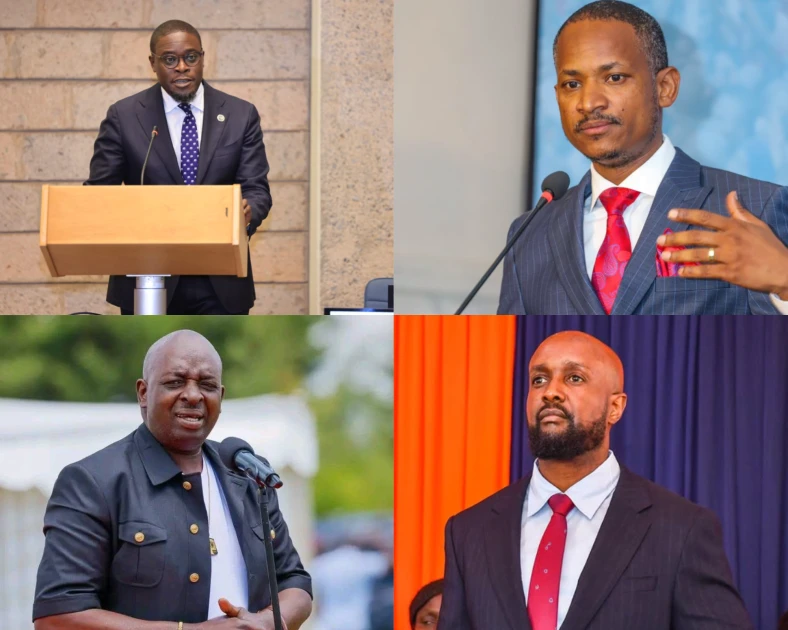
Nairobi Governor Johnson Sakaja, and Embakasi East P Babu Owino (ABOVE); Embakasi North MP James Gakuya and his Kasarani counterpart Ronald Karauri (BELOW). PHOTO | COURTESY

Audio By Vocalize
The race for the top city of the nation’s capital, Nairobi, is beginning to look less like a routine gubernatorial contest and more like a political chessboard, where one wrong move could alter the entire game.
At
the centre of the unfolding battle is incumbent Governor Johnson Sakaja, whose
2027 re-election bid is increasingly being complicated by the emergence of
heavyweight challengers; among them Members of Parliament Babu Owino (Embakasi
East), Ronald Karauri (Kasarani) and James Gakuya (Embakasi North).
And
beneath the contest for City Hall lies an even bigger question: Which political
party will carry the most consequential candidates into the Nairobi ballot?
For
Sakaja, the party question has suddenly become impossible to ignore. The
Governor remains a member of President William Ruto's United Democratic
Alliance (UDA), but in August he publicly confirmed that the Orange Democratic Movement
(ODM) officials, MPs, youth and women leaders had approached him about joining
the party.
Sakaja
said he was still consulting and had not set a date for leaving UDA. He also
linked the discussions to his longstanding relationship with the late former
Prime Minister and ODM’s long-term chief Raila Odinga, whom he described as
being like a father to him.
That
admission opened up a new political chapter.
Sakaja’s
party puzzle
The
Governor's dilemma is not simply about changing party colours. It is about
determining which political platform gives him the strongest coalition of
support in a city where party structures, ethnic alliances, youth mobilisation,
business networks and individual popularity can intersect in unpredictable
ways.
ODM’s
Director of Elections and Suna East MP Junet Mohamed has publicly challenged
Sakaja to join ODM if he wants the party's support for a second term.
But
ODM leaders have also warned that joining the party would not automatically
guarantee Sakaja a direct ticket.
Nairobi
ODM Chairman George Aladwa has said aspirants seeking the party's ticket would
have to face its nomination process. That leaves Sakaja with a political
calculation of his own. Stay with UDA, explore ODM, or wait for a broader
coalition arrangement?
The
answer could shape the entire Nairobi race.
Then
comes Babu
If
Sakaja has a party puzzle, then the outspoken Embakasi East lawmaker Babu Owino
has chosen his own chessboard.
The
MP has now confirmed that The Mwananchi Party (TMP) will be his political
vehicle for the 2027 General Election, including his Nairobi gubernatorial bid.
He has also proposed working with Senator Edwin Sifuna's soon-to-be-launched
party through a coalition arrangement under the wider Linda Mwananchi movement.
Babu's
Nairobi strategy is particularly significant because he is seeking to convert
his established Embakasi East political base into a citywide movement.
He
has already declared that he intends to serve for only one term as Governor
before pursuing the presidency in 2032; an indication that he sees the City
Hall contest not merely as an end in itself but as part of a longer political
journey.
The
question, however, is whether his support can travel beyond his traditional
political base and translate into a sufficiently broad Nairobi coalition.
That
remains an open question.
Karauri
enters from a different lane
Then
there is renowned betting honcho Ronald Karauri.
The
Kasarani MP announced his intention to seek the Nairobi governorship in
February, saying he would be on the ballot and framing his bid around what he
described as persistent leadership challenges in the capital.
Karauri's
political profile is different from both Sakaja and Babu.
He
arrived in elective politics from the corporate and business world and won the
Kasarani parliamentary seat in 2022 without the ticket of a major political
party.
Now
he is attempting something considerably bigger — turning that
constituency-level political capital into a citywide gubernatorial campaign.
His
challenge will be translating personal networks and a constituency base into an
organisation capable of competing across Nairobi's 17 constituencies and 85
wards.
Gakuya
and the DCP factor
James
Gakuya brings yet another dimension.
The
Embakasi North MP is associated with Rigathi Gachagua's Democracy for the
Citizens Party (DCP) and has been positioned as the outfit’s Nairobi
gubernatorial candidate.
DCP
has been building its Nairobi machinery, with Gachagua publicly predicting a
major parliamentary and county assembly presence for the party in the capital.
Gakuya
therefore enters the contest carrying not only his own political profile but
also the organisational ambitions of a relatively new political formation
seeking to establish itself as a major force in Nairobi.
The
party has also ruled out joining a revived Azimio coalition (now renamed
Ukombozi Alliance), with Gakuya saying DCP has no place in that arrangement.
That
could make the gubernatorial contest even more fragmented if multiple political
formations insist on fielding their own candidates.
The
numbers are already talking, but not speaking with one voice
Perhaps
the biggest warning against writing off any of the contenders comes from the
polling. Different surveys conducted at different times have produced sharply
different pictures.
These
surveys used different methodologies, sample sizes and fieldwork periods, so
they should not be treated as directly comparable measurements of the same
moment.
But
they demonstrate one thing clearly: Nairobi is not a settled political market.
The party card could change everything. And this is where the Nairobi race gets
complicated.
The
four major names may be competing for the same office, but they are not
necessarily competing with the same political machinery.
Sakaja
has the advantage of incumbency and an established City Hall administration.
Babu has a highly recognisable political profile and a newly declared party
vehicle. Karauri is building from his Kasarani base and wider personal
networks. Gakuya is attached to a DCP structure that is actively expanding its
Nairobi footprint. Then there are other potential players.
Businesswoman
Agnes Kagure is also campaigning for the Governor's seat under the Kenya
Patriots Party, meaning the field could become even more crowded.
And,
as of September 25, KANU spokesperson Tony Gachoka has also publicly declared
his intention to pursue the Nairobi governorship on the said party’s ticket.
So
the question is no longer simply who wants City Hall?
It
is, who will assemble the coalition capable of getting across the finish line?
Nairobi’s
hard nut to crack
For
the candidates, the arithmetic is brutal. Nairobi has millions of voters spread
across diverse communities, economic classes and political constituencies.
The
race will require more than loud rallies. It will test party organisation,
ward-level mobilisation, fundraising, coalition building, candidate visibility
and the ability to convert national political alliances into local votes.
It
will also test whether voters prioritise party identity, individual candidates,
performance, promises, local networks or broader national political alignments.
And
the party nomination stage could itself become a political battlefield.
For
Sakaja, the central question is whether his next move will be made from within
UDA or through another political arrangement.
For
Babu, it is whether The Mwananchi Party (TMP) can become more than a vehicle
carrying one candidate.
For
Gakuya, it is whether DCP can translate its growing Nairobi ambitions into a
winning citywide organisation.
For
Karauri, it is whether his relatively independent political profile can scale
from Kasarani to the entire capital.
And
for all of them, there is the unpredictable Nairobi voter.
The
City Hall chessboard is wide open
Political
analyst Kevin Osido argues that the contenders still have time to reshape the
contest but cannot afford political complacency.
“Babu
has the young people behind him while Sakaja has a burden of incumbent load to
prove what he has done,” Osido observes.
He
adds that party choice and campaign financing will be among the factors likely
to influence the contest.
But
with nominations still ahead, alliances still shifting and additional
candidates entering the race, the final political map remains unsettled.
One
thing, however, is becoming increasingly difficult to dispute: Nairobi City
Hall is turning into one of Kenya's most closely watched political battles of
2027.
And
so who will unlock the right party, the right coalition, the right grassroots
machine — and ultimately, the right place on the ballot paper.?
For
now, the chess pieces are moving. Sakaja is calculating. Babu is building.
Karauri is positioning. Gakuya is mobilising. And Nairobi is watching.
The
City Hall battle has begun.
Join the Discussion
Share your perspective with the Citizen Digital community.
No comments yet
This discussion is waiting for your voice. Be the first to share your thoughts!