
China’s manufacturing transformation offers lessons for developing countries
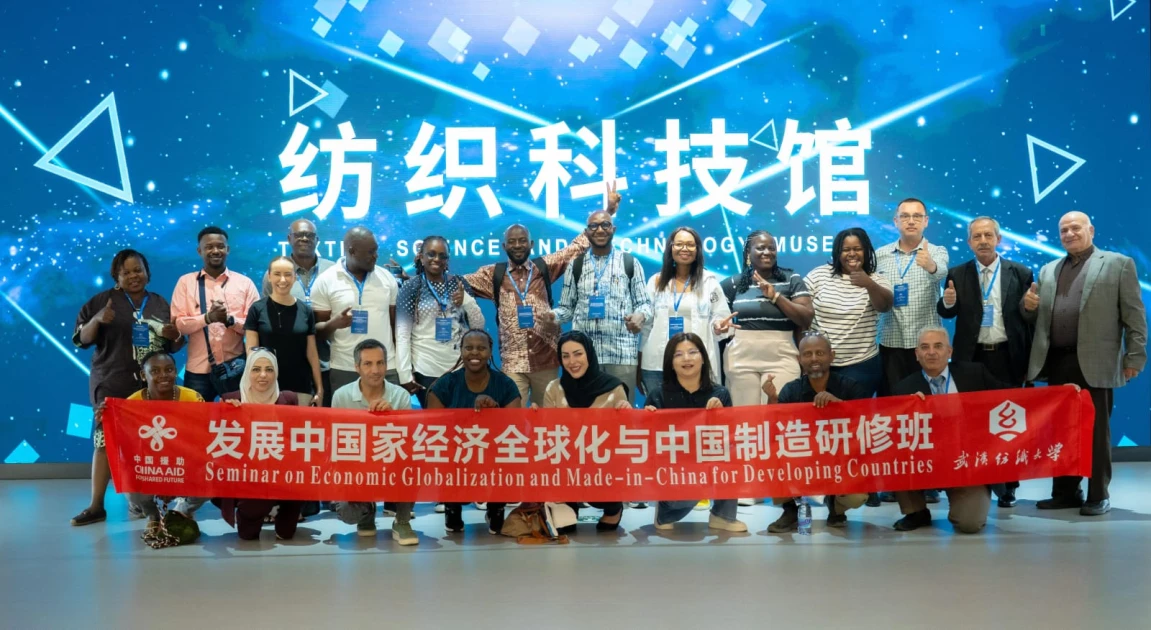
Participants representing nine countries pose for a group photo after a session on China's manufacturing transformation and industrial development at Wuhan Textile University on May 27, 2026.

Audio By Vocalize
China's rapid transformation from a low-cost manufacturing hub into a global leader in advanced manufacturing is offering valuable lessons for developing countries seeking to accelerate industrialisation, boost competitiveness and expand their presence in global markets.
These were among the key issues discussed during the Ministry of Commerce-sponsored Seminar on Economic Globalization and Made-in-China for Developing Countries, hosted by Wuhan Textile University. The programme brought together participants from Kenya, South Africa, Romania, Ethiopia, North Macedonia, Grenada, Jordan, Palestine and Guinea.
The seminar examined China's transition from being known as the "world's factory" for inexpensive goods to becoming a leader in innovation, digital technology, green manufacturing and high-value industrial production.
Central to this transformation is China's manufacturing strategy aimed at strengthening indigenous innovation while reducing reliance on imported technologies. The strategy prioritises key sectors such as robotics, electric vehicles, aerospace, telecommunications and advanced medical equipment.
The initiative is backed by China's 14th Five-Year Plan, which places emphasis on high-quality development, digital transformation and green growth. The policy has accelerated investment in smart manufacturing, renewable energy technologies and research and development.
Figures presented during the seminar showed that China's manufacturing value-added reached 39.9 trillion yuan in 2023, accounting for about 35 per cent of global manufacturing output. In 2024, the country invested 3.3 trillion yuan in research and development, equivalent to 2.8 per cent of its Gross Domestic Product (GDP).
Participants also learnt about China's technological achievements, including its 45,000-kilometre high-speed railway network, intelligent manufacturing systems, rapid expansion of electric vehicles and advances in unmanned aerial vehicle (UAV) technology.
The training programme covered China's economic and social development, digital economy, international trade, green growth, export competitiveness, foreign investment policies, cross-border e-commerce, industrial restructuring, global value chains and strategies for accessing international markets.
Participants further undertook study visits to Xi'an and Wuhan, where they observed China's industrial development, manufacturing innovation and economic modernisation.
The seminar was hosted by Wuhan Textile University, one of China's leading institutions in textile education and manufacturing research. Through its Foreign Aid Management Center, the university has organised more than 100 international training programmes for government officials, technical experts and industry managers from over 90 countries.
Among the participants was Catherine Chengoli, Director of Resource Mobilisation, Investments and Partnerships in the Office of the Governor, Bungoma County, who said China's experience provides practical lessons for Kenya's agricultural sector, particularly coffee production.
"Bungoma County has fertile land suitable for coffee farming, especially around Mount Elgon, Kanduyi and Sang'alo. What we need now is collaboration and technology transfer to help our farmers improve productivity and access more lucrative export markets," she said.
Chengoli noted that modern agricultural technologies and machinery showcased during the seminar could significantly improve productivity and value addition among smallholder farmers.
"Most of our coffee farming is still carried out manually. We have seen advanced machinery here in China that can help increase production and improve value addition. We look forward to partnerships that will strengthen the coffee value chain and support our small-scale farmers," she said.

Deputy Director, Dept. of International Exchange and Cooperation (black top)guides participants through Wuhan Textile University during an educational tour highlighting the institution's research and innovation facilities.
She added that existing Kenya-China cooperation frameworks provide an opportunity to deepen collaboration in technology transfer, capacity building and market access.
"Our coffee farmers may be small-scale producers, but they have enormous potential to contribute to wealth creation and economic growth. We hope these partnerships will create more opportunities for them," Chengoli added.
Chinese investments are already supporting industrial development in Africa. In Kenya, companies operating within the Mombasa Special Economic Zone have invested in textile and apparel manufacturing, creating jobs while promoting skills development and technology transfer.
As developing countries pursue industrial growth and economic transformation, participants said China's experience highlights the importance of long-term planning, investment in infrastructure, innovation and human capital development in building globally competitive industries.
Join the Discussion
Share your perspective with the Citizen Digital community.
No comments yet
This discussion is waiting for your voice. Be the first to share your thoughts!