

China ends 2021 with worst COVID week since taming original epidemic
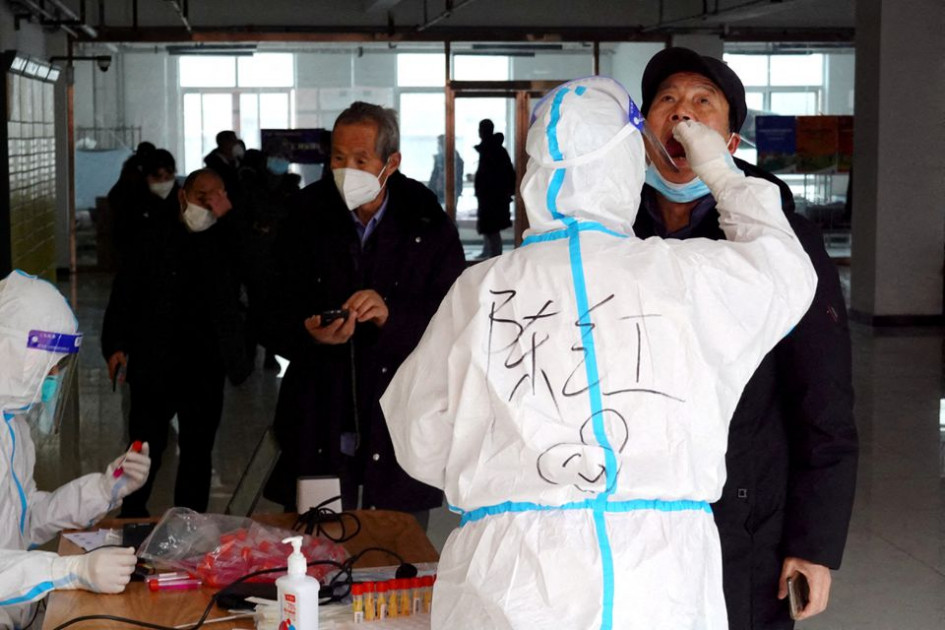
A medical worker in protective suit collects a swab sample from a man for nucleic acid testing at a residential compound, during another round of mass testing following the coronavirus disease (COVID-19) outbreak in Xian, Shaanxi province, China December 27, 2021. REUTERS/File Photo

Audio By Vocalize
China ended its final week of 2021 with its biggest tally of
local coronavirus cases for any seven-day period since subduing the country's
first epidemic nearly two years ago, despite an arsenal of some of the world's
toughest COVID-19 measures.
The National Health Commission reported on Saturday 175 new
community infections with confirmed clinical symptoms for Dec. 31, bringing the
total number of local symptomatic cases in mainland China in the past week to
1,151.
The surge has been driven mostly by an outbreak in the
northwestern industrial and tech hub of Xian, a city of 13 million.
The deepening outbreak in Xian will likely firm authorities'
resolve to curb transmissions quickly as and when cases emerge. The city, under
lockdown for 10 days as of Saturday, has reported 1,451 local symptomatic cases
since Dec. 9, the highest tally for any Chinese city in 2021.
While China's case count is tiny compared to many outbreaks
elsewhere in the world, forestalling major flare-ups in 2022 will be important.
Beijing will be hosting the Winter Olympic Games in February, and the ruling
Communist Party will hold a once-every-five-year congress, expected in the
fall, where President Xi Jinping will likely secure a third term as party
secretary.
The emergence of the highly transmissible Omicron variant
will also drive Beijing to stick to its high vigilance against the virus. China
has reported a handful of imported Omicron cases and at least one locally
transmitted case.
Since August, China has tried to get any outbreak under
control within about two weeks, much shorter than the four to six weeks in
earlier battles against sporadic flare-ups following the initial nationwide
epidemic, according to the National Health Commission.
Cities along China's borders are at higher virus risk,
either due to the presence of overland transport links or the entry of infected
travelers from other countries. Some were hit by Delta outbreaks that resulted
in harsh travel curbs last year.
Yunnan, which shares a border with Myanmar, Laos and
Vietnam, reported new local symptomatic cases on 92 out of 365 days last year,
or 25% of the time, more often than any other province, autonomous region or
municipality.
The Xian outbreak, which led to cases in other cities
including Beijing, could be traced back to a flight arriving from Pakistan, but
it was unclear how it spread to local communities.
Many people have been forbidden from leaving their
residential compounds, but a city government official said on Friday curbs
would be loosened in less risky compounds when the time was right.
Postgraduate student Li Jiaxin, 23, said nobody can leave
the campus of her university. She spent New Year's Eve with her three roommates
and was unable to meet with her boyfriend and family.
"I may be what you would consider a person with a
strong sense of ritual, so I still feel a little sad that we are not together
at this time," she said.
China's tough epidemic policies have helped stop its
sprawling industrial sector from sliding into prolonged shutdowns, reaping
important export gains as other pillars of growth weakened.
But unpredictable disruptions have shaken consumer sentiment
and hammered the catering, hospitality and tourism sectors.
An employee surnamed Wang at a traditional teahouse in
Kunming, the capital of Yunnan, said her company's revenues had been halved
compared with pre-pandemic levels.
"Many guests from other provinces had come to our
teahouse especially for a taste of Yunnan's Pu'er tea, but now there are fewer
of them," Wang said.
"My salary hasn't been cut, but I feel I may lose my
job at any time."
Leave a Comment