
Bloomberg unveils $285m fund for clean energy access in developing economies
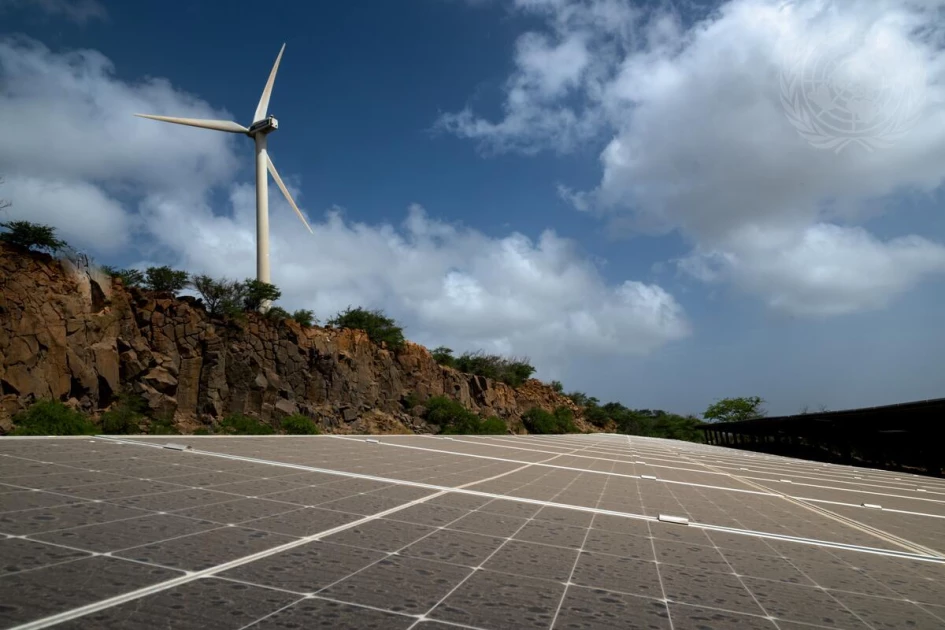
A wind turbine next to solar panels in Carbo Verde. UN PHOTO| Mark Garten

Audio By Vocalize
Yet millions of households and businesses across Kenya and Africa still face unreliable power, high energy costs and slow progress in connecting renewable energy to national grids.
The main challenges are often not the technology itself, but the systems around it, including weak power grids, limited funding, unclear policies, lack of technical skills and energy markets that still rely on fossil fuels.
Against this backdrop, Bloomberg Philanthropies has launched a new $285 million initiative aimed at helping emerging and developing economies build the institutions, market systems and investment pipelines needed to scale clean energy fast enough to meet rising demand.
Announcing the commitment, Michael R. Bloomberg, the UN Secretary-General’s Special Envoy on Climate Ambition and Solutions, said the initiative aims to strengthen clean energy industries in countries where electricity demand is rising fastest, but where the growth of renewable energy is still slowed by structural barriers.
"Clean energy is now cheaper than fossil fuels in virtually every part of the world, and as a result, its share of global power production is growing. But fixable obstacles are still slowing down deployment, and with energy demand rising at an unprecedented speed, we can’t allow those obstacles to continue standing in the way of lower energy costs for households and businesses, and cleaner air and water for communities. This new investment will help ensure they don’t,” said Bloomberg.
The announcement comes at a time when global power demand is climbing rapidly, driven by industrial growth, urbanisation, electrification, artificial intelligence and population growth.
At the same time, many countries are under pressure to cut emissions, improve energy security and lower the cost of power for households and businesses.
António Guterres, United Nations Secretary-General emphasized that the clean energy age has arrived.
“As demand for power surges, it must now scale fast in the economies that need it most. Michael Bloomberg's commitment does exactly that, backing the industries that will power homes, lower bills, lift economies, and clear the air for billions. Together, let's bring the renewables revolution to every corner of the world,” he explained.
Clean energy is now the cheapest source of new power in most of the world, with renewables reaching 34% of global electricity generation in 2025, overtaking coal’s 33% share for the first time in roughly a century.
By 2030, renewables and nuclear are projected to generate half of the world’s electricity.
Ali Mohamed, Kenya's Special Envoy for Climate Change, said that the renewable energy potential across Africa is enormous. What has held back deployment is not a lack of ambition or resources on the ground.
“It is the gap between that potential and the capacity to translate it into investment, projects, and power on the grid. Long-term offtake to de-risk investment and innovative financing solutions to achieve future-proof investments that can close that gap is precisely what developing economies need right now, and it is what will determine whether the energy transition delivers for the people who need it most,” explained Mohamed.
While renewable energy costs have fallen dramatically over the past decade, many countries still lack the institutional capacity to plan for clean power, attract private investors, design competitive electricity markets or integrate variable power from solar and wind into existing grids.
In many cases, renewable energy industries are still young and under-resourced, competing against fossil fuel sectors that have spent decades building political influence, technical expertise and financing networks.
As a result, even countries with abundant sunshine, wind resources and ambitious climate targets can struggle to convert clean energy potential into actual megawatts on the grid.
Saliem Fakir, Executive Director of African Climate Foundation, said that Africa has abundant renewable energy resources and rapidly growing electricity demand.
He explained that what has been missing is not the potential, but the institutional infrastructure and capabilities to unlock it: an ecosystem of players with the analytical capacity to engage in energy planning, the technical expertise to work with regulators, and the credibility to mobilize private finance at scale.
“Philanthropy that targets those gaps directly is the kind of intervention that can shift the trajectory of a continent's energy system. Bloomberg Philanthropies' commitment to doing exactly that gives us a real opportunity to change the shape of Africa's energy future in a lasting way,” he said.
Barbara Buchner, Chief Executive Officer of Climate Policy Initiative, said some of the markets with the greatest renewable energy potential are also the ones where the basic prerequisites for growth, such as policy frameworks, institutional capacity, industry coordination and reliable data, are still being built.
According to the initiative, the new funding will focus on closing that gap by backing countries responsible for nearly 70 per cent of global power-sector emissions and helping them build stronger clean-energy ecosystems.
The support will go toward strengthening renewable energy industry associations, improving data and technical analysis, helping governments and regulators design markets that attract clean energy investment and unlocking private capital for energy infrastructure.
The organisation says the aim is to help solar and wind generate more than half of electricity in the targeted countries by 2030.
But as clean energy becomes more competitive, another reality is becoming clear: low costs alone do not guarantee deployment.
In many countries, the real bottlenecks are hidden deeper in the energy system, in the absence of strong grid planning, slow regulatory approvals, weak transmission networks, poor market design, limited access to long-term financing and a shortage of institutions capable of representing renewable energy interests in national decision-making.
For Africa, where electricity demand is expected to rise sharply over the coming decades, the implications are significant.
The continent is home to some of the world’s richest renewable energy resources, yet many countries still face persistent power shortages, expensive electricity and low levels of energy access.
Industry leaders say the challenge is not a lack of clean energy potential, but the difficulty of translating that potential into projects that can attract investment and deliver electricity reliably and at scale.
The new fund suggests that the next battle in the clean energy transition will not simply be about proving renewables can compete. It will be about ensuring countries have the institutions, technical skills, financing mechanisms and regulatory systems needed to make clean power a reliable part of everyday life.
In that sense, the Bloomberg Philanthropies commitment is not just about supporting clean energy projects. It is about trying to fix the systems that determine whether clean energy can reach homes, businesses and industries at the speed and scale the future demands.
Building on more than a decade of climate and energy work, this commitment aims to help ensure that the countries driving future electricity demand have the capacity, expertise, and investment needed to build cleaner, more affordable and more secure energy systems.
Join the Discussion
Share your perspective with the Citizen Digital community.
No comments yet
This discussion is waiting for your voice. Be the first to share your thoughts!