
Asteroid that doomed the dinosaurs originated beyond Jupiter
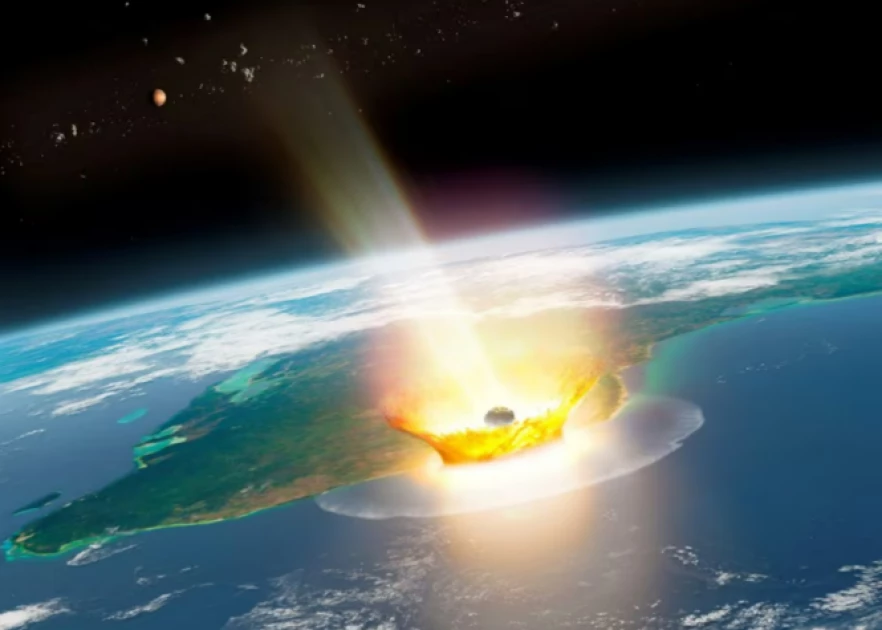
An artist's impression of a large asteroid impacting at Chicxulub on the Mexican coastline, which caused the end-Cretaceous mass extinction, 66 million years ago, with the planet Mars and asteroid bodies in the background, in this image obtained by Reuters on August 14, 2024. Illustration by Mark Garlick/Handout via REUTERS.

Audio By Vocalize
It was a turning point in the history of life on Earth. An
asteroid an estimated 6-9 miles (10-15 km) wide slammed into Mexico's Yucatan
Peninsula 66 million years ago, triggering a global
cataclysm that eradicated about three-quarters of the world's species
and ended the age
of dinosaurs.
The impact pulverized the asteroid and spread its debris
worldwide, still present in a global layer of clay deposited in the aftermath of
that fateful
day. A new analysis of this debris has resolved a long debate about the
nature of the asteroid, showing that it was a type that originated beyond
Jupiter in the outer solar system.
The impactor, based on the debris composition, was a
carbonaceous asteroid, or C-type, so named because of a high concentration of
carbon. The study ruled out that the impactor was a comet or that the debris
layer had been laid down by volcanism, as some had hypothesized.
"A projectile originating at the outskirts of the solar system sealed the fate of the dinosaurs," said geochemist Mario Fischer-Gödde of the University of Cologne in Germany, lead author of the study published on Thursday in the journal Science.
The impact at the end of the Cretaceous Period gouged the
Chicxulub (pronounced CHIK-shu-loob) crater, 112 miles (180 km) wide and 12
miles (20 km) deep. The clay layer is rich in metals including iridium,
ruthenium, osmium, rhodium, platinum and palladium which are rare on Earth but
common in asteroids.
The researchers focused on ruthenium - specifically, the
ratio of its isotopes present in the clay layer. Isotopes are atoms of the same
element with slightly different masses because of differing numbers of
subatomic particles called neutrons. Ruthenium has seven isotopes, with three
especially important in the findings. The ruthenium isotope ratios matched
other known carbonaceous asteroids.
"Ruthenium is especially useful in this context as the
isotopic signature in the clay layer is almost entirely made up of ruthenium
from the impactor and not the background sediment, and ruthenium shows distinct
isotopic compositions between inner and outer solar system materials,"
said geoscientist and study co-author Steven Goderis of Vrije Universiteit
Brussel in Belgium.
C-type asteroids, among the solar system's most ancient
objects, are the most common asteroid type, followed by stony S-type asteroids
and rarer metallic M-type asteroids. Compositional differences among asteroids
arise from how far from the sun they formed.
"The C-type asteroids represent leftover building
blocks of the outer solar system's gas and ice planets, whereas the S-type
asteroids are the primary building blocks of terrestrial planets like Earth"
in the inner solar system, Fischer-Gödde said.
After forming in the outer solar system, the asteroid
probably later migrated inward to become part of the main asteroid belt between
Mars and Jupiter, Fischer-Gödde said, before somehow being sent hurtling in the
direction of Earth, perhaps due to a collision.
"All meteorites falling onto Earth, which are fragments
from both C-type and S-type asteroids, originate from the asteroid belt. So it
appears to be most likely that the (end-Cretaceous) impactor also originates
from the asteroid belt," Fischer-Gödde said. "But there are also many
bodies stored in the Kuiper Belt and in the Oort Cloud (regions far beyond the
outermost planet Neptune), and basically not much is known about the
composition of these bodies."
The researchers analyzed samples from five other asteroid
impacts dating from 37 million to 470 million years ago, finding that all were
S-type, illustrating the rarity of a carbonaceous asteroid strike.
Dinosaurs had long ruled the land but, aside from their bird
lineage, were wiped out following the impact, as were the flying reptiles
called pterosaurs, the large marine reptiles and other sea life including many
marine plankton species.
The mammals made it through, allowing these furry critters
to eventually dominate the land and setting the stage for our species to arise
roughly 300,000 years ago.
"I think without this cosmic coincidence of an asteroid
impact," Fischer-Gödde said, "life on our planet would probably have
developed vastly differently."
Join the Discussion
Share your perspective with the Citizen Digital community.
No comments yet
This discussion is waiting for your voice. Be the first to share your thoughts!