
AI, disinformation put media at centre of Africa’s electoral preparedness
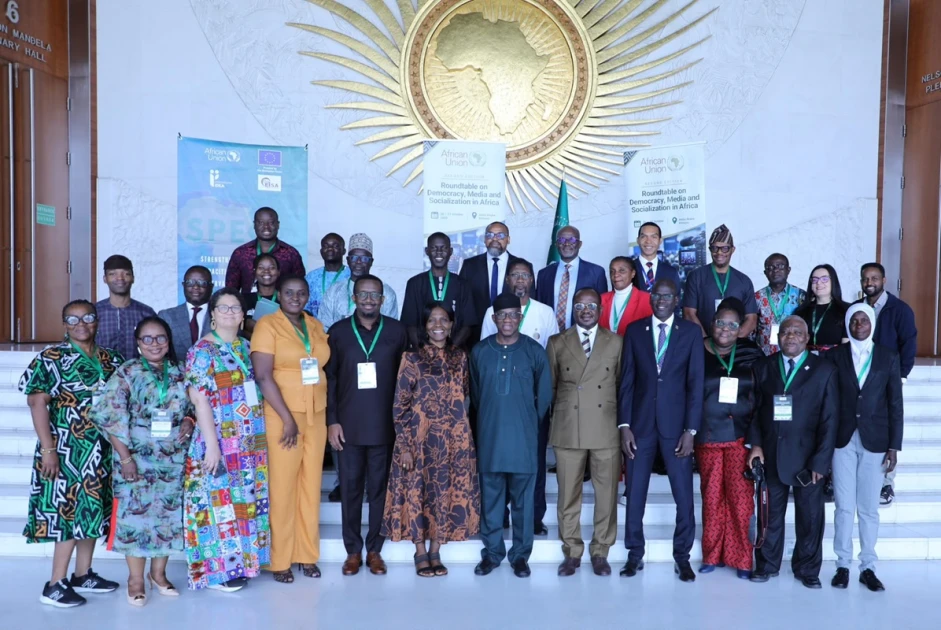
Participants at the African Union’s Second Roundtable on Democracy, Media and Socialisation in Africa pose for a group photo in Addis Ababa, Ethiopia. Photo / Courtesy

Audio By Vocalize
The African Union is seeking stronger media literacy, independent journalism and safeguards against digital disinformation as African countries prepare for the 2026–2027 electoral cycle.
The measures were among the priorities discussed at the
Second Roundtable on Democracy, Media and Socialisation in Africa, held in
Addis Ababa, amid concerns about the influence of artificial intelligence and
digital platforms on democratic participation.
The meeting, convened by the African Union Commission’s
Department of Political Affairs, Peace and Security, brought together media
practitioners, election management bodies, academics, civil society
organisations, youth and women’s networks and international partners.
Under the theme “From Dialogue to Action: Advancing
Democratic Resilience through Media, Socialisation and Inclusion in Africa,”
participants explored how information systems and public engagement can support
credible elections and strengthen democratic institutions.
AU Commissioner for Political Affairs, Peace and Security
Ambassador Bankole Adeoye said democratic values must be embedded in
communities, schools, media spaces and public institutions.
He called for practical proposals to improve access to
credible information, strengthen civic and voter education and expand citizen
participation in governance.
Discussions examined the opportunities and risks associated
with generative artificial intelligence and digital platforms, including
misinformation, disinformation and hate speech. Participants also considered
digital sovereignty and the growing need for citizens to assess information
critically.
Proposed responses included media and digital literacy
programmes, fact-checking initiatives, support for independent journalism and
measures to build public trust in reliable information.
The roundtable also addressed the working environment for
journalists, including their safety and labour rights, as well as the role of
investigative and community journalism in reaching citizens beyond major urban
centres.
Participants further highlighted the need to strengthen
youth civic engagement, increase women’s leadership and ensure that persons
with disabilities are included in democratic processes.
The meeting builds on the first roundtable, held in Nairobi
in May 2025, which recommended stronger protection for journalists,
continent-wide media and digital literacy initiatives, democracy education and
greater support for investigative and community journalism.
Participants in Addis Ababa reviewed progress on those
recommendations and identified priorities for implementation ahead of the next
roundtable in 2027.
The deliberations are expected to inform an Action Roadmap
setting out priority interventions, institutional responsibilities and
monitoring and reporting arrangements.
Adeoye challenged participants to move beyond discussion and
deliver measurable results, saying the value of the meeting would ultimately be
judged by its impact on the democratic experiences of African citizens.
The roundtable was supported by International IDEA with
funding from the European Union.
Join the Discussion
Share your perspective with the Citizen Digital community.
No comments yet
This discussion is waiting for your voice. Be the first to share your thoughts!