
African financial firms urged to balance AI innovation with cyber resilience
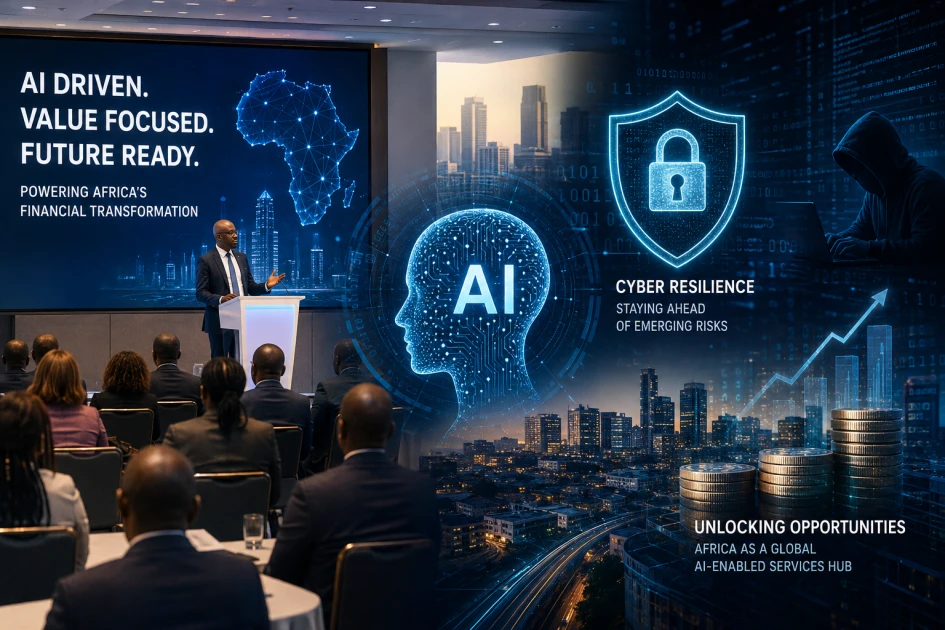
An AI representation image. PHOTO | AI

Audio By Vocalize
Financial institutions across Africa have been urged to adopt artificial intelligence (AI) strategically and focus on measurable business value rather than succumbing to growing pressure surrounding the technology.
Speaking during the opening of BFSI Week 2026 in Nairobi on
Wednesday, industry leaders said AI has the potential to transform Africa's
financial services sector, but warned that its success will depend on strong
leadership, cyber resilience and responsible implementation.
The two-day conference, which has brought together more than
300 executives and decision-makers from banking, SACCOs, insurance, fintech and
technology firms, is examining the role of emerging technologies in
accelerating Africa's financial transformation.
Harry Hare, Chairman of CIO Africa by dx5, cautioned
organisations against adopting AI simply because it has become the latest
technology trend.
"Technology is not there for technology's sake.
Technology is there to help us solve very specific problems, improve efficiency
and create value for customers," said Hare.
He noted that businesses are increasingly facing pressure
from boards, customers, competitors and technology vendors to embrace AI, but
stressed that organisations must first establish the value they intend to
create.
"Your board is asking what you are doing about AI. Your
customers are asking how you are using AI. Your competitors are adopting AI,
and vendors are constantly offering AI solutions," he said.
Hare acknowledged the transformative potential of AI but
urged organisations to remain focused on practical outcomes.
"Let's ride the hype, but let's reason reality into
what we're doing in technology so that we don't lose sight of what technology
is supposed to do," he added.
At the same time, experts warned that the rapid adoption of
AI is creating new cybersecurity risks for businesses.
Dennis Muriithi, Senior Solutions Engineer at Sophos, said
cybercriminals are increasingly leveraging AI to launch more sophisticated
attacks at unprecedented speed and scale.
"With new technology come new risks, and one of the
most constant risks has always been cybersecurity," he said.
According to Muriithi, phishing attacks have surged
significantly during the generative AI era, while AI-powered cyber threats
continue to rise globally.
"The number is not going to go down. Whatever we're experiencing
today will get worse," he warned.
He explained that AI is now being deployed throughout the
cyberattack lifecycle, from reconnaissance and credential theft to ransomware
deployment, reducing the time organisations have to detect and respond to threats.
"In the AI era, we are moving from minutes to seconds
of impact," he said.
Muriithi called on financial institutions to strengthen
preparedness by developing clear incident response frameworks and ensuring
leadership teams understand their responsibilities during cyber crises.
"The question is, what is your escalation chain? Do you
have a plan?" he posed.
Despite the risks, speakers noted that AI also presents
significant economic opportunities for Africa.
Sarah Muriuki, Group Head of Enabler Systems Support at
Equity Bank Kenya, said the continent is increasingly positioning itself as a
global hub for AI-enabled service delivery.
"Africa is not only a market for AI, we are becoming a
delivery engine," she said.
Muriuki pointed to the continent's growing business process
outsourcing and shared services industry, arguing that African firms should
move beyond competing solely on labour cost advantages and focus on delivering
higher-value services powered by AI.
"Are we going to just stay as an arbitrage back office,
or do we level up and start bringing value to the market through AI-augmented
services?" she asked.
She argued that unlocking the full benefits of AI will
require bold leadership and strategic decision-making rather than technology
investments alone.
"That is not a technology question. It is a leadership
question," she said.
The discussions highlighted the balancing act facing
financial institutions across Africa as they seek to harness AI to improve efficiency,
customer experience and competitiveness while managing growing cybersecurity
and governance challenges.
Delegates attending BFSI Week are expected to continue
exploring how digital innovation and emerging technologies can strengthen
operational resilience, expand financial inclusion and drive the next phase of
growth in Africa's financial sector.
Join the Discussion
Share your perspective with the Citizen Digital community.
No comments yet
This discussion is waiting for your voice. Be the first to share your thoughts!