
Africa urged to turn biodiversity restoration commitments into measurable Action

Audio By Vocalize
Africa’s regional stakeholders and biodiversity experts have increasingly emphasised the need to strengthen restoration efforts across the continent, highlighting the importance of robust monitoring, reporting, and data-driven action to achieve concrete restoration goals.
This call was made during a high-level subregional workshop aimed at strengthening biodiversity restoration monitoring under the Global Biodiversity Framework.
Addressing the attendees, Kenya’s Cabinet Secretary (CS) for Environment, Climate Change, and Forestry, Dr Deborah Barasa, underscored the critical importance of translating restoration commitments into tangible, measurable outcomes.
She noted that ecosystem restoration is central to tackling biodiversity loss, mitigating climate change, and achieving sustainable development, stressing that progress cannot be demonstrated without credible monitoring and reporting systems.
“Restoration is about giving nature a chance to recover. In doing so, we protect livelihoods, secure water, support food production, and build resilience to climate change. Mere restoration of ecosystems is not enough. We also need to track and communicate what is working, learn from what is not, and ensure that in the coming years, restoration commitments transform from promises on paper into reality,” Dr. Barasa emphasised.
Echoing these sentiments, Mr. Patrick Mucheleka, Chairperson of the Regional Centre for Mapping of Resources for Development (RCMRD) Governing Council and Permanent Secretary, Ministry of Lands and Natural Resources, Zambia, highlighted the value of subregional cooperation in delivering global biodiversity commitments. He observed that while countries face diverse ecological and socio-economic contexts, they often share common challenges related to data availability, technical capacity, and reporting requirements.
“Across our region, we all face similar pressures: land under stress, ecosystems stretched to their limits, and communities that rely directly on nature for their livelihoods. We share a responsibility to turn our restoration commitments into real, measurable action,” said Mr. Mucheleka.
Addressing the gathering via video message, Astrid Schomaker, Executive Secretary of the Convention on Biological Diversity, emphasised the critical role of partnerships in tackling the multi-faceted planetary crises of biodiversity loss, land degradation, climate change, pollution, and waste.
“We need all hands on deck. The world requires a whole-of-government and whole-of-society acceleration in implementing the Global Biodiversity Framework,” Schomaker stated.
The workshop convened policymakers and technical experts from 11 countries in Eastern and Southern Africa to accelerate implementation of Target 2 of the Kunming-Montreal Global Biodiversity Framework. Target 2 aims to ensure that, by 2030, at least 30 percent of degraded terrestrial, inland water, and coastal and marine ecosystems are effectively restored.
Participating countries included Comoros, Eswatini, Ethiopia, Kenya, Madagascar, Rwanda, Somalia, South Sudan, Uganda, the United Republic of Tanzania, and Zambia.
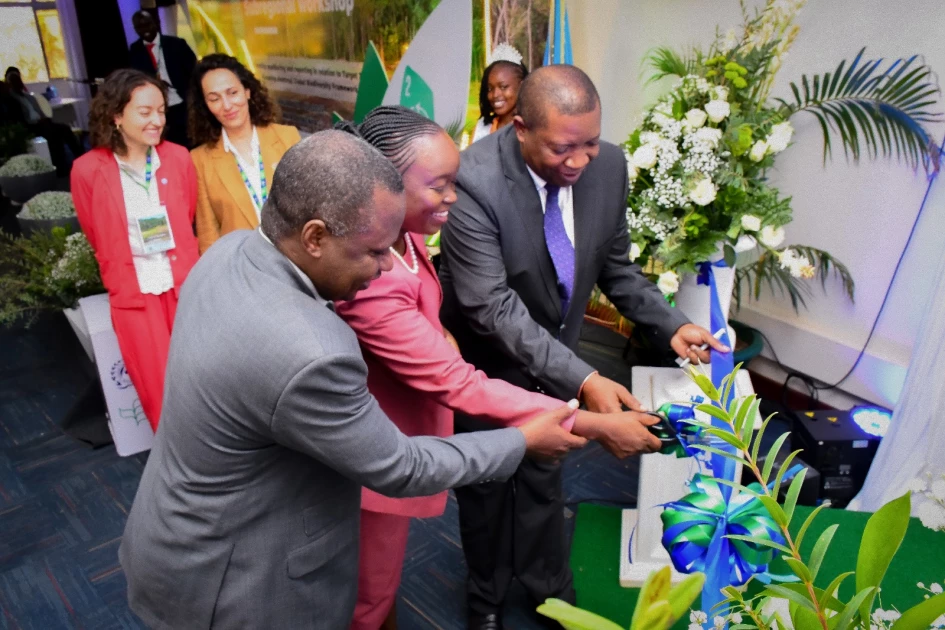
The workshop also marked the official launch of RCMRD’s role as a Subregional Technical and Scientific Cooperation Support Centre, alongside the establishment of its Steering Committee. In this role, RCMRD will assist countries in Eastern and Southern Africa to accelerate implementation of the Global Biodiversity Framework by providing coordinated scientific, technical, and data-driven support.
“With its new mandate as a Subregional Technical and Scientific Cooperation Support Centre, RCMRD is ready to provide the data, tools, and coordination necessary to deliver on Target 2,” said Dr. Emmanuel Nkurunziza, RCMRD Director General.
Participants also included representatives from Africa’s four other Subregional and Technical Scientific Cooperation Support Centres—Central African Forest Commission (COMIFAC), Ecological Monitoring Centre (CSE), Sahara and Sahel Observatory (OSS), and South African National Biodiversity Institute (SANBI)—as well as members of key stakeholder groups, including women, youth, and indigenous communities.
Join the Discussion
Share your perspective with the Citizen Digital community.
No comments yet
This discussion is waiting for your voice. Be the first to share your thoughts!