
Africa risks losing control of its data as AI adoption accelerates- Report

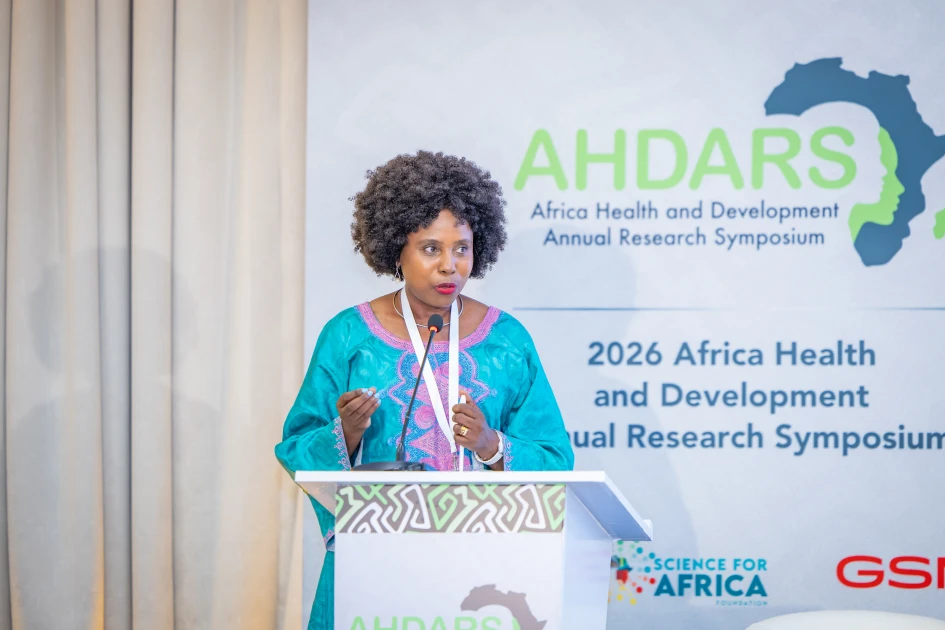
APHRC Executive Director Dr. Catherine Kyobutungi speaks during the 3rd Africa Health and Development Annual Research Symposium (AHDARS) in Nairobi on November 11, 2026. PHOTO | APHRC

Audio By Vocalize
A new report by the African Population and Health Research Centre (APHRC), the Science for Africa Foundation (SFA Foundation) and the Global System for Mobile Communications Association (GSMA) warns that despite progress in developing data governance policies, Africa remains heavily constrained by limited computing infrastructure, inadequate financing and technical capacity.
The Africa Evidence Outlook report, launched on Wednesday during the 3rd Africa Health and Development Annual Research Symposium (AHDARS) in Nairobi, notes that the continent risks losing control of its data and knowledge assets unless it invests in systems that can be managed and sustained by African institutions.
The report, which examined more than 20 data and knowledge systems across health, education, genomics, research and AI, argues that the challenge is no longer simply collecting data but ensuring African institutions have the capacity to govern, maintain and use it.
It further highlights the gap between Africa's contribution to global scientific research and its capacity to support the infrastructure required to generate and process knowledge.
Africa accounts for approximately 2.8 per cent of global scientific knowledge but holds less than one per cent of the world's computing capacity.
Evidence reviewed from 67 institutions across 28 countries also revealed constraints in data storage, software, internet connectivity and energy infrastructure.
Speaking at the launch, APHRC Executive Director Dr Catherine Kyobutungi said African countries needed to move beyond policy commitments and establish systems that guarantee ownership and control of their data.
"We as Africans need to turn Africa data commitments into reality, including the Malabo Convention, the AU Data Policy Framework, and the continental AI strategy," she said.
"What is at stake is the ability to decide what is built from African data and knowledge, for whom and on what and whose terms to ultimately translate research into policy, technology and innovation, while strengthening African-led knowledge systems."
The report, however, points to emerging African-led initiatives that demonstrate how institutions can retain control of sensitive information while allowing researchers to collaborate across borders.
Examples include the African Population Cohorts Consortium (APCC) and the Data Architecture Systems and Standards for APHRC (DASSA), which enable researchers to analyse data without necessarily transferring sensitive datasets outside the continent.
SFA Foundation Chief Executive Officer Dr Tom Kariuki said data sovereignty should focus on determining the conditions under which information is accessed, shared and used rather than restricting its movement.
"Data sovereignty in Africa is not about restricting data movement but rather setting the terms of access, use, and sharing. Through initiatives such as the APCC, data custodians maintain control and accountability while researchers across jurisdictions analyse it together. That is how we collaborate without giving up authority, and that is the model we want to see scaled across the continent," he said.
The report proposes eight interventions to strengthen African ownership of data and research, including increased investment in digital infrastructure, stronger institutional financing models and implementation of existing continental data governance commitments.
It also calls for locally developed data and AI tools used in sectors such as healthcare and public services to be tested and validated against African data and local contexts.
GSMA Head of Africa Angela Wamola said sustainable digital health systems required more than technological solutions, pointing to the need for strong institutions, supportive policies, skilled personnel and reliable systems.
"The Digital Health Index helps African governments identify gaps and target action and investment where it can have the greatest impact – building stronger health systems and improving access to quality healthcare across Africa," she said.
The report further urges governments to prioritise investment in data and knowledge infrastructure, while research institutions and universities are encouraged to strengthen local expertise and African-led knowledge production.
Technology companies and development partners have also been challenged to develop solutions suited to African needs and provide sustained funding to support the institutions and personnel responsible for maintaining data systems.
The findings come as African countries continue developing regulatory frameworks for data governance and artificial intelligence, including the Malabo Convention, the African Union Data Policy Framework and the continental AI strategy.
The annual Africa Health and Development Annual Research Symposium brings together researchers, policymakers, development partners and other stakeholders to share research findings and explore approaches to addressing the continent's health and development challenges.
Join the Discussion
Share your perspective with the Citizen Digital community.
No comments yet
This discussion is waiting for your voice. Be the first to share your thoughts!