
Abdirahman Mohamed: The night Roberto Baggio broke my heart
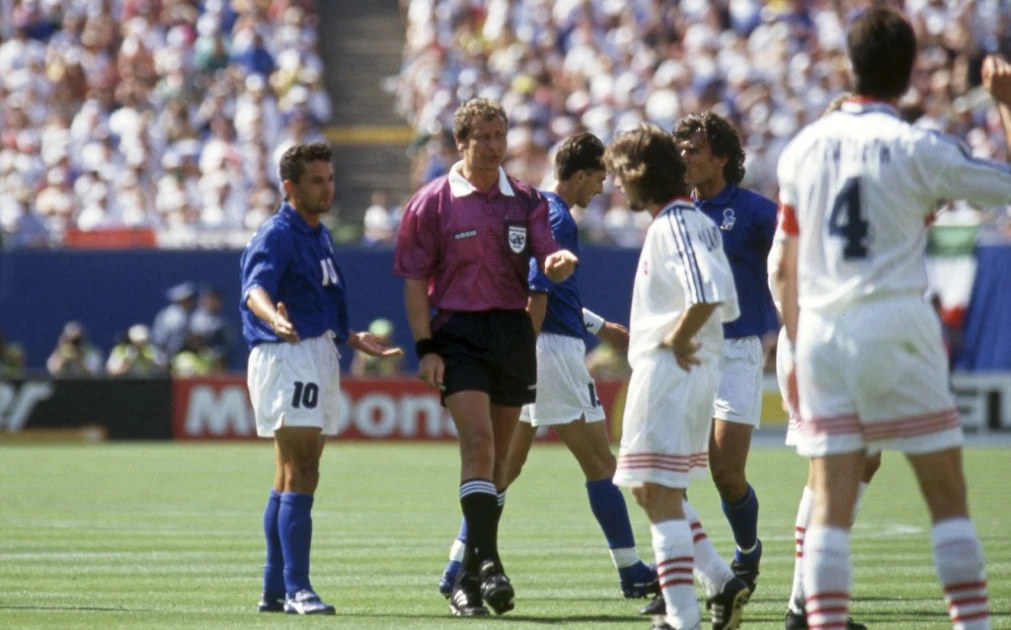
June 23, 1994 – Archive photo. Football (soccer), 1994 FIFA World Cup USA, Group E match: Italy vs Norway (1–0). German referee Helmut Krug pictured in a half-length portrait with Roberto Baggio. Photo: Jürgen Fromme / firo Sportphoto / dpa Picture-Alliance via AFP.

Audio By Vocalize
I had just moved back to Kericho, a cold but vibrant town nestled in Kenya's South Rift. For a ten-year-old boy who had spent the previous years in Nairobi, it felt like moving to another world. Nairobi had everything. Kericho had rolling tea plantations, misty mornings and a football-mad community where every dusty field became a stadium after school.
What Kericho did not have was Kenya Television Network (KTN).
KTN was still in its infancy and its signal barely stretched beyond Nairobi. To most people, that meant very little. To me, it felt like losing a best friend.
Football was my world.
I played every chance I got, and I was good at it. But more importantly, during my years in Nairobi, KTN had introduced me to what was then the greatest football league on earth—Italy's Serie A.
Every weekend I watched the masters.
There was AC Milan, led by the incomparable Paolo Maldini, with Dutch greats Frank Rijkaard and Ruud Gullit orchestrating one of Europe's finest teams. George Weah, the fearless Liberian striker who would later become President of Liberia, was already showing the world why he would become Africa's greatest footballer.
Across the city, Inter Milan boasted Dennis Bergkamp's genius and Paulo Sousa's elegance.
Then there was Juventus.
Juventus wasn't just my team.
It was Roberto Baggio's team.
To a ten-year-old boy, Roberto Baggio wasn't simply a footballer. He was a magician. His touch, his vision, the effortless way he glided past defenders—it all looked like something from another planet. I admired him so much that whenever I wrote my name on my exercise books, I proudly signed it "Roberto Baggio."
When the FIFA World Cup kicked off in the United States that summer, there was never any question where my allegiance lay.
I was Italy.
Watching the tournament, however, required military planning.
Because the matches were being played in America, kick-off times in Kenya came in the dead of night. For a primary school boy, staying awake until two or three in the morning was forbidden.
But passion has a way of making impossible things possible.
With the help of my cousin, who was in secondary school and whom I had successfully converted into an Italia supporter, we quietly sneaked out of bed whenever Italy played. We would tiptoe through the house, praying the floorboards wouldn't betray us.
Every Italy match felt like a secret operation.
Italy's tournament began disastrously.
Drawn alongside the Republic of Ireland, Mexico and Norway, the Azzurri stumbled through the group stage. Ireland beat them. Mexico held them. Italy defeated Norway, but all four teams remarkably finished on four points.
Mexico topped the group on goals scored. Ireland edged Italy on the head-to-head rule. Italy scraped into the knockout rounds as one of the best third-placed teams.
Even more worrying for me, Roberto Baggio had not scored.
The man I believed could conquer the world looked strangely ordinary.
Then came Nigeria.
African champions.
Fearless.
Gifted.
Led by Rashidi Yekini, Emmanuel Amunike, Finidi George, Jay-Jay Okocha and Peter Rufai.
When Emmanuel Amunike put Nigeria ahead and Gianfranco Zola was sent off, Italy looked finished.
Down to ten men.
One goal behind.
Only minutes remaining.
Then, in the 88th minute, football reminded us why greatness exists.
Roberto Baggio collected the ball inside the penalty area and calmly slid it beyond Peter Rufai.
Goal.
I don't remember shouting.
I remember exploding.
The house was asleep, yet somehow my cousin and I celebrated without waking anyone. Italy was alive.
In extra time, Baggio calmly converted the winning penalty.
The Divine Ponytail had rescued his country.
A few days later came Spain in the quarter-finals.
By then, my faith had completely returned.
That week, our Arts and Crafts teacher gave us an assignment to create a tie-and-dye design on a piece of cloth. While my classmates experimented with different patterns, I had only one idea in mind.
I painted the map of Italy.
When I finished, I proudly nicknamed my masterpiece "Roberto Baggio."
Looking back today, I smile at the innocence of it all. My teacher probably thought it was just another school project. To me, it was a tribute to my hero.
Against Spain, Baggio rewarded that faith once again.
Italy edged through 2-1, and who else but Roberto Baggio scored the winner.
I felt as though he was doing it for me.
Then came Bulgaria in the semi-final.
Once again, it was Baggio.
Two magnificent goals.
Italy were in the World Cup final.
For an entire week, I floated through life convinced destiny had already written its ending.
Then came Sunday, 17 July 1994.
The day of the final.
Italy versus Brazil.
Even my mother understood what that match meant to me.
She supported Brazil.
I supported Italy.
Knowing how deeply I loved football—and especially Italy—she gave me what I jokingly call my gate pass. Permission to stay up and watch the final.
For a ten-year-old, it felt like receiving VIP accreditation to the biggest sporting event on earth.
The Rose Bowl in Pasadena became the centre of my universe.
The game itself was tense, cautious and painfully short on chances. Romário and Bebeto searched for openings. Italy defended with courage. Baggio, carrying the weight of an entire nation, struggled with a hamstring injury but refused to stay off the pitch.
For 120 minutes, neither side could find a goal.
Then came football's cruellest examination.
The penalty shootout.
As each player walked from the centre circle, my heart beat faster.
Brazil converted.
Italy missed.
Brazil scored again.
The pressure kept growing.
Then came the image that has never left me.
Roberto Baggio placed the ball on the penalty spot.
Everything seemed to pause.
The stadium.
The commentators.
Even our living room.
He ran forward.
He struck the ball.
It sailed over the crossbar.
Brazil were world champions.
For the first time in my young life, football broke my heart.
That night was one of the longest nights I have ever experienced.
Sleep refused to come.
Again and again, I replayed the penalty in my mind.
"What if it had gone in?"
"What if Baggio had scored?"
I couldn't understand how the greatest player in the world—my greatest player in the world—could miss.
Years later, I would learn something that every football supporter eventually discovers.
Heroes are not remembered because they never fail.
They are remembered because they dare to take responsibility when everyone else is watching.
Roberto Baggio carried Italy almost single-handedly from the brink of elimination against Nigeria to the World Cup final. Without him, there would never have been a penalty to miss.
That is why history remembers the miss, but football lovers remember the journey.
And on a lighter note, childhood has a funny way of expressing admiration.
Whenever we played football in Kericho after that World Cup, I occasionally found myself missing penalties on purpose.
Not because I wanted to lose.
Simply because Roberto Baggio had missed one.
Looking back now, I laugh at the thought.
Kkkkk.
Only a ten-year-old could believe that imitating your hero meant copying even his most painful moment.
Today, whenever I see footage of that final, I no longer see the missed penalty first.
I see a little boy in Kericho, wrapped in an Italian dream, holding a school project shaped like the map of Italy, secretly watching football long after midnight with his cousin, armed with a gate pass from his Brazilian-supporting mother, believing that one man with a ponytail could make anything possible.
For me, that was never just the 1994 World Cup Final.
It was the tournament that taught me football is more than trophies.
It is memory.
It is family.
It is hope.
And sometimes, heartbreak is what makes the love last forever.
The author, Abdirahman Mohamed Abdullahi, is a football enthusiast.
Join the Discussion
Share your perspective with the Citizen Digital community.
No comments yet
This discussion is waiting for your voice. Be the first to share your thoughts!