
43 African countries launch anti-corruption research centre in Nairobi
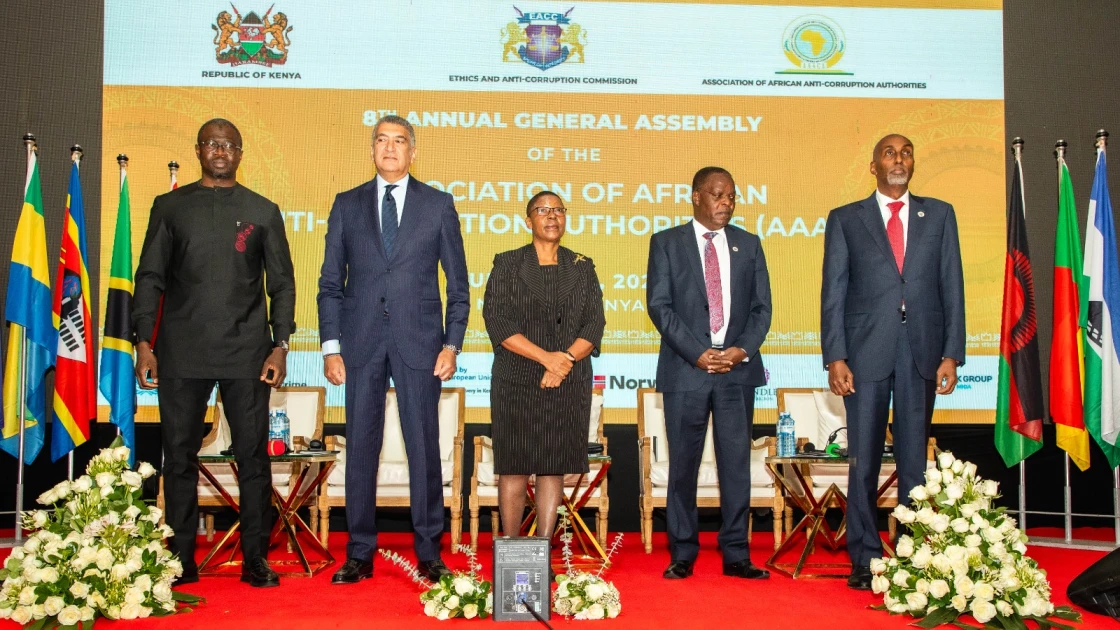
From Right: EACC CEO Abdi Mohamud, Chairperson David Oginde, AG Dorcas Oduor and AAACA President General Hisham El Rakaybi during the launch of the anti-corruption research centre at KSMS in Nairobi on June 17, 2026. PHOTO | EACC

Audio By Vocalize
African leaders have officially launched the Centre for Anti-Corruption Studies and Research in Africa (CEREAC) in Nairobi, marking a major milestone in the continent's efforts to strengthen the fight against graft through research, innovation and technology.
The centre, launched during the 8th Annual General Assembly
of the Association of African Anti-Corruption Authorities (AAACA) on Wednsdaye, becomes the
first institution of its kind in Africa and is expected to provide research,
training, capacity building and technical support to anti-corruption agencies
across the continent.
The launch brought together heads of anti-corruption
agencies from more than 45 institutions drawn from 43 African countries,
alongside government officials, development partners and governance experts.
Delegates led by AAACA President General Hisham El Rakaybi underscored that corruption in Africa has evolved beyond national borders, with emerging
technologies, digital financial systems and virtual assets increasingly being
used to conceal illicit wealth and evade detection.
Speaking during the launch, Ethics and Anti-Corruption Commission (EACC) Chief Executive Officer Abdi Ahmed Mohamud said the fight against corruption can no longer be treated as a purely domestic issue.
"The fight against corruption is no longer merely a national concern; it is a continental and global imperative," said Mohamud.
Mohamud described the launch of the centre as a culmination of a four-year process that began during AAACA's fifth Annual General Assembly in Burundi in 2022.
Attorney General Dorcas Oduor, who presided over the official launch on behalf of President William Ruto, said corruption remains one of the biggest obstacles to Africa's economic transformation and sustainable development.
Ruto, in a speech delivered by AG Oduor, observed that while Africa is benefiting from
technological innovation, expanding intra-African trade, a youthful population
and the implementation of the African Continental Free Trade Area, governance
challenges continue to undermine development gains.
"The aspirations embodied in Agenda 2063, the African
Union Convention on Preventing and Combating Corruption, and the Sustainable
Development Goals cannot be fully realised unless we confront corruption with
the same determination, urgency, and collective purpose with which we pursue
economic growth and regional integration," read the AG.
The President warned that corruption has become increasingly
technology-enabled and transnational, with illicit proceeds often hidden
through shell companies, beneficial ownership structures, digital assets and
other emerging technologies.
"Corruption today is no longer a localised or isolated
phenomenon. It has become increasingly sophisticated, technologically enabled,
and transnational in character," read AG Oduor.
According to Ruto, Africa continues to lose hundreds of
billions of dollars annually through corruption, illicit financial flows, tax
evasion, procurement fraud and related financial leakages.
"These are resources that should be financing schools,
hospitals, roads, water systems, energy infrastructure, and opportunities for
our young people," he noted in the speech read by the AG.
The President further called on African countries to embrace
technology in anti-corruption efforts, citing artificial intelligence, data
analytics, digital registries, open contracting platforms and beneficial
ownership databases as tools capable of detecting irregularities and
strengthening accountability.
"Technology alone, however, is not enough. We must combine innovation with ethical leadership, institutional integrity, and an unwavering commitment to the rule of law," read Oduor.
EACC Chairperson Dr David Oginde also noted that the continent must increasingly shift towards the use of artificial intelligence and other emerging technologies to detect, investigate and track both domestic and cross-border corruption cases.
"We need to strengthen our institution’s capacities by embracing innovation. Digital graft is becoming more and more difficult to deal with, with the systems that we have used in the past. We must innovate and use AI, blockchain and other advanced technologies that can be used to curb movement of resources in real time," he said.
The new centre will provide a platform for research,
innovation, policy development, capacity building and knowledge exchange, while
helping governments and anti-corruption agencies identify emerging corruption
risks and evaluate the effectiveness of anti-corruption interventions.
Kenya was unanimously selected as the host country for the centre during an extraordinary virtual meeting of AAACA members in January 2024 before the decision was ratified at subsequent assemblies.
The Nairobi-based institution is expected to serve as the
continent's primary body for applied anti-corruption research and
evidence-based policy advisory, strengthening cooperation among African
anti-corruption agencies in tackling increasingly complex corruption networks.
Join the Discussion
Share your perspective with the Citizen Digital community.
No comments yet
This discussion is waiting for your voice. Be the first to share your thoughts!