
2027 matrix: The gambles at stake as Kenya braces for General Election without Raila
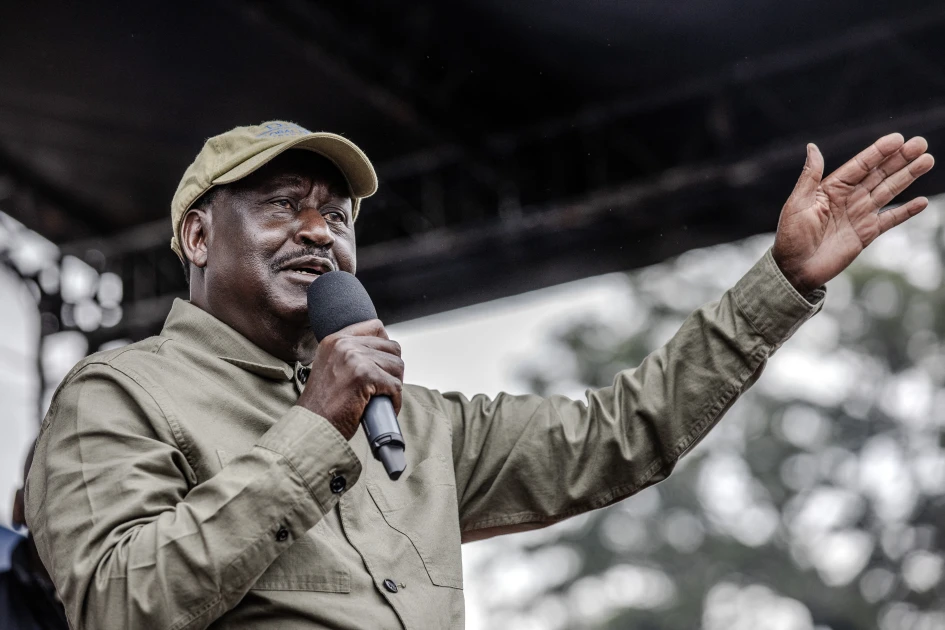
Late Raila Odinga addresses the crowd during a public rally against the high cost of living after the passing of the finance bill, at the Kamukunji grounds in Nairobi, Kenya on July 7, 2023. (Photo by Luis Tato / AFP)

Audio By Vocalize
For almost four decades, Kenyan politics ran on a simple question; Where does Raila stand? Presidents, rivals and ordinary voters all organized their choices around the answer.
October 15, marks one year since Raila Odinga died, and the country is still adjusting to a political world where that question no longer has an answer, because Raila is not here.
August 2027 will be the first general election in nearly 40 years without Baba on the scene, as candidate, kingmaker or conscience.
Call it the Zero Raila Matrix: every old formula has to be recalculated from scratch. What factors will help conceptualize a new formula if any?
The Government’s Play: Hug the Legacy
President William Ruto’s camp is not waiting for the recalculation to finish. Since the “broad-based” arrangement brought ODM stalwarts into government, the ruling alliance has worked to position itself as the keeper of Raila’s flame.
The evidence is everywhere this month. October 2026 is being marked as Mwezi wa Baba, Baba’s Month.
A state-funded mausoleum has been commissioned at Kang’o ka Jaramogi, the Odinga family home. The message to Luo-Nyanza is overly simplistic, and rather plain: we honour what you loved, so stand with us.
However, this strategy has a practical end. Ruto’s team wants to absorb the pro-government wing of ODM, led by Oburu Odinga and Gladys Wanga, into a permanent coalition for 2027.
If it works, the president gains the party machinery, the grassroots structures and the emotional goodwill of one of Kenya’s most loyal voting blocs.
But a legacy cannot be borrowed forever. Critics ask whether the government is honouring Raila or harvesting him.
Many Nyanza voters, who spent years in the streets for the causes Raila championed, may not forgive what looks like grief turned into campaign material.
Opposition’s Split
The opposition has been split in two since the funeral.
The co-opted faction is made up of ODM leaders who prefer to stay inside the tent. They like the access, the appointments and the stability, and some are openly demanding the Deputy Presidency as the price of their support in 2027. They argue it is better to shape government from the inside than shout from outside.
The Resurgent Opposition within the ODM party sees it differently; they walked away and have morphed into small opposition parties along the way.
Nairobi Senator Edwin Sifuna, former ODM secretary-general, is increasingly cast as the heir to Raila’s restless, defiant political spirit.
Alongside him are Siaya Governor James Orengo and Babu Owino in the wider break-away Linda Mwananchi movement.
Their view is that Raila’s real legacy was never about proximity to power. It was about holding power to account.
Their only real path is to build something new: an anti-Ruto alliance anchored in economic governance, resistance to heavy taxation and public accountability.
It is a clear message. Whether it can be carried across a country as divided as Kenya is another matter.
Scenario One: The Plurality Trap
In a case where the opposition fails to unite. Edwin Sifuna runs. Kalonzo Musyoka runs. Fred Matiang’i runs. As does Martha Karua et al.
All regional chiefs plant their own flags in their spheres of influence. Each wins a county here, a constituency there, but none comes close to achieving a national threshold.
Meanwhile, the incumbent, whatever his approval ratings, enjoys a single consolidated bloc.
Kenyans have seen this film before. In 1997, a splintered opposition watched Daniel arap Moi walk to victory despite widespread national discontent.
The lesson is blunt… in Kenya, a divided majority loses to a united minority.
The danger is that each opposition leader sees himself as the one destined to lead. Egos, regional loyalties and old rivalries are expensive, and history indicates that voters will pick the short end of the stick. If this scenario holds, the opposition will have handed Ruto a second term it could have easily stopped.
Scenario Two: The Grand Alliance
Now imagine the opposite. The opposition’s leaders swallow their pride and sign a single ticket. A younger, issue-driven figure such as Sifuna, with energy and ideological sharpness, stands alongside seasoned opposition stalwarts who bring regional networks and experience.
Young urban voters meet older rural loyalists. The coalition holds because everyone sees the alternative.
In that case, 2027 becomes a contest of a different kind: not which tribe stands where, but what has happened to my pocket.
The cost of unga, the price of fuel, the diminishing pay-slip and the state of the jobs market would all be on the ballot. That would be a healthier election, and a point of real reckoning for the incumbent.
The hard part is the arithmetic of trust. Alliances in Kenya have a habit of collapsing over a single question: “who gets what, where and when?”
Scenario Three: The Luo-Nyanza Gamble
The government’s own path has risks too. Ruto’s re-election plan leans heavily on keeping the ODM machine in step with his administration. The rank and file of ODM foot soldiers are asking hard questions and despite being called to order many times, they are still restless. It is a delicate balancing act.
Every concession to ODM has a price elsewhere. The push by some ODM factions for top seats, the Deputy Presidency chief among them, is already stirring unease in Ruto’s traditional strongholds in Central Kenya and the Rift Valley. Those regions did not deliver the 2022 victory to share it casually. If they feel crowded out or taken for granted, the coalition that won in 2022 could quietly fray.
So the president faces a squeeze. Give ODM too much, and the base sulks. Give ODM too little, and Nyanza walks. Expect a long season of drawn knives and delicate negotiations, carefully worded statements and sudden meetings in quiet hotels. It will not be done until it is done.
Scenario Four: The Economy
Whatever the political choreography, there may be a force larger than any alliance: the cost of living. With Raila gone, a convenient political scapegoat or coat-tails to hang on has disappeared.
For years, any national gridlock could be blamed on the “handshake,” the “protests,” or the great rivalry itself.
On the other hand, many politicians would have their chances almost flailing until Raila turns up in their locality and declares “Fulani Tosha!” Now there is no one left to point at or lean on. More than ever before, voters are looking at the state of the economy and how it is affecting them.
Forecasts suggest that if inflation is not stabilized and the fallout from aggressive taxation is not addressed before mid-2027, no backroom deal will save the government from voter backlash. A mausoleum can win sympathy, but it cannot lower the price of cooking oil.
This is the quiet truth of the Zero Raila Matrix. Elections are rarely decided by sentiment alone. When household budgets are squeezed, voters tend to remember who made it harder.
Is Kenya Poorer Without Raila?
The question is hard, and the honest answer is both. Democratically, a little poorer. For decades Raila was the institutional check on state excess.
Even his critics acknowledged that his presence made governments think twice. His death left a void in oversight.
With ODM elements now inside the government, controversial bills and tax measures have met less organized, structured resistance. Citizens may be more exposed to overreach than before, and that is a real cost.
Politically, perhaps richer. There is another side to the ledger. Kenya’s politics has long been personality-driven and ethnically balkanised.
For the first time, a candidate cannot simply rely on being “for or against Raila.” Kenyans are seeking to scrutinize candidate’s manifestos and broad policy directions should they come into office. The “Baba” shortcut is gone.
The result is a new generation of leaders who must earn authority through policy, communication and economic ideas rather than inherited tribal loyalty.
Voters, for their part, seem more willing to ask harder questions and to demand real answers to real problems, not slogans or cheap claims.
A Realistic Picture Kenya, Post-Raila
Put the pieces together, and Kenya is now a country without its biggest political gravitational force, but inching forward and moving into an uncharted political path.
The ruling coalition is stronger on paper but practically frayed at the seams. The opposition is passionate but scattered.
Young voters, more educated and forced to economic and political realities of their day, are digitally connected, impatient and unmoved by old tribal arithmetic; however, history is yet to record their rigour and resolve.
What is certain is that Raila’s absence has changed the equation. It used to be: Are you with Raila or against him? Now it is: What have you done, and what will you do?
That may be the most enduring thing Baba leaves behind: an election where, finally, the person on the ballot has to speak for themselves, and learn to be comfortable in thinking and doing things for themselves.
Join the Discussion
Share your perspective with the Citizen Digital community.
No comments yet
This discussion is waiting for your voice. Be the first to share your thoughts!