

Webb telescope spots infant planets in different stages of development
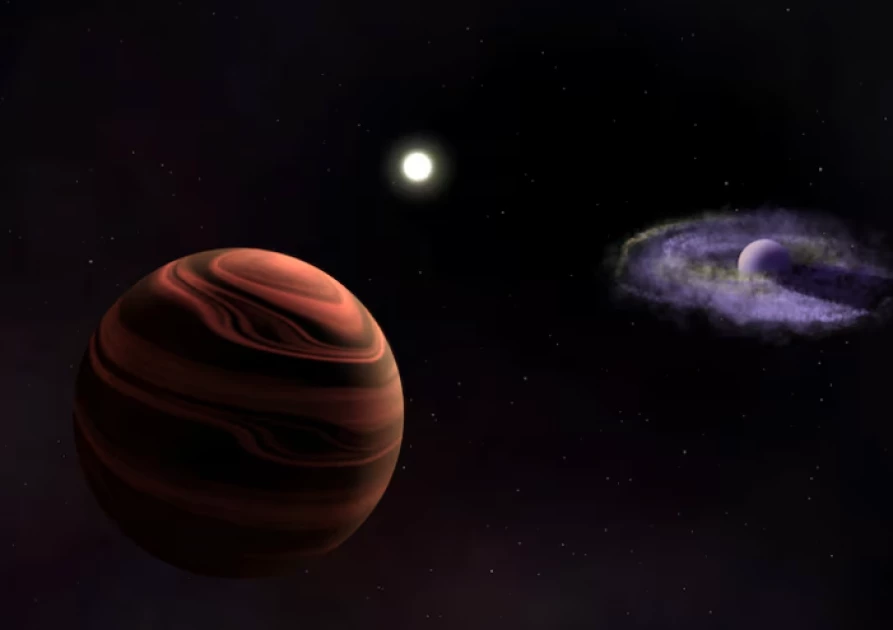
An artist's rendition of the sun-like star YSES-1 in the center, with the planet YSES-1 b and its dusty circumplanetary disk (right) and the planet YSES-1 c with silicate clouds in its atmosphere (left), is seen in this handout image obtained by Reuters on June 11, 2025. Ellis Bogat/Handout via REUTERS/Illustration

Audio By Vocalize
The James Webb Space Telescope has observed two
large planets at different stages of infancy - one with an atmosphere brimming
with dusty clouds and the other encircled by a disk of material - orbiting a
young sun-like star in a discovery that illustrates the complex nature of how
planetary systems develop.
The two gas giant planets, both more massive than our solar
system's largest planet, Jupiter, were directly imaged by Webb in a
planetary system located in the Milky Way galaxy about 310 light
years from Earth in the direction of the constellation Musca. A light-year is
the distance light travels in a year, 5.9 trillion miles (9.5 trillion km).
Astronomers have detected more than 5,900 planets beyond our
solar system - called exoplanets - since the 1990s, with less than 2%
of these directly imaged like these two. It is rare to find exoplanets in their
early developmental stages.
The birth of a planetary system begins with a large cloud of
gas and dust - called a molecular cloud - that collapses under its own gravity
to form a central star. Leftover material spinning around the star in what is
called a protoplanetary disk forms planets.
This planetary system was observed by Webb very early in its
developmental history. The star, named YSES-1, is about the same mass as the
sun. The two planets orbit a long distance from the star, each probably needing
thousands of years to complete a single orbit.
While the sun is roughly 4.5 billion years old, this star is
approximately 16 million years old, a veritable newborn. The researchers were
surprised to find that the two neonatal planets observed by Webb appeared to be
at different stages of development.
The innermost of the two has a mass about 14 times greater
than Jupiter and orbits the star at a distance 160 times greater than Earth
orbits the sun and more than five times as far as our solar system's outermost
planet Neptune.
The planet is surrounded by a disk of small-grained dust, a
state one might expect in a very early stage of formation when it is still
coalescing, or perhaps if there has been a collision of some kind or a moon is
in the process of taking shape. Webb spotted water and carbon monoxide in its
atmosphere.
The outermost planet has a mass about six times greater than
that of Jupiter and orbits the star at 320 times the distance of Earth to the
sun. Its atmosphere is loaded with silicate clouds, differing from our solar
system's gas giants. Webb also detected methane, water, carbon monoxide and
carbon dioxide in the atmosphere. It has no disk of material around it.
The puzzling combination of traits presented by these two
planets in the same system illustrates "the complex landscape that is planet
formation and shows how much we truly don't know about how planetary systems
came to be, including our own," said astrophysicist Kielan Hoch of the
Space Telescope Science Institute in Baltimore, who led the study published
this week in the journal Nature.
"Theoretically, the planets should be forming around
the same time, as planet formation happens fairly quickly, within about one
million years," Hoch said.
A real mystery is the location where the planets formed,
Hoch added, noting that their orbital distance from the host star is greater
than would be expected if they formed in the protoplanetary disk.
"Furthermore, why one planet still retains material
around it and one has distinct silicate clouds remains a big question. Do we
expect all giant planets to form the same way and look the same if they formed
in the same environment? These are questions we have been investigating for
ages to place the formation of our own solar system into context," Hoch
said.
In addition to amassing a trove of discoveries about
the early universe since becoming operational in 2022, Webb has made a major
contribution to the study of exoplanets with its observations at
near- and mid-infrared wavelengths.
"Webb is revealing all sorts of atmospheric physics and
chemistry happening in exoplanets that we didn't know before, and is currently
challenging every atmospheric model we used pre-Webb," Hoch said.
Leave a Comment