
NASA rover finds potential sign of ancient life in Martian rocks
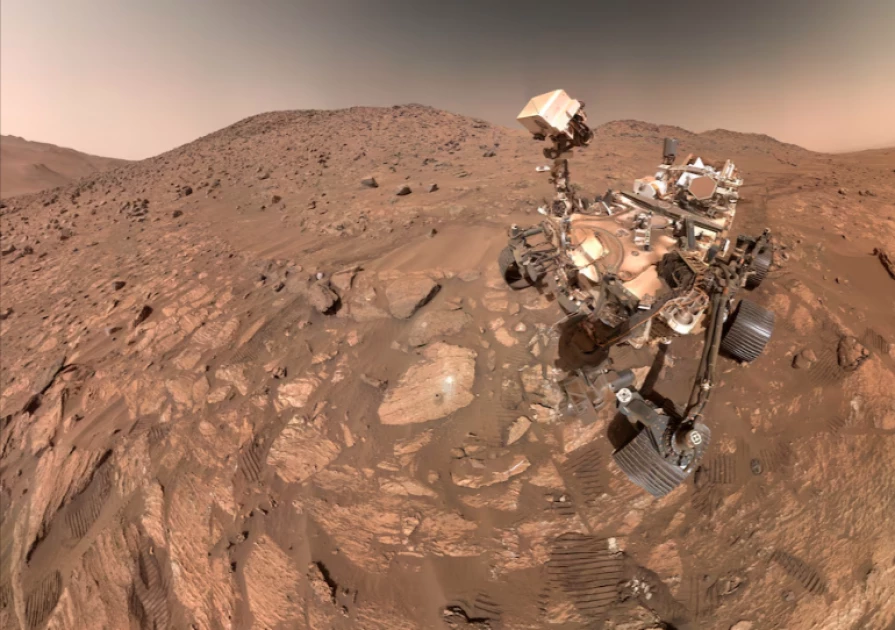
A "selfie" taken by NASA's Perseverance Mars rover, made up of 62 individual images, on July 23, in this image released on September 10, 2025. A rock nicknamed "Cheyava Falls," which has features that may bear on the question of whether the Red Planet was long ago home to microscopic life, is seen to the left of the rover near the center of the image. NASA/JPL-Caltech/MSSS/Handout via REUTERS

Audio By Vocalize
A sample obtained by NASA's Perseverance rover of
reddish rock formed billions of years ago from sediment on the bottom of a lake
contains potential signs of ancient microbial life on Mars, according to
scientists, though the minerals spotted in the sample also can form through
nonbiological processes.
The discovery by the six-wheeled rover in Jezero Crater
represents one of the best pieces of evidence to date about the possibility
that Earth's planetary neighbor once harbored life.
Perseverance scientist Joel Hurowitz of Stony Brook
University, lead author of the study published in the journal Nature said
a "potential biosignature" was detected in rock that formed at a time
when Jezero Crater was believed to have been a watery environment, between 3.2
and 3.8 billion years ago.
Acting NASA Administrator Sean Duffy told a news conference
that the U.S. space agency's scientists examined the data for a year and
concluded that "we can't find another explanation, so this very well could
be the clearest sign of life that we've ever found on Mars - which is
incredibly exciting."
NASA released an image of the rock - a very fine-grained,
rusty-red mudstone - bearing ring-shaped features resembling leopard spots and
dark marks resembling poppy seeds. Those features may have been produced when
the rock was forming by chemical reactions involving microbes, according to the
researchers.
A potential biosignature is defined as a substance or
structure that may have a biological origin but needs more data or further
study before a conclusion can be made about the absence or presence of life.
Nicky Fox, associate administrator for NASA's Science
Mission Directorate, noted that the scientists were not announcing the
discovery of a living organism.
"It's not life itself," Fox told the news
conference.
The rover since 2021 has been exploring Jezero Crater, an
area in the planet's northern hemisphere that once was flooded with water and
home to an ancient lake basin. Scientists believe river channels spilled over
the crater wall and created a lake.
Perseverance has been analyzing rocks and loose material
called regolith with its onboard instruments and then collecting samples and
sealing them in tubes stored inside the rover.
It collected the sample named Sapphire Canyon in July 2024
from a rock called Cheyava Falls in a locale known as Bright Angel rock
formation. The sample came from a set of rocky outcrops on the edges of Neretva
Vallis, an ancient river valley about a quarter of a mile (400 meters) wide
carved by water rushing into the crater.
Two minerals were detected that appear to have formed as a
result of chemical reactions between the mud of the Bright Angel formation and
organic matter present in that mud, Hurowitz said. They are: vivianite, a
mineral bearing iron and phosphorus, and greigite, a mineral bearing iron and
sulfur.
"These reactions appear to have taken place shortly
after the mud was deposited on the lake bottom. On Earth, reactions like these,
which combine organic matter and chemical compounds in mud to form new minerals
like vivianite and greigite, are often driven by the activity of
microbes," Hurowitz told Reuters.
"The microbes are consuming the organic matter in these
settings and producing these new minerals as a byproduct of their
metabolism," Hurowitz said.
The rover's instruments found that the rock was rich in
organic carbon, sulfur, phosphorus and iron in its oxidized form, rust. This
combination of chemical compounds could have offered a rich source of energy
for microbial metabolisms, Hurowitz said.
"The reason, however, that we cannot claim this is more
than a potential biosignature is that there are chemical processes that can
cause similar reactions in the absence of biology, and we cannot rule those
processes out completely on the basis of rover data alone," Hurowitz said.
Mars has not always been the inhospitable place it is today,
with liquid water on its surface in the distant past.
The sample collected and analyzed by Perseverance provides a
new example of a type of potential biosignature that the research community can
explore to try to understand whether or not these features were formed by life,
Hurowitz said, "or alternatively, whether nature has conspired to present
features that mimic the activity of life."
"We can make a lot of progress on this question with
laboratory experiments and fieldwork here on Earth to try to understand the
various pathways that might create features like the ones we observe in the
Bright Angel formation. But the ultimate tests can only be performed on the
Sapphire Canyon core sample if and when it is brought back to Earth for
study," Hurowitz added.
U.S. President Donald Trump's current budget proposal
would cancel NASA's existing Mars Sample Return mission. Duffy said NASA
is examining various ways for potential sample retrieval or even sending
equipment to Mars to do further analysis there.
"We're going to look at our budgets and we're going to
look at our timing, and how we spend money better and what technology do we
have to get samples back more quickly," Duffy said.
Join the Discussion
Share your perspective with the Citizen Digital community.
No comments yet
This discussion is waiting for your voice. Be the first to share your thoughts!