
OPINION: Time to end impunity for crimes against journalists is now, let’s get to it
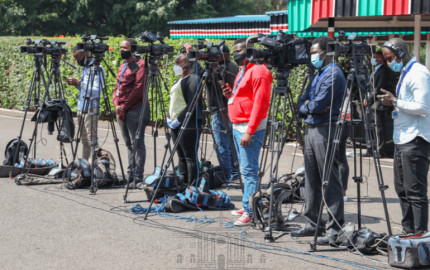
Journalists covering a past press conference at State House, Nairobi. PHOTO | PSCU

Audio By Vocalize
Every year on November 2, the world observes International Day
to End Impunity for Crimes against Journalists (IDEI). The day was proclaimed
by the UN General Assembly on December 2013 and the date selected in
remembrance of the assassination of two French journalists in Mali that same
year.
The importance of this day, according to UNESCO, is to urge member
states to implement definite measures countering the culture of impunity. It
aims at condemning all attacks and violence against journalists and media
workers. It also urges member states to do their best to prevent violence
against journalists and media workers, to ensure accountability, bring to
justice perpetrators of crimes against journalists and media workers, and
ensure that victims have access to appropriate remedies. Additionally, it calls
upon the promotion of a safe and enabling environment for journalists to
perform their work independently and without undue interference. Kenya is one
such member state of the United Nations.
Between 2006 and 2020, over 1,200 journalists have been killed
for reporting the news. In nine out of ten cases, the killers go unpunished.
Impunity leads to more killings and is often a symptom of worsening conflict
and the breakdown of law and judicial systems according to UNESCO.
Impunity for crimes against journalists is a global problem. This
fact was best demonstrated in 2020 when journalists and the media suffered
greatly at the hands of their governments keen on controlling the narrative on
the COVID-19 prevalence, response, and death rates.
World
leaders curtailing media freedom
Across the world, there were instances of a deliberate effort
to control journalists’ work such as in Brazil where President Jair Bolsonaro
condemned journalists covering the epidemic.
Iran, Malaysia, Greece, Germany, Pakistan, Spain, China,
India, Hungary, Russia, Venezuela, Myanmar, Kosovo, Palestine, Moldova,
Albania, Mexico, Belarus, Nicaragua, Poland, Bolivia, Singapore, Bangladesh,
Nepal, Ukraine among others were accused of attempt at controlling what
journalists say or not regarding COVID-19.
While the aforementioned countries condemned media reports and
blamed journalists for ‘bad’ coverage, countries like Vietnam, Cambodia, and
Indonesia quickly enacted laws giving their rulers censorship powers but disguised
as crisis measures linked to the coronavirus pandemic.
Iraq, for example, suspended the license of some news agencies
while the United Arab Emirates introduced a hefty fine on journalists. In
Jordan, security forces arrested a TV company’s owner while Turkey jailed a
host of journalists.
In Zimbabwe, a freelance journalist was beaten up by the
police and forced to delete video footage on his camera after filming a police
operation to disperse people during the lockdown in Harare.
The same experience was reflected in other African nations such
as Uganda, Somalia, Tanzania, Ghana Nigeria, Egypt, Algeria, Namibia, DRC,
South Africa, and Zambia, where international media and media freedom watchdogs
reported the atrocities.
Here in Kenya, and according to Article 19-Eastern Africa,
between May 2020 and April 2021, Kenya recorded at least 51 cases of attacks
against individual journalists, nine being female journalists. According to the
organization, the attacks varied from threats, intimidation, harassment both
online and offline, physical assaults, invasion of media houses, and in some
extreme cases, killings. Police officers led in these crimes against
journalists and media workers.
Government
and security agencies perpetuating impunity
Whereas the victims [journalists] are said to have reported assaults
to the police, there is almost no case or evidence to show that a single police
officer was ever arrested and prosecuted for his/her crimes. It is this culture
of impunity that perhaps has inculcated the lack of accountability from the
security agents that consider journalists as criminals rather than messengers.
According to the Reporters without Borders’ 2021 World Press
Freedom Index evaluating the state of journalism in 180 countries and
territories, Kenya was ranked 102 - lower than Ethiopia – among where crimes
against journalists are very high. The press freedom situation was classified
as “problematic” by the organization.
Whereas impunity for crimes against journalists appears
as a new problem, it is not. Journalism in Kenya has suffered tremendously but
it is in the 1980s and 1990s that it was at its lowest.
As noted by George Ogola in a journal article, “before 2009,
Kenya did not have a press law, making both media workers and organizations
particularly vulnerable to state intimidation. Media freedom was provided for
in section 79a of the constitution, but it remained subject to the provisions
of the penal code, which gave the government power to clamp down on the media
in the interest of public morality, public order, and national security.”
Between 1988 and 1990, nearly 20 publications were banned and
their editors forced into exile, jailed, or fined.
It would be until 2002 when Kibaki’s government opened up the
media space that conditions of practicing journalism improved. Media would
eventually earn its rightful place under Article 34 of the Constitution (2010).
The Constitution also entrenched other liberties such as freedom of expression
and right to access information under Article 33 and 35 respectively.
And so, from the dark days of constant threats, harassment,
and intimidation by the government, to unfettered control and mistrust by the
ruling elite, and oppressive rules coupled with a lack of legislation that
expressly defended the workings of the journalist, the media has made great
strides in professionalizing its operations.
Anti-Media
Laws
That be the case, the media in Kenya, according to Internews
Network, is still facing different pressures from different areas — legal
threats, economic challenges, fluid audience behavior, and [now] the COVID-19
pandemic.
That apart, the media also faces statutes that prohibit media
progress through very strong anti-media laws that emasculate media freedom.
There exist 13 other laws in the country that also purport to guide media
operations. These include the Kenya Films and Stage Plays Act of 1963; Computer
Misuse and Cybercrime Act 2018, The Kenya Broadcasting Act, Cap 221 of 1988;
The Copyright Act, Cap 130; 1966; The Books and Newspapers Act, Cap 111; 1930;
The Defamation Act, Cap 36; 1970.
Other anti-media laws include: The Armed Forces Act, Cap 199;
1968; The Official Secrets Act, Cap 187 of 1968; The Preservation of Public
Security Act, Cap 57; 1960; The Public Order Act, Cap 56; 1950; The Police Act,
Cap 84; 1988; The Penal Code, Cap 63; 2014; and The Chief’s Authority Act, Cap
128; 1937.
It’s imperative to note that the Media Council of Kenya and
other stakeholders have raised the issue of urgency to amend the KBC Act,
Public Order Act, Books and Newspaper Act, and Computer Cyber Crime Act. The
remaining also needs to be amended.
Media’s
culpability
But as we celebrate this day and condemn crimes and atrocities
against journalists, we must admit that the media isn’t without blame. In 2007/2008
for example, Kenya suffered heavily during the post-election violence and sections
of the media were accused of being enablers, with one journalist being among six
suspects indicted by the International Criminal Court (ICC). He was, however, later acquitted.
Impunity for crimes against journalists is also a social
matter. Journalists are some of the poorly paid professionals in this country.
A challenge that has exacerbated the culture of ‘’brown envelope’’ journalism.
The ‘’brown envelope’’ syndrome has in turn compromised media ethics and
journalism values. Journalists of the modern day have prioritized the brown
envelope over the pursuit of humanity.
The other prevalent but faceless crime against journalists is
sexual harassment in the newsroom. Many female journalists suffer silently due
to sexual overtures by their male colleagues. The crimes aren’t just limited to
sexual harassment but also online threats, verbal abuses and even gender-based
violence.
As we condemn the crimes against journalists and call for
justice to prevail for crimes caused against journalists, we must also address
the insolences that foster the culture of impunity among state operatives and
the political class.
Journalists must reevaluate their place in the society - that of
speaking truth to power without fear or favor. Kenya’s media recently failed
that test during the ‘Pandora Papers’
leak that contained files of several leaders with offshore accounts holding
billions. The leaks, which also implicated the first family, were given acres
of space and extensive coverage in international media. In Kenya, shoddily,
quickly and poorly researched articles were published and in one or two days,
the media stopped highlighting the story. A clear indication of fear of
rattling the first family.
Onwards, to end impunity for crimes against scribes,
journalists must start by cleaning their own house and acting beyond reproach. Two,
journalists like all professionals, need to work in a safe environment. This is
not just a responsibility of the journalists and media stakeholders but for
everyone, including the government, and the ordinary citizens, for without journalism,
there is no freedom of expression or right to access information or democracy.
Lastly, journalism isn’t a crime and journalists aren’t
criminals. For every journalist killed, the truth is killed.
The author is a Kenyan journalist, writer, and
communication specialist with a special interest in media law and political
communication. He remains a close observer of, and
participant in, Journalism and the Media.
Join the Discussion
Share your perspective with the Citizen Digital community.
No comments yet
This discussion is waiting for your voice. Be the first to share your thoughts!