

OPINION: Kenya’s developmental ambition to first world status - The role of foreign policy
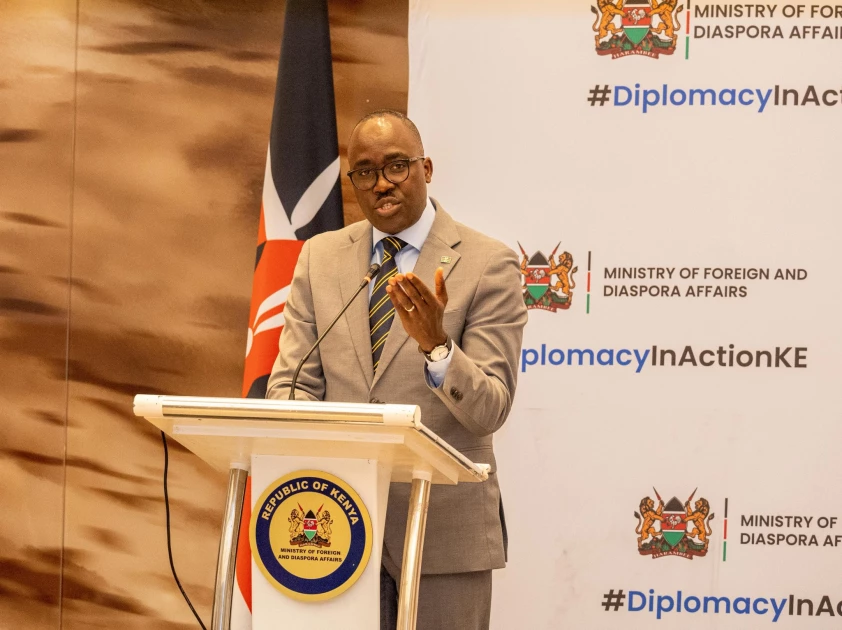
Foreign Affairs PS Korir Sing’oei speaks during a on Thursday, September 11, 2025. PHOTO | COURTESY

Audio By Vocalize
Over the last two months, President Ruto has framed his developmental goal for the country as the rapid and disciplined transformation anchored in strong institutions, quality human capital, and innovative and efficient deployment of resources modeled after Singapore.
This aspiration is well within reach based on the clear appreciation that countries rise depending on national coherence around a shared vision whose attainment is made possible by the coordinated and sustained contribution by different sectors. This article briefly sketches the role that foreign policy has and continues to play in Singapore’s own developmental trajectories as a benchmark by which Kenya’s current foreign policy orientation can aid in the country’s realization of the quest for higher developmental status.
First, Singapore has been intentional in promoting regional stability through active leadership of the Association of South-East Asian Nations (ASEAN) regional grouping.
As a crucial mediator and a hub for international dialogue- including its hosting of the famous meeting between North Korea’s strongman Kim Jung UN and President Trump- Singapore has leveraged its neutrality to facilitate cooperation on transnational issues and mitigate potential conflicts, allowing the country to enjoy long durations of stability.
This is an attribute shared with Kenya which views her own stability and progress as inextricably linked to regional integration and harmonious coexistence: our investment in regional groupings including the EAC, IGAD, Comesa and ICGLR being primary examples. This approach has allowed both Singapore and Kenya to serve as critical bridgeheads between disparate actors, fostering dialogue and stability in regions frequently characterized by friction.
Second, Singapore has pursued a pragmatic blend of diplomatic agility centered on fostering strong bilateral relationships, even with geopolitical rivals. This involves a nuanced balancing act, fostering economic interdependence and security cooperation with both the United States and China, despite their ongoing strategic competition.
This approach is not dissimilar to Kenya’s which has cultivated robust security cooperation with the United States and significant economic cooperation with China including under the Belt and Road Initiative. In 2025 alone, President Ruto engaged both Beijing and Washington in equal and respectful measure enabling the unlocking of critical mutually beneficial instruments of cooperation from these highly consequential nations. It is instructive that in pursuing this approach, the cultivation of strategic autonomy remains the guiding paradigm for both countries.
Third, despite its size, like Kenya, Singapore has been steadfast in defending reliance on diplomacy in dispute settlement, the promotion of multilateralism and a rules-based international order.
It has championed its non-aligned stance and opted to uphold fundamental principles of the UN Charter in many instances. This calibration has ensured that Singapore remains a trusted partner for all, while reserving the right to express disagreement when international law or its national interests are at stake.
It is no surprise that Singapore served in the UNSC in 2000-1 while Kenya has served at the Council thrice, the latest in 2021-22. Both countries have also been active in peacekeeping and coincidentally worked together in East Timor under the UN Mission in East Timor (UNMET) in 1999.
These similarities suggest a near alignment between Singapore and Kenya. However, a closer scrutiny may reveal that Singapore has been acutely focused on her economic interests using diplomatic and commercial instruments relative to Kenya. From the early days of its statehood, the country cultivated its status as a global financial hub attracting major global financial institutions into the country.
It also set up unimpeachable financial regulatory systems securing the jurisdiction’s reputation as a safe destination for capital. Equally, through the Government Investment Centre (GIC), the country has since the 1980s reimagined its state owned enterprises and leveraged their resources to finance national development rather than rely on debt financing.
The GIC has also invested additional surpluses abroad. This has allowed the country greater autonomy in domestic policy and less susceptibility to the dictates of multilateral banks or bilateral lenders. While Kenya prioritizes economic diplomacy in her foreign policy and has gone ahead to negotiate or enjoin strategic trade agreements with the EU, China and the US (AGOA) and with African countries under the AfCTA, much still remains to be done to ensure these frameworks deliver for Kenya.
Of critical importance is the need for institutional coordination between relevant government MDAs and private sector actors driving Kenya’s economic and commercial diplomacy. This coordination should be underpinned by a heightened and shared awareness of what Kenya’s true place in a fast changing world looks like.
Evidently, while Kenya and Singapore may have pursued distinctive foreign policy approaches, they have been pragmatic in prioritizing their national interest and long-term strategic resilience within an emergent multipolar world. Over the course of this year, the Ministry will intentionally seek to draw deeper understanding of and be inspired by Singapore foreign policy model towards supporting the President’s drive to accelerate Kenya’s social-economic progres.
The writer, Korir SingOei, is the Principal Secretary, Ministry of Foreign Affairs
Leave a Comment