

Moses Obimbo: How village curiosity inspired a global health advocate

Audio By Vocalize
In the heart of Masana, a small village in Western Kenya, a young, curious man listened to the silent cries of families in the forgotten homes where mothers had died due to excessive bleeding during childbirth.
He took the curiosity a notch higher, becoming a visionary leader training young doctors and pioneering research in maternal health in Kenya. Three and a half decades later, his humility and keen interest have matched his brilliance in managing postpartum haemorrhage as the leading cause of death among women during birth.
As a husband, father, researcher, and specialist doctor, he takes these roles as a maternal health advocate, mirroring his humble journey from a curious village boy to a leading advocate for maternal health and a Calestous Juma Fellow.
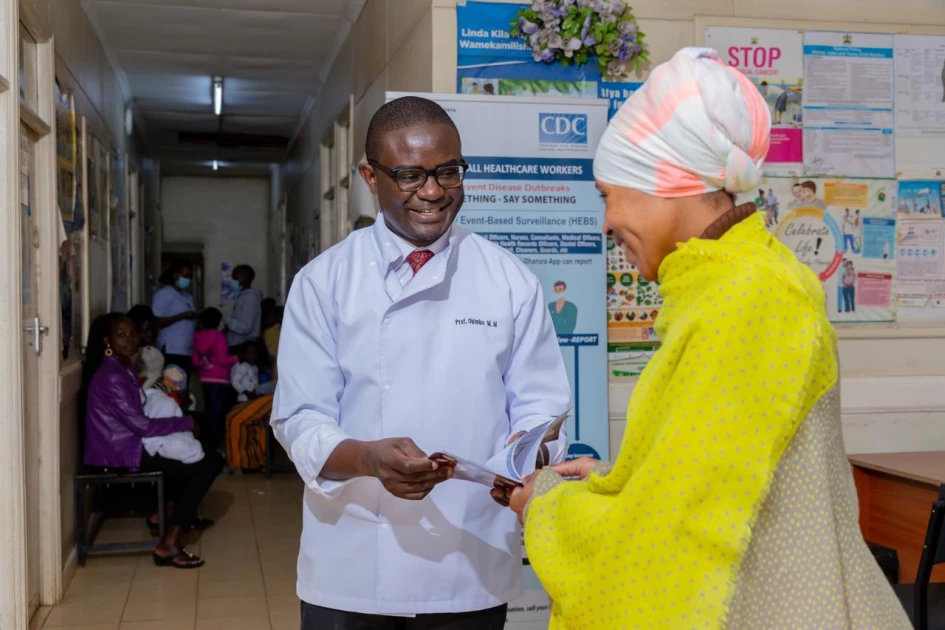
Today, he is a Professor and Chairman of the Department of Human Anatomy and Medical Physiology at the University of Nairobi, where his profound passion for medicine and science carries on daily.
Obimbo grew up in the village at a time when people were grappling with the devastating effects of HIV/AIDS, and this, he says, deeply troubled him.
"While in Primary School down in the village, I used to ask myself if there was nothing people could do to make a difference in these people's lives because every so often you would hear a neighbour has passed on, and it was just scary and this put in me that inquisitive mind knowing that something can be done to save the situation," he says.
He excelled in sciences at Moi High School, Kabarak and secured admission to study medicine at the University of Nairobi, laying the groundwork for his future. His undergraduate years were marked by exceptional academic performance. He became a teaching instructor in the Department of Human Anatomy and a research assistant at the Kenya AIDS Vaccine Initiative (KAVI), working under the guidance of esteemed professors like Julius Ogeng’o, Job Bwayo, Ndinya Achola, Omu Anzala, and Walter Jaoko.
During his studies, a pivotal realization struck him: "The health of the mother determines human generational health."
This profound insight captivated him, steering his focus towards maternal research. While initially exploring this interest through essays and HIV/AIDS vaccine development, his commitment to understanding how a mother's health impacts future generations deepened.
After medical school and internship at Kikuyu and Kiambu hospitals, Obimbo embarked on his first Master of Science in Human Anatomy, mentored by Professors Julius Ogengo and Hassan Saidi.
This marked his entry into rigorous basic science, focusing on reproductive sciences. "I started looking at how the uterus is supplied by blood and how these changes happen in early childhood, puberty, pregnancy, and just adulthood," says Obimbo.
This kind of a starting point paved the way for his PhD, where he further investigated the uterine vascular system in humans and pigs, and later, as a post-doctoral, delved into placenta biology, HIV, and preterm birth at the University of California, San Francisco, alongside his residency in Obstetrics and Gynecology.
In 2021, Obimbo was recognized for his significant contributions when he became one of fourteen African scientists to receive the highly competitive Calestous Juma Science Leadership Fellowship, sponsored by the Gates Foundation.
He says this fellowship allowed him to delve into the vaginal microbiome, studying how these bacteria change during pregnancy and impact outcomes like preterm births, stillbirths, intrauterine growth restrictions, and miscarriages.
His current research involves analyzing data from 1,500 women, employing omics technologies and AI analytics to identify predictive markers and potential therapeutic targets.
"I am trying to figure out if there are some hidden patterns that would be able to help explain why some women have babies soon, why some lose their babies while they are still in the womb, and then I will deploy AI analytics to identify the predictive markers and identify what are these potential therapeutic targets that one can use," he explains.
Beyond the lab, Obimbo remains an active clinical leader, practicing obstetric and gynecologic care, including managing high-risk pregnancies and infertility. This clinical work provides him with firsthand insights into patient challenges, such as recurrent vaginal infections.
"Out of every 10 patients I see in the clinic, maybe three or four will complain of vaginal itchiness, vaginal discharge, foul smell," he notes, emphasizing how these practical problems inspire his laboratory research.
Recognizing that many maternal health challenges extend beyond clinical solutions, Obimbo has transitioned into advocacy.
He said a critical turning point came through discussions with his friend and colleague, Dr. Kireki Omanwa, President of the Obstetrics and Gynaecology Association (KOGS), regarding postpartum hemorrhage (PPH).
PPH is a devastating reality in Kenya, accounting for 35% to 60% of maternal deaths and claiming the lives of 7 to 10 women daily. Globally, it contributes to an estimated 100,000 deaths annually.
"Postpartum haemorrhage is preventable, and it is treatable. So, no one should die because of this particular condition," he states passionately.
He says that this conviction spurred the launch of the Postpartum Haemorrhage Campaign, a movement with four key pillars: advocacy and community engagement, evidence generation and healthcare worker upskilling, health systems strengthening, and data ecosystem strengthening.
A cornerstone of this campaign is the "Run for Her" initiative. The inaugural run in October 2024 at Ulinzi Sports Ground saw over 1,500 participants and reached more than 300,000 people through various campaigns.
Obimbo explains that the event garnered significant support from government officials, including the Cabinet Secretary for Health and several governors, renowned athlete Faith Kipyegon, and various international partners like UNICEF and USAID.
Beyond raising awareness, the run also facilitated the donation of 600 units of blood to hospitals, which is crucial for managing PPH.
"Building on this success, the 'Run for Her' initiative is expanding globally. On September 28, 2025, cities across 10 African countries will hold similar runs, including Kampala, Dar es Salaam, Kigali, and Abuja. The powerful message behind these runs is clear: "We are blocking the roads because we do not have maternal justice. We need our mothers to be treated fairly. We need no woman to die because of preventable causes, especially postpartum haemorrhage," he further explains.
Obimbo, a dedicated team including Dr. Kireki Omanwa, Prof. Julius Ogengo, Prof. Anne Kihara (President of FIGO), Dr. Laura Oyiengo from UNICEF, and Dr. Eunice Atsali from the Midwife Association of Kenya, is leading this charge.
Their ambitious goal is to reduce maternal mortality from PPH by more than half within the next five years through policy changes, clinician training, and evidence-based management.
Despite his extensive commitments, Prof. Obimbo continues to teach and mentor students at the University of Nairobi. He runs the Obimbo Lab, where young and experienced researchers collaborate on various aspects of women's reproductive health, including HPV, microbiome science, and Rhesus disease.
He explains with a laugh that his daily routine is meticulously structured, balancing administrative duties, teaching, clinical practice, and research meetings, and that he also makes time for his family, dedicating Sundays to church and quality time with his wife, who has been the cornerstone of support and his children.
"I spent time with my family in the morning when I drop my children to school, or in the evening when we sit to work on their homework, but then on Sundays, I always take them out after church, and in the evenings, I have made it a tradition to have a barbecue on the grill," he says.
He says he aims to incorporate more personal activities like hiking and, eventually, golf, emphasizing the importance of work-life balance and delegation.
Looking ahead, Obimbo envisions a global movement that ensures "all our women are safe," recognizing that healthy women guarantee healthy future generations. He advocates for a multi-sectoral approach, where clinicians, communities, and policymakers collaborate to address maternal health challenges.
He specifically calls for government investment in heat-stable carbetocin, cold-chain storage for essential medications like oxytocin and the availability of products like balloon tamponades in public hospitals, alongside continuous medical education for healthcare workers.
"Like you can go to a public hospital and realize oxytocin was supplied, but it was not stored well because the fridge was not working, so it is no longer effective, and you cannot give it to a mother because it will not work anyway," he says, adding that the government should provide cold storage at every point of care.
His ultimate hope for the next five years is to see the PPH "Run for Her" become one of the most significant advocacy runs globally. He implores all stakeholders to recognize that women's health is the primary health and commit to supporting women and girls in every aspect of their lives to ensure a healthy future.
Obimbo is committed to ensuring that this advocacy to address this top cause of maternal deaths delivers healthier communities, inspiring us to greatness that lies not in recognition but in service.
Leave a Comment