

What next after Kenya abandoned Ksh.63B IMF disbursement
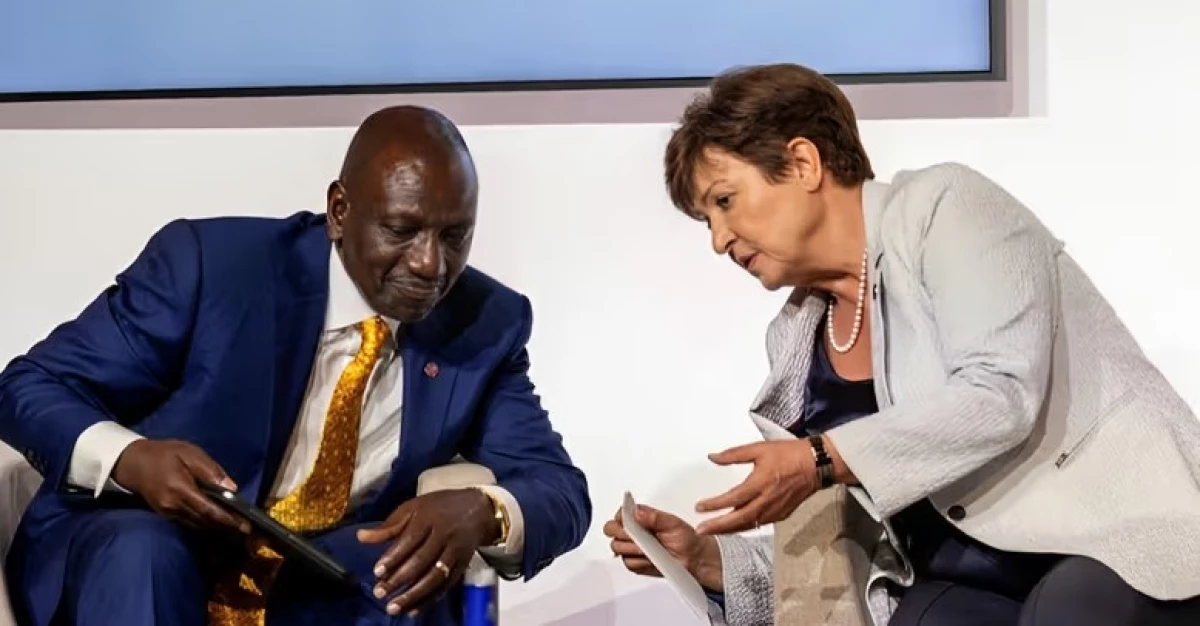
President William Ruto (left) speaks to Kristalina Georgieva, managing director of the IMF at a past forum. PHOTO/COURTESY

Audio By Vocalize
Kenya's decision to terminate the ninth review of the
International Monetary Fund (IMF) program symbolises a radical shift for a
country that has relied on the arrangement since April 2021.
The resolution followed a request from the Kenyan government
to explore a new program that would chart a way forward in the country's
efforts to rebuild its fiscal policies.
This means that the current Extended Fund Facility (EFF) and
Extended Credit Facility (ECF) arrangement will cease, leaving only one active
program; the Resilience and Sustainability Facility (RSF).
The EFF and ECF programs were incorporated to provide
financial assistance to countries facing problems in reducing inflation levels
because of structural issues and hence would require time to rebuild.
The EFF program provides a country four years to restructure
while ECF can be extended to five years.
On the other hand, the RSF program supports a country's
climate agenda.
In April 2021, the IMF entered into an agreement with Kenya to
disburse Ksh.467.5 billion under the EFF/ECF arrangement.
So far, Kenya has accessed Ksh.404 billion, leaving out a gap
of Ksh.63.4 billion that Kenya has foregone following the program's
termination.
Experts have opined that the Kenyan government was backed into
a corner for not meeting the fiscal targets set by the IMF and cited that the
country could have missed out on funds during the ninth review.
"Kenya has not been meeting fiscal targets since 2023 during
the sixth review and only met one out of ten structural benchmarks. Even for a
ninth review and non-adherence to these targets, there's a chance Kenya would
not have received the funds," Churchill Ogutu, an economist with the
financial consulting IC group, told Citizen.Digital
To put it into perspective, Kenya has accessed 89 per cent of
the total amount capped by the IMF, meaning that the aborted ninth review
ensures Kenya still qualifies for more funds in the successive program.
For investors, any country that cuts ties with the IMF stirs
unease in the financial markets. While Kenya has requested a new program with
the Washington-based lender, the terms remain unclear.
A decline in investor confidence can lead to capital flight
and thus a sharp depreciation of the Kenyan shilling.
A weakened shilling means the cost of importing products would
surge. At the same time, the country would face high inflation, raising the
cost of living.
Further, IMF programs keep a country accountable for its
expenses and thus enhance financial discipline by providing economic oversight.
Without it, a country may struggle with economic waste.
Further, it may lead to capital outflows from investors who rely on IMF-backed
programs as a sign of economic stability.
According to Ogutu, Kenya's request for a new program offered
the investors a temporal relief.
"From an investor perspective, a country that has an IMF
program as an anchor assists in providing economic oversight. There was a
knee-jerk reaction from investors but there's a request for a new program to
cool the waters. They are weighing the options of the successor program,"
he pointed out.
Ogutu listed three programs that Kenya may explore in the new
arrangement: financed, non-financed (capacity building) and insurance-based.
He opined that Kenya's best option would be to take the
capacity-building approach that includes hands-on training and peer-learning
opportunities that would aid a country to become self-reliant.
He warned that Kenya may face tougher economic conditions
should it opt for a finance-based program.
"The better option would be to have technical assistance
from the IMF to ensure all delays are no longer there. For a finance-based
program, the bar would have to be raised for Kenya to successfully adhere to
the conditions in the current financial program," he noted.
Leave a Comment