
What does Putin want in Ukraine? The conflict explained

Audio By Vocalize
After
months of military buildup and brinkmanship on its border with Ukraine,
Russia invaded its ex-Soviet neighbor with a multi-pronged attack, threatening
to destabilize Europe and draw in the United States.
A
whirlwind of diplomatic efforts to stave off a Russian invasion in recent weeks
failed to defuse tensions that had mounted over months.
Russia
had been tightening its military grip around Ukraine since last year, amassing
tens of thousands of soldiers, as well as equipment and artillery, on the
country's doorstep.
The
escalation in the years-long conflict between Russia and Ukraine has triggered
the greatest security crisis in Europe since the Cold War. Russia's attacks on
several parts of Ukraine raise the specter of a dangerous showdown between
Western powers and Moscow.
So
how did we get here? The picture on the ground is shifting rapidly, but here's
a breakdown of what we know.
What's
the situation on the border?
Several
areas across Ukraine came under attack on Thursday morning after Russian
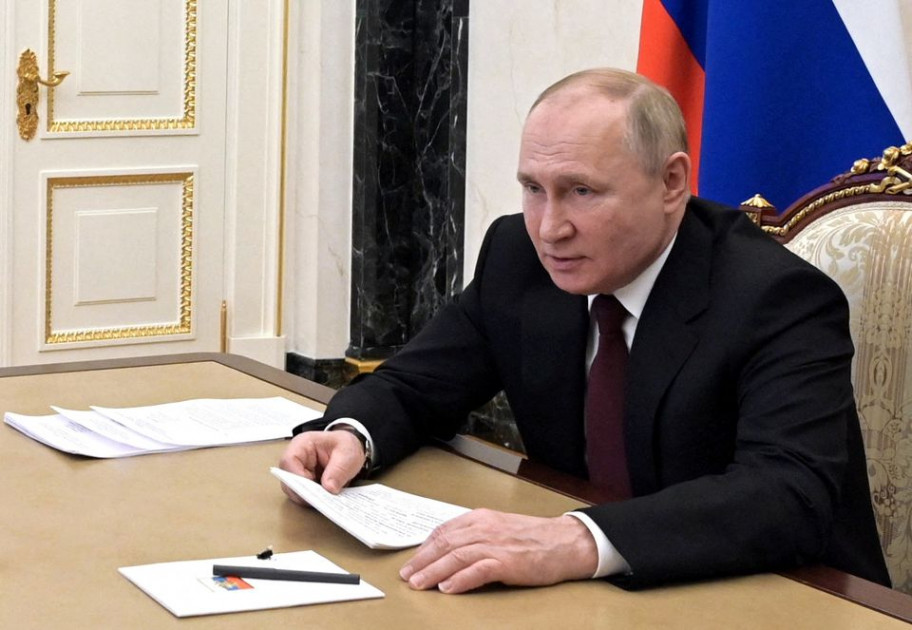
President Vladimir Putin declared the start of a "special military
operation" and warned of bloodshed unless Ukrainian forces lay down their
arms.
The
move came after months of speculation about what Moscow's intentions were with
the troops it had massed on the Ukrainian border. More than 150,000 Russian
troops encircled the country on three sides, like a sickle,
according to estimates from US and Ukrainian intelligence officials.
Some
of those forces began pouring across the border, crossing into Ukraine from the
north in Belarus and to the south from Crimea, according to the Ukrainian State
Border Service. Elsewhere, explosions rang out in multiple cities, including
the capital Kyiv.
The
coordinated assault came days after Putin announced that Moscow
would officially recognize the self-declared Donetsk and Luhansk People's Republics (DNR
and LNR), in eastern Ukraine's Donbas region, ordering the deployment of
Russian troops there in what was widely believed to be the opening salvo to a
broader military confrontation.
The
territory recognized by Putin extended beyond the areas controlled by
pro-Russian separatists, raising red flags about Russia's intended creep into
Ukraine.
Russia
repeatedly denied it was planning an assault, but an escalation in shelling in
eastern Ukraine heightened fears that it could be stoking the violence to justify a wider conflict.
As
the situation on Ukraine's border has intensified, NATO has raised
the readiness of its rapid response force, while member countries put troops on
standby and deployed battalions, planes and ships to the region. The US
ordered 3,000 additional soldiers to be deployed to Poland,
bringing the total number of reinforcements sent to Europe in recent weeks to
about 5,000.
The
US says it has no intention of sending troops into Ukraine, which is not a NATO
member. On Thursday, NATO's secretary general, Jens Stoltenberg condemned the
Russian attack as a "grave breach of international law,
and a serious threat to Euro-Atlantic security."
The
US has unveiled a "first tranche" of new sanctions against Russia,
including on two large financial institutions, the country's sovereign debt,
and Russian elites and their family members.
US
President Joe Biden has vowed the world will "hold Russia
accountable" for the invasion, and is expected to spell out a set of additional sanctions, which were once meant to deter
such an assault.
Biden
and European leaders have previously warned that Russia would suffer serious
consequences should Putin move ahead with a wider invasion. But that has not
stopped Russia from continuing to bolster its military positions.
In
late 2021 and early 2022, satellite images revealed new Russian deployments of
troops, tanks, artillery and other equipment cropping up in multiple locations,
including near eastern Ukraine, Crimea and Belarus, where its forces were
participating in joint drills with Moscow's closest international ally.
Despite
receiving funding, training and equipment from the US and other NATO member
countries, experts say Ukraine would be significantly outmatched by Russia's military, which has been modernized
under Putin's leadership. If an all-out war broke out between the two
countries, tens of thousands of civilians could die and up to 5 million could
be made refugees, according to some estimates.
What
has set the stage for the conflict?
Ukraine
was a cornerstone of the Soviet Union until it voted overwhelmingly for
independence in a democratic referendum in 1991, a milestone that turned out to
be a death knell for the failing superpower.
After
the collapse of the Soviet Union, NATO pushed eastward, bringing into the fold
most of the Eastern European nations that had been in the Communist orbit. In
2004, NATO added the former Soviet Baltic republics Estonia, Latvia and
Lithuania. Four years later, it declared its intention to offer membership to
Ukraine some day in the distant future -- crossing a red line for Russia.
Putin
sees NATO's expansion as an existential threat, and the prospect of Ukraine
joining the Western military alliance a "hostile act" -- a view he
invoked in a televised speech on Thursday, saying that Ukraine's aspiration to
join the military alliance was a dire threat to Russia.
In
interviews and speeches, Putin has previously emphasized his view that Ukraine
is part of Russia, culturally, linguistically and politically. While some of
the mostly Russian-speaking population in Ukraine's east feel the same, a more
nationalist, Ukrainian-speaking population in the west has historically
supported greater integration with Europe.
In
early 2014, mass protests in the capital Kyiv known as Euromaidan forced out a
Russia-friendly president after he refused to sign an EU association agreement.
Russia responded by annexing the Ukrainian peninsula of Crimea and fomenting a
separatist rebellion in Ukraine's east, which seized control of part of the
Donbas region. Despite a ceasefire agreement in 2015, the two sides have not seen a
stable peace, and the front line has barely moved since. Nearly 14,000 people
have died in the conflict, and there are 1.5 million people internally
displaced in Ukraine, according to the Ukrainian government.
In
the eight years since, Moscow has been accused of engaging in hybrid warfare against Ukraine, using cyberattacks,
economic pressure and propaganda to whip up discord. Those tactics have
escalated in recent months, and in early February the State Department claimed
Putin was preparing a false-flag operation to create "a pretext for an
invasion."
What
does Putin want?
In
a lengthy essay penned in July 2021, Putin
referred to Russians and Ukrainians as "one people," and suggested
the West had corrupted Ukraine and yanked it out of Russia's orbit through a
"forced change of identity."
That
type of historical revisionism was on full display in Putin's emotional and
grievance-packed address to the nation on Monday announcing his decision to
recognize the Donetsk and Luhansk People's Republics, while casting doubt on
Ukraine's own sovereignty.
But
Ukrainians, who in the last three decades have sought to align more closely
with Western institutions like the European Union and NATO, have pushed back
against the notion that they are little more than the West's
"puppet."
In
fact, Putin's efforts to bring Ukraine back into Russia's sphere have been met
with a backlash, with several recent polls showing that a majority of
Ukrainians now favor membership of the US-led transatlantic military alliance.
In
December, Putin presented the US and NATO with a list of security demands.
Chief among them was a guarantee that Ukraine will never enter NATO and that
the alliance rolls back its military footprint in Eastern and Central Europe --
proposals that the US and its allies have repeatedly said are non-starters.
Putin
indicated he was not interested in lengthy negotiations on the topic. "It
is you who must give us guarantees, and you must do it immediately, right
now," he said at his annual news
conference late last year. "Are we deploying missiles near
the US border? No, we are not. It is the United States that has come to our
home with its missiles and is already standing at our doorstep."
High-level talks between the West and Russia wrapped in
January without any breakthroughs. The standoff left Europe's leaders to engage
in a frenzy of shuttle diplomacy, exploring whether a negotiating channel
established between France, Germany, Russia and Ukraine to resolve the conflict
in Ukraine's east -- known as the Normandy Format talks -- could provide an
avenue for calming the current crisis.
In
a news conference with the new German Chancellor Olaf Scholz on February 16,
Putin repeated unsubstantiated claims that Ukraine is carrying out a
"genocide" against Russian speakers in the Donbas region and called
for the conflict to be resolved through the Minsk peace progress -- echoing similar rhetoric that was
used as a pretext for annexing Crimea.
But
less than a week later, after Russia's upper house of parliament approved the
deployment of military forces outside the country on February 22, Putin told
reporters that the Minsk agreements "no longer exist," adding:
"What is there to implement if we have recognized these two
entities?"
The
agreements, known as Minsk 1 and Minsk 2 -- which were hammered out in the
Belarusian capital in a bid to end a bloody in eastern Ukraine -- have never
been fully implemented, with key issues remaining unresolved.
Moscow
and Kyiv have long been at odds over key elements of the peace deal, the second of which was inked in 2015 and
lays out a plan for reintegrating the two breakaway republics into Ukraine.
Ukrainian President Volodymyr Zelensky recently stated that he did not like a
single point of the Minsk accords, which require dialogue on local elections in
the Russian-backed separatist regions and -- although unclear in what sequence
-- would also restore the Ukrainian government's control over its eastern
borders. Critics say the agreement could give Moscow undue sway over Ukrainian
politics.
Putin
previously responded in blunt terms by saying that regardless of whether Zelensky
likes the plan, it must be implemented. "Like it or don't like it, it's
your duty, my beauty," Putin said in a news conference alongside French
President Emmanuel Macron. Zelensky, a former comedian and TV star, won a 2019
election in a landslide on promises to end the war in Donbas, but little has
changed. Responding to a question about Putin's stark, undiplomatic language,
Zelensky responded in Russian, saying bluntly: "We are not his."
What
is Ukraine's view?
President
Zelensky previously downplayed the danger of all-out war with Russia, noting
that the threat has existed for years and that Ukraine is prepared for military
aggression. But on Thursday, as Russia launched an assault on his country,
Zelensky made an emotional address directly to the Ukrainian people, declaring
martial law in the country.
"Russia
began an attack on Ukraine today. Putin began war against Ukraine, against the
entire democratic world. He wants to destroy my country, our country, everything
we've been building, everything we are living for," Zelensky said in a
video message posted on his official Facebook page.
In
Kyiv, where Ukrainians had continued to go about their daily business while
Russian troops sat at their borders, the streets were empty on Thursday.
Across
the country, residents have been preparing for the worst -- packing emergency
evacuation kits and taking time out of their weekends to train as reservists.
Ukraine's
government insists that Moscow cannot prevent Kyiv from building closer ties
with NATO, or otherwise interfere in its domestic or foreign politics.
"Russia cannot stop Ukraine from getting closer with NATO and has no right
to have any say in relevant discussions," the Foreign Ministry said in a
statement to CNN.
Tensions
between the two countries have been exacerbated by a deepening Ukrainian energy
crisis that Kyiv believes Moscow has purposefully provoked. Ukraine views the
controversial Nord Stream 2 pipeline -- connecting Russian gas supplies
directly to Germany -- as a threat to its own security.
Nord Stream 2 is one of two pipelines that Russia has
laid underwater in the Baltic Sea -- in addition to its traditional land-based
pipeline network that runs through eastern Europe, including Ukraine. Kyiv
views the pipelines across Ukraine as an element of protection against invasion
by Russia, since any military action could potentially disrupt the vital flow
of gas to Europe.
After
requests from Zelensky and the US administration, German Chancellor Olaf Scholz
said on Tuesday that he would halt the certification of the pipeline following Putin's
decision to order troops into parts of eastern Ukraine.
Nord
Stream 2 is just one of myriad challenges facing Zelensky's
government. The former actor, who played a president on Ukrainian television,
has had a brutal baptism of fire into real-world politics since assuming office
in 2019.
His
government's popularity has stagnated amid multiple domestic political
challenges, including a recent third wave of Covid-19 infections and a
struggling economy.
Many
Ukrainians are unhappy that the government has not delivered on the promises
that brought it into power, including cracking down on corruption in the
country's judicial system. But the more pressing concern is Zelensky's failure
so far to bring peace to the country.
Leave a Comment