

Thousands of Sudanese families flee 7 States fearing arrests
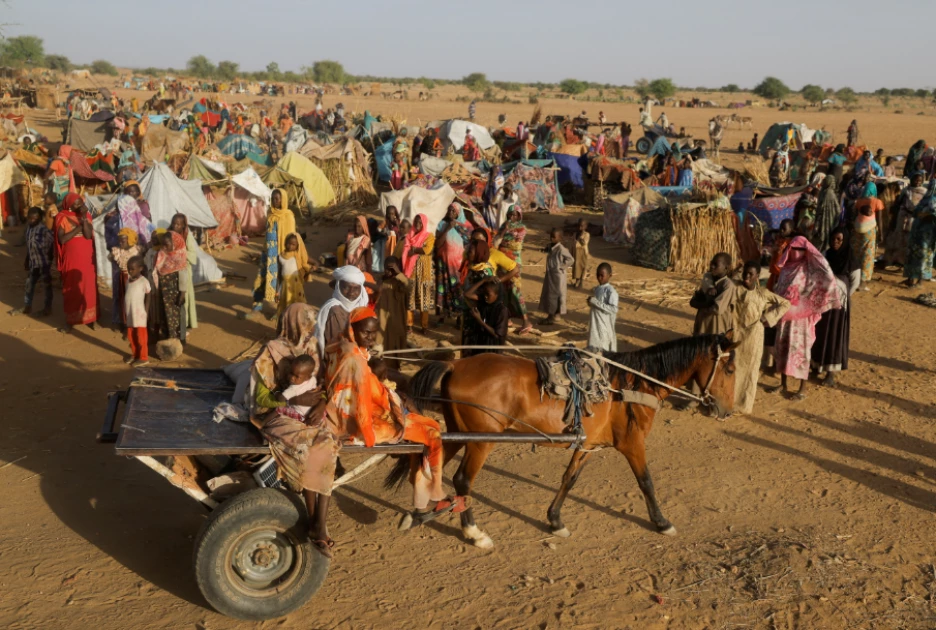
Sudanese refugees who fled the violence in their country, ride a cart as they pass other refugees standing beside makeshift shelters near the border between Sudan and Chad in Koufroun, Chad May 6, 2023. REUTERS/Zohra Bensemra/File Photo

Audio By Vocalize
In recent weeks, Sudan has witnessed a
significant wave of mass displacement, with tens of thousands fleeing seven
different states. The exodus is driven by fears of arbitrary arrests under
accusations of affiliation with the Rapid Support Forces (RSF).
According to the Sudanese National
Observatory for Human Rights, the final days of June saw the displacement of
approximately 343,473 individuals - forming 68,801 families - from 38 areas
across seven states. Many fled in anticipation of prosecution or retaliation,
accused of ties to the RSF.
The Observatory warns that while 44% of
these families found refuge in Gedaref State, over 15,000 remain without
shelter and fear being targeted.
Reports continue to emerge of
violations against civilians in areas under the control of the army and its
allied Islamist militias. These include swift sham trials on political charges
that often culminate in ethnic persecution, arbitrary detentions, torture, and
forced displacement.
Mounting accusations have been leveled
at the Sudanese military authorities and the Al-Baraa bin Malik militia in
Khartoum, alleging a coordinated plan to forcibly displace the Nubian
population from their ancestral lands.
Bulldozers operated by local
authorities reportedly demolished 806 homes in Abu Riel neighborhood, Omdurman,
a move widely condemned as ethnic cleansing under a veneer of legal
justification.
A report by the Ru’a Media Center cites
sources claiming that the demolitions are part of a covert strategy devised by
leaders of the Islamic Movement - an arm of Sudan’s Muslim Brotherhood - to
expel Nubians from northern states in order to "Islamize and secure"
strategic regions.
According to the same sources, the
directive came from high-level circles within the National Congress Party to
engineer a new demographic reality serving separatist agendas.
Sultan Hassan Musa, paramount chief of
the Nubian people, stated that “the Islamists’ bulldozers destroyed our
ancestral homes while Nubian sons fight on the front lines in the army.” He
accused the Brotherhood of repaying this loyalty with forced displacement.
A leaked document from the National
Congress Party’s ‘High Security Committee’ reportedly contains secret
instructions to expedite the demolition of Nubian areas under the pretext of
zoning violations. The document, signed by the acting deputy governor of
Khartoum in charge of land affairs - a known figure in the Islamic Movement’s
inner circle - also stipulates that alternative housing be offered exclusively
to Islamist loyalists.
In testimonies from the displaced,
former soldier Naji Osman Dawoud (54) said legal documents proving ownership of
the destroyed properties were burned at gunpoint. Dr. Mona Abdelqader recounted
that members of the Al-Baraa bin Malik militia, operating under army
protection, looted their belongings.
International human rights
organizations have condemned the demolitions. Observers have also noted the
complicity of some northern tribes in facilitating the expulsions, which
coincided with public statements from Islamist leaders calling for the
"securing" of the capital and the withdrawal of Nubians from the
army.
Military analyst Taha Osman warned in the
Ru’a Media Center report that these actions risk igniting a northern civil war
and could lead to a revolt by Nubian officers within the military ranks.
The report concludes with a stark
warning: "While the Islamic Movement proclaims that no voice should rise
above the sound of battle, it continues to dismantle Sudan, stone by stone.
This time, at the very heart of the capital, Khartoum."
One of the many civilians affected by
ongoing violations in Sudan is university student Doha Shuaib, who was forcibly
and arbitrarily detained without formal charges or a court appearance
throughout her incarceration.
The Sudanese National Observatory for
Human Rights described her arrest, allegedly for collaboration with the RSF, as
further evidence of the systemic abuses committed by the military and its
Islamist allies in territories under their control.
According to the Observatory, detainees
often face severe conditions during custody, including enforced disappearance
and inhumane treatment, clear violations of international law and the basic
principles of justice.
Although the so-called Omdurman-Karrari
Criminal Court ordered the release of 23-year-old Doha, a student at Nilein
University, citing insufficient evidence, her case remains emblematic of a
broader culture of impunity. Releases like hers occur without acknowledgment of
wrongdoing or reparations for the victims, raising serious concerns about the
persistent absence of accountability.
The Observatory has called on both
domestic and international human rights bodies to launch independent
investigations into arbitrary detention practices and unlawful releases, to
hold perpetrators accountable, and to ensure such abuses are not repeated.
According to ‘Madamik’ newspaper, Doha
was arrested in early January from a displacement shelter on Tuti Island and
spent six months behind bars, including two weeks at the Karrari security
detention center, where she faced charges of undermining the state and
threatening national security. She was later transferred to Al-Thawra Police
Station in District 11, and ultimately to the Women’s Prison in Omdurman.
Numerous women’s organizations - including
the Unified Feminist Coordination, the Democratic Women’s Union, and No to
Women’s Oppression - as well as the Emergency Lawyers and Democratic Lawyers’
Association, issued statements denouncing her arrest and demanding her
immediate release.
Leave a Comment