

South Korean presidential guards prevent arrest of impeached Yoon after tense stand-off
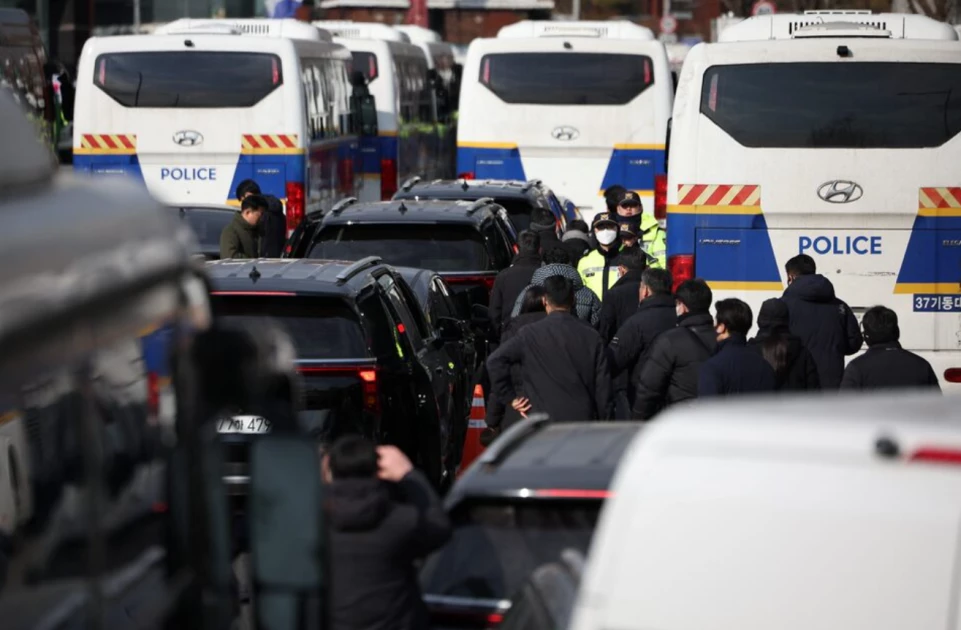
Police officers and investigators leave impeached South Korean President Yoon Suk Yeol's official residence, as investigators were unable to execute an arrest warrant on Friday for Yoon according to the Corruption Investigation Office for High-ranking Officials, in Seoul, South Korea, January 3, 2025. REUTERS/Kim Hong-Ji

Audio By Vocalize
South Korea's presidential guards and military troops
prevented authorities from arresting impeached President Yoon Suk Yeol on
Friday in a tense six hour stand-off inside Yoon's compound in the heart of
Seoul.
Yoon is under criminal investigation for insurrection over his
Dec. 3 martial law bid that stunned South Korea and lead to the first arrest
warrant to be issued for a sitting president.
"It was judged that it was virtually impossible to
execute the arrest warrant due to the ongoing standoff," the Corruption
Investigation Office for High-ranking Officials (CIO) said in a statement.
The CIO officials and police evaded hundreds of Yoon
supporters who gathered in the pre-dawn hours near his residence on Friday,
vowing to block the arrest "with our lives".
Some chanted "President Yoon Suk Yeol will be protected
by the people," and called for the head of the CIO to be arrested.
Officials from the CIO, which is leading a joint team of
investigators into possible insurrection charges related to Yoon's brief
declaration of martial law, arrived at the gates of the presidential compound
shortly after 7 a.m. (2200 GMT Thursday) and entered on foot.
Once inside the compound, the CIO and police were outnumbered
by cordons of Presidential Security Service (PSS) personnel, as well as
military troops seconded to presidential security, a CIO official told
reporters.
As many as 200 formed a human chain to block the CIO and
police, the official added.
South Korea's Ministry of National Defense said the troops
were under the control of the PSS.
The CIO called off the effort to arrest Yoon around 1:30 p.m.
due to concerns over the safety of its personnel due to obstruction, and said
it "deeply regretted" Yoon's attitude of non-compliance.
Insurrection is one of the few criminal charges from which a
South Korean president does not have immunity.
His arrest warrant, approved by a court on Tuesday after Yoon
ignored multiple summons to appear for questioning, is viable until Jan. 6.
Yoon has been isolated since he was impeached and suspended
from power on Dec. 14.
In a statement after the arrest effort was suspended, Yoon's
legal team said the CIO had no authority to investigate insurrection and it was
regrettable that it had tried to "forcibly execute an illegal and invalid
arrest and search warrant" in a sensitive security area.
The statement warned police against supporting the arrest
effort.
The interim head of Yoon's People Power Party welcomed the
suspension and said the investigation must be carried out without detaining
Yoon.
The current warrant gives investigators only 48 hours to hold
Yoon after he is arrested. Investigators must then decide whether to request a
detention warrant or release him.
Yoon sent shockwaves through Asia's fourth-largest economy and
one of the region's most vibrant democracies with his late-night announcement
that he was imposing martial law to overcome political deadlock and root out
"anti-state forces".
Within hours, however, 190 lawmakers had defied the cordons of
troops and police to vote against Yoon's order. About six hours after his
initial decree, Yoon rescinded it.
He later issued a defiant defence of his decision, saying
domestic political opponents are sympathetic to North Korea and citing
uncorroborated claims of election tampering.
Two South Korean military officials, including army chief Park
An-su who was named martial law commander during the short-lived declaration,
have been indicted after being detained by prosecutors investigating
insurrection charges, Yonhap reported on Friday.
Kim Yong-hyun, who resigned as Yoon's defence minister after
playing a major role in the martial law decree, has been detained and was
indicted last week on charges of insurrection and abuse of power.
Separate from the criminal investigation, his impeachment case
is currently before the Constitutional Court to decide whether to reinstate or
permanently remove him. A second hearing in that case is scheduled for later on
Friday.
Leave a Comment