

Shakahola massacre: Digital forensics, DNA, witnesses deepen case against Mackenzie
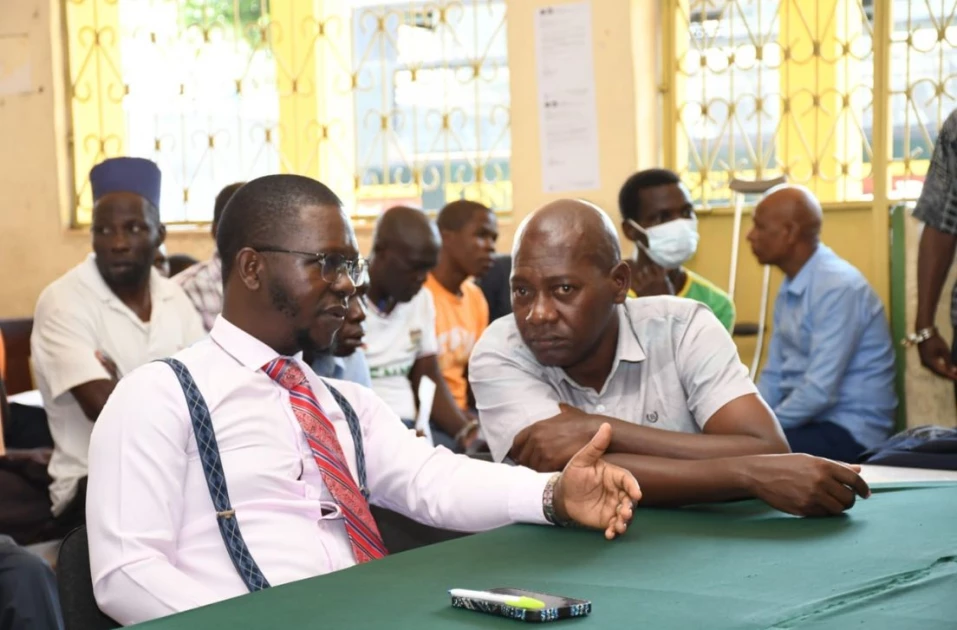
Paul Mackenzie confers with his lawyer when he appeared before Principal Magistrate Nelly Chepchirchir at the Tononoka Children’s Court on September 16, 2025. Photo/ODPP

Audio By Vocalize
The Office of the Director of Public Prosecutions (ODPP) lined
up four more witnesses on Tuesday, September 16, to reveal harrowing details of
alleged abuses carried out by controversial preacher Paul Nthenge Mackenzie and
35 co-accused individuals.
According to the prosecution, Mackenzie and the other suspects
are facing grave charges including child cruelty, torture, and denial of
education, in connection with the Shakahola massacre.
Appearing before Principal Magistrate Nelly Chepchirchir at
the Tononoka Children’s Court, one of the witnesses, Maxwell Kisienya, Director
of Bridge International Academy in Lungalunga, recounted the disappearance of a
student, identified as S.B.B., who was last seen at the school in October 2017.
According to Kisienya, the child had attended the school for
two years but failed to return after being sent home due to unpaid school fees.
No transfer request was ever submitted, and the child's whereabouts have
remained unknown.
The prosecution also provided digital evidence from Police
Constable Joseph Mwai, a Digital Forensics Expert attached to the
Anti-Terrorism Police Unit, which showed photos of several malnourished
individuals at the Shakahola forest.
Further, Government Pathologist Dr. Richard Njoroge, who
conducted post-mortem examinations on bodies recovered from mass graves in
Shakahola, told the court that due to advanced decomposition, most of the
bodies had deteriorated into skeletal remains, making it difficult to determine
the cause of death in many cases.
However, in several instances, he confirmed that starvation
appeared to be the likely cause, noting extreme loss of body mass relative to
height.
Dr. Njoroge also testified that teeth, bones, and nail samples
were collected from the 453 exhumed bodies, and DNA tests have helped relatives
to identify some of the victims.
Chief Inspector Job Wafula Wanyonyi, who was among the first
responders to Shakahola, also described the harrowing conditions he encountered
during a fact-finding mission on April 13, 2023.
The inspector also revealed that dozens of people were found
confined in makeshift shelters, many too weak to stand or speak.
Among those rescued was a minor, identified as C.A.A., who
reported being forced to fast until near death. Despite rescue efforts, four
individuals, two men and two women, died during the operation.
In his testimony, he added that several individuals were
guarding the confined areas, armed with crude weapons such as rungus (clubs)
and jembes (hoes).
The hearing continues on Wednesday, September 17, with more
witnesses expected to take the stand.
Leave a Comment