

Rock collected in 1972 space mission reveals moon's age
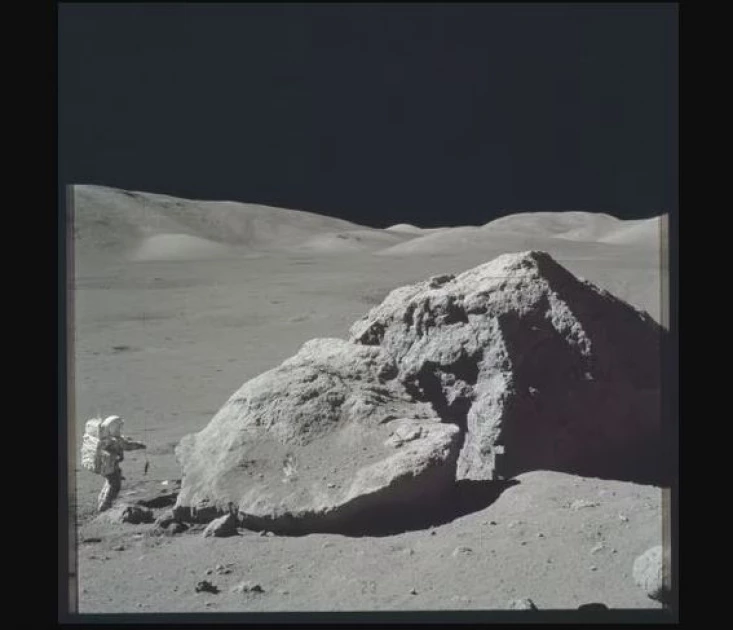
Scientist-astronaut Harrison Schmitt is photographed standing next to a huge, split boulder during the third Apollo 17 extravehicular activity (EVA) at the Taurus-Littrow landing site on the moon during the Apollo 17 mission in this December 13, 1972 NASA handout photo.REUTERS/NASA/Handout via Reuters/File Photo Acquire Licensing Rights.

Audio By Vocalize
A half-century later, crystals of the mineral zircon inside a coarse-grained igneous rock fragment collected by Schmitt are giving scientists a deeper understanding about the moon's formation and the precise age of Earth's celestial partner.
The moon is about 40 million years older than previously thought - forming more than 4.46 billion years ago, within 110 million years after the solar system's birth, scientists said on Monday, based on analyses of the crystals.
The leading hypothesis for lunar formation is that during the solar system's chaotic early history a Mars-sized object called Theia slammed into primordial Earth. This blasted magma - molten rock - into space, forming a debris disk that orbited Earth and coalesced into the moon. But the exact timing of the moon's formation has been hard to nail down.
Mineral crystals were able to form after the magma cooled and solidified. The researchers used a method called atom probe tomography to confirm the age of the oldest-known solids that formed after the giant impact, the zircon crystals inside the fragment of a type of rock called norite collected by Schmitt.
"I love the fact that this study was done on a sample that was collected and brought to Earth 51 years ago. At that time, atom probe tomography wasn't developed yet and scientists wouldn't have imagined the types of analyses we do today," said cosmochemist Philipp Heck, senior director of research at the Field Museum in Chicago, a University of Chicago professor and senior author of the study published in the journal Geochemical Perspectives Letters.
Leave a Comment