
Middle East airspace shut after Israel strikes Iran, airlines cancel flights
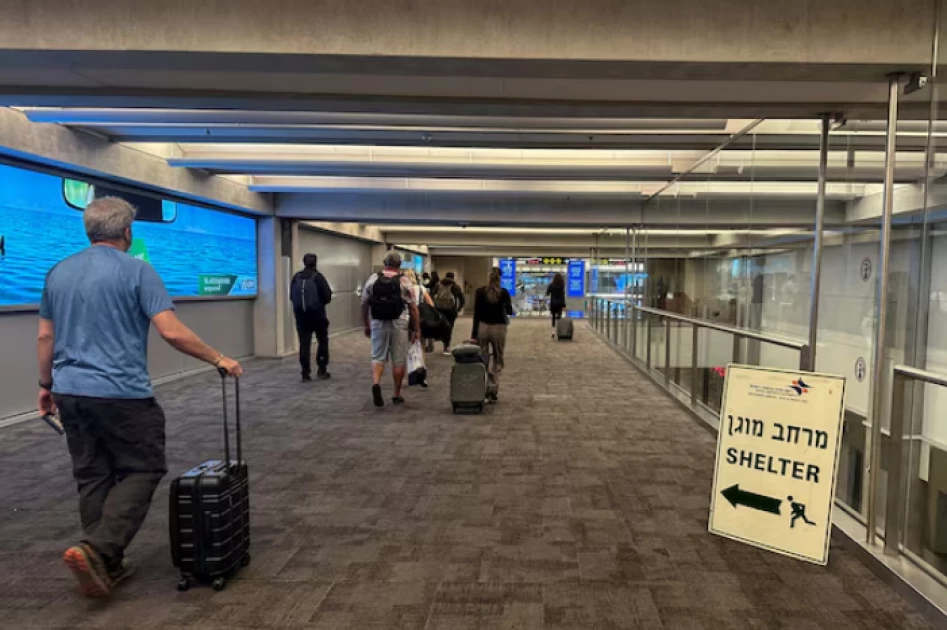
People walk next to a sign directing for Shelter after landing in Israel at the arrivals section of Ben Gurion International airport in Lod near Tel Aviv, Israel October 11, 2023 REUTERS/Marius Bosch/File Photo

Audio By Vocalize
Airlines steered clear of much of the Middle East on Friday
after Israeli attacks on Iranian sites forced carriers to cancel or
divert thousands of flights in the latest upheaval to travel in the region.
Proliferating conflict zones around the world are becoming
an increasing burden on airline operations and profitability, and more of
a safety concern. Detours add to airlines' fuel costs and lengthen journey
times.
Israel on Friday said it targeted Iran's nuclear
facilities, ballistic missile factories and military commanders at the start of
what it warned would be a prolonged operation to prevent Tehran from building
an atomic weapon.
Tel Aviv's Ben Gurion Airport was closed and Israel's air
defence units stood on high alert for possible retaliatory strikes from Iran.
Israel's El Al Airlines said it had suspended flights to and
from Israel as did Air France KLM and budget carriers Ryanair and Wizz
Wizz said it had re-routed flights affected by closed
airspace in the region for the next 72 hours. Israeli airlines El Al, Israir
and Arkia were moving planes out of the country.
FlightRadar data showed airspace over Iran, Iraq and Jordan
was empty, with flights directed towards Saudi Arabia and Egypt instead.
About 1,800 flights to and from Europe had been affected so
far on Friday, including approximately 650 cancelled flights, according to
Eurocontrol.
With Russian and Ukrainian airspace closed due to war, the
Middle East region has become an even more important route for international
flights between Europe and Asia.
The escalation of the Middle East conflict knocked shares
in airlines around the world with British Airways owner IAG down 4.6%,
Delta Air Lines down 4%, and Ryanair off 3.5%. A surge in oil prices after
the attack also stirred concerns about jet fuel prices.
Many global airlines had already halted flights to
and from Tel Aviv after a missile fired by Yemen's Houthi rebels towards Israel
on May 4 landed near the airport.
Iranian airspace has been closed until further notice,
according to state media and notices to pilots.
Air India, which flies over Iran on its Europe and North
American flights, said several flights were being diverted or returned to their
origin, including ones from New York, Vancouver, Chicago and London.
Germany's Lufthansa (LHAG.DE), said its flights to
Tehran have been suspended and that it would avoid Iranian, Iraqi and Israeli
airspace for the time being.
Emirates (EMIRA.UL) also cancelled flights to and from Iraq,
Jordan, Lebanon, and Iran while Qatar Airways axed flights to Iran, Iraq and
Syria.
Iraq early on Friday closed its airspace and suspended all
traffic at its airports, Iraqi state media reported.
Eastern Iraq near its border with Iran contains one of the
world's busiest air corridors, with dozens of flights crossing between Europe
and the Gulf, many on routes from Asia to Europe, at any one moment.
Jordan, which sits between Israel and Iraq, also closed its
airspace several hours after the Israeli campaign began.
Russia's civil aviation authority Rosaviatsia said it had
instructed Russian airlines to stop using the airspace of Iran, Iraq, Israel
and Jordan until June 26. It said flights to airports in Iran and Israel were
also off limits for civil carriers. FlyDubai has cancelled 22 flights scheduled
for June 13-14 to Dubai from 10 Russian airports, Russia's RIA news agency
said, citing Rosaviatsia.
"Traffic is now diverting either south via Egypt and
Saudi Arabia, or north via Turkey, Azerbaijan and Turkmenistan," according
to Safe Airspace, a website run by OPSGROUP, a membership-based organisation
that shares flight risk information.
The Israeli-Palestinian conflict in the Middle East since
October 2023 led to commercial aviation sharing the skies with
short-notice barrages of drones and missiles across major flight paths – some
of which were reportedly close enough to be seen by pilots and passengers.
Six commercial aircraft have been shot down unintentionally
and there have been three near misses since 2001, according to aviation risk
consultancy Osprey Flight Solutions.
Last year, planes were shot down in Kazakhstan and in Sudan.
These incidents followed the downing of Malaysia Airlines flight MH17 over
eastern Ukraine in 2014 and of Ukraine International Airlines flight PS752 en
route from Tehran in 2020.
Join the Discussion
Share your perspective with the Citizen Digital community.
No comments yet
This discussion is waiting for your voice. Be the first to share your thoughts!