
Mbadi defends controversial remarks on free education, maintains Gov't can’t sustain full capitation
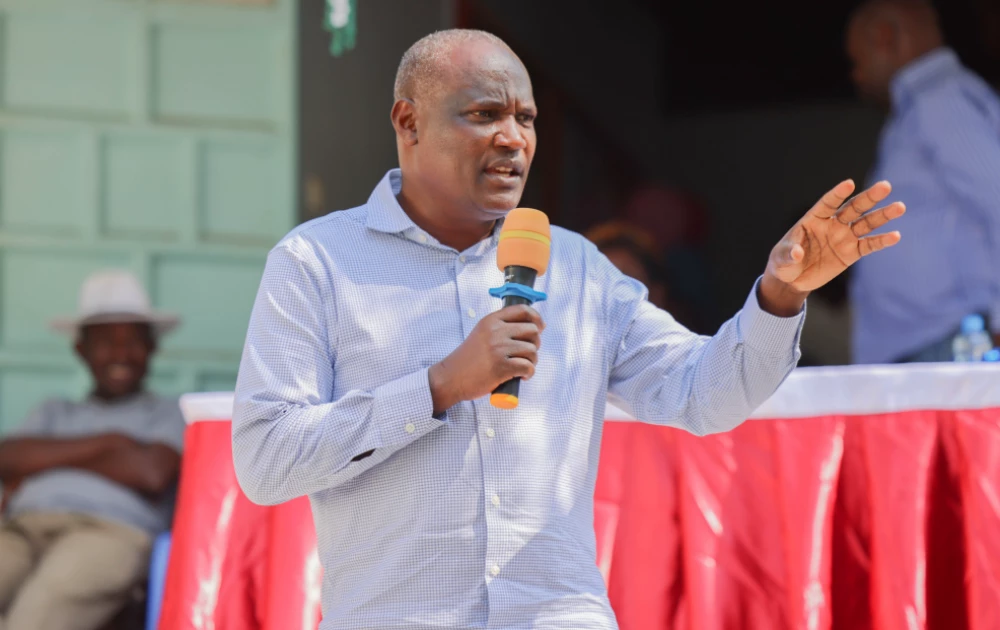
Treasury CS John Mbadi speaks when he presided over a thanksgiving ceremony at God Oloo Secondary School in Suba South, Homa Bay County, on July 25, 2025. PHOTO | COURTESY

Audio By Vocalize
Treasury Cabinet Secretary John Mbadi has stood his ground over recent
controversial remarks suggesting that the government can no longer fully fund
free primary and secondary education, insisting that Kenya’s budgetary
limitations make it impossible to achieve full capitation for every learner.
Mbadi attracted criticism
when he appeared before a Parliamentary committee on Thursday and said that the financial burden of free education is too heavy for the State to sustain, intimating that
parents will soon be forced to dig deeper into their pockets.
In an address aimed at clarifying his earlier position, Mbadi maintained
that while education remains a key government priority, the current financial
muscle cannot meet the full cost per student — a reality he accuses some
leaders of conveniently ignoring.
“For the ten years (Mwai) Kibaki was a President, he never attempted to
start or introduce free secondary education,” Mbadi said on Friday during a
thanksgiving ceremony at God Oloo
Secondary School in Suba South, Homa Bay County.
The Treasury CS directly tackled a narrative that credits the late
retired President Kibaki’s administration with the rollout of free secondary education,
noting that it is instead his predecessor Uhuru Kenyatta who initiated the now
too heavy cross to bear.
“I hear people say that Kibaki was able to teach or have our children
learn for free; it is not true. He made sure that our children went to school
for free in primary schools. For secondary school, it is President Uhuru Kenyatta
who started this initiative. At first it was subsidized secondary school. Then
later he announced that it should be free day secondary school,” he said.
Mbadi detailed that under the current model, as introduced by Uhuru,
government policy stipulates Ksh.22,000 per student annually in senior secondary
schools, Ksh.15,000 for junior secondary, and Ksh.1,400 for primary school
learners.
However, he admitted that the government has consistently fallen short
of meeting the full Ksh.22,000 mark due to funding gaps.
“Since the introduction of free day secondary school, the government has
not been able to give or allocate every student Ksh.22,000. The government has
always been having debts for schools. That is why you hear principals saying
they have not received full capitation,” he noted.
“But let me tell you this, the government disburses the whole amount
allocated in the budget, but still it is not enough. So, the only thing I did was
to confirm that, Yes, we have allocated so much budget and we’re giving it in
full, but it is not enough to give every child in Kenya Ksh.22,000.”
He blamed Parliament for contributing to the shortfall, claiming MPs had
slashed the capitation budget even further in the latest financial year.
“I was wondering, when MPs were asking me why I’ve not released
Ksh.22,000 per student. I asked them where do I get that money? It is them who
passed the budget,” Mbadi stated.
“In fact, the latest budget, even the capitation we had put, Parliament
reduced it further. So, once a budget has been allocated, where do I get money
to pay the full Ksh.22,000?”
The CS said that despite full payments being made for Term One and Term
Two this year, the amount disbursed translates to only about Ksh.17,000 per
student — far below the official benchmark.
As a potential remedy, he proposed rechanneling bursary funds from the
National Government Constituency Development Fund (NG-CDF) towards bridging the
Ksh.5,000 per student capitation deficit.
According to him, 40% of the NG-CDF which is earmarked for bursaries by
law — amounting to about Ksh.21 billion — could be redistributed to cover the
shortfall nationally, thus ensuring full fees are paid without individual
students having to petition MPs for bursaries.
However, he claims the suggestion was met with resistance from lawmakers:
“When they heard that, hapo hawataki!”
Mbadi’s remarks come in the wake of uproar from education stakeholders,
teachers’ unions, parents, and MPs who accused him of jeopardizing access to
basic education.
Critics argued that any admission by the government that it can’t
sustain free education amounts to walking back on one of the country’s most
transformative social policies.
Nonetheless, Mbadi insists he is not backing down from stating “the
truth,” and that it’s time leaders and citizens alike confronted the hard facts
of the country’s financial realities.
“In Kenya sometimes people don’t want to hear facts, they like fiction,
they like to be misled, they like people who are telling them what they want to
hear. We have a shortfall, and that is a fact,” he maintained.
However, Basic
Education Principal Secretary Julius Bitok on Friday clarified that free
primary and secondary education will not be scrapped, addressing widespread
concerns sparked by Mbadi’s remarks.
Speaking at St. Thomas Girls Secondary School in Kilifi, PS Bitok
explained that the government will lobby Parliament to bridge the funding gap
for capitation and national examinations.
“I
want to assure the country that the policy on free primary and secondary
education has not changed. The government will continue financing education
through capitation as it has been over the years," he said.
He added that
despite allocating the ministry a historical Ksh.702 billion in the current
financial year, the funds don't match the funding needs required in the
education sector.
“Growing
demand means we must work even harder to ensure these investments reach every
learner, especially through capitation. We are continuing to engage Parliament
so that we get the required resources to support education in this
country," Bitok noted.
The PS further
defended CS Mbadi's remarks, citing that they were taken out of context.
Leave a Comment