

Israeli strike kills hungry Gaza family in their sleep
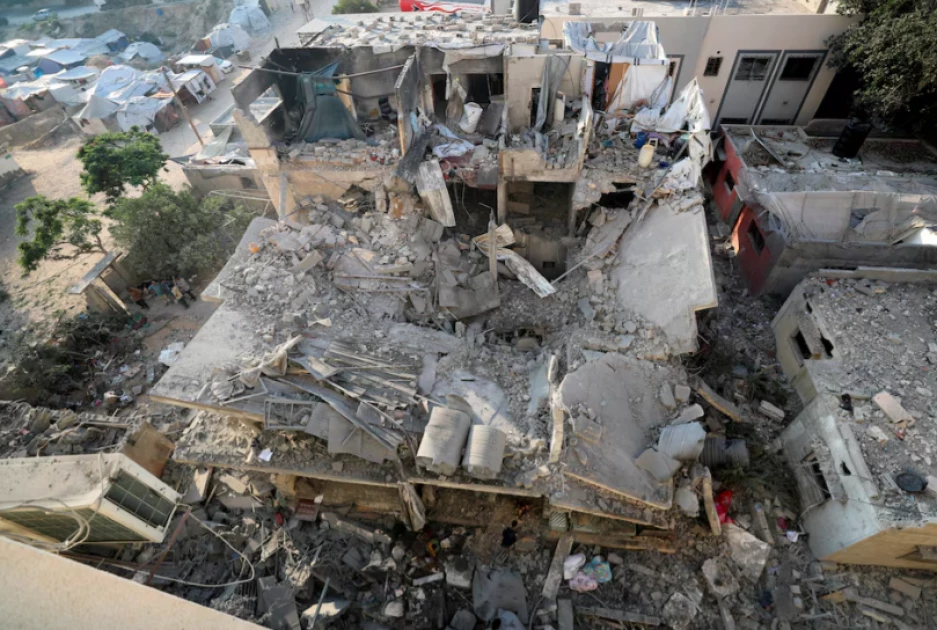
Debris lies at the site of an overnight Israeli air strike on a house, in Gaza City, July 23, 2025. REUTERS/Mahmoud Issa

Audio By Vocalize
The Al-Shaer
family went to bed hungry at their home in Gaza City. An Israeli airstrike
killed them in their sleep.
The family - freelance journalist Wala al-Jaabari, her husband and their five children - were among more than 100 people killed in 24 hours of Israeli strikes or gunfire, according to health officials.
Their corpses lay in
white shrouds outside their bombed home on Wednesday, with their names scribbled
in pen. Blood seeped through the shrouds as they lay there, staining them red.
"This is my
cousin. He was 10. We dug them out of the rubble," Amr al-Shaer, holding
one of the bodies after retrieving it.
Iman al-Shaer, another
relative who lives nearby, said the family hadn't eaten anything before the
bombs came down. "The children slept without food," he said.
The Israeli military
did not immediately comment on the strike at the family's home, but said its
air force had struck 120 targets throughout Gaza in the past day, including
"terrorist cells, military structures, tunnels, booby-trapped structures,
and additional terrorist infrastructure sites".
Relatives said some
neighbours were spared only because they had been out searching for food at the
time of the strike.
Ten more
Palestinians died overnight from starvation, the Gaza health ministry said,
bringing the total number of people who have starved to death to 111, most of
them in recent weeks as a wave of hunger crashes on the Palestinian
enclave.
The World
Health Organisation said on Wednesday that 21 children under the age of five
were among those who died of malnutrition so far this year. It said it had been
unable to deliver any food for nearly 80 days between March and May and that a
resumption of food deliveries was still far below what is needed.
In a statement on
Wednesday, 111 organisations, including Mercy Corps, the Norwegian Refugee
Council and Refugees International, said mass starvation was spreading even as
tons of food, clean water and medical supplies sit untouched just outside Gaza,
where aid groups are blocked from accessing them.
Israel, which cut
off all supplies to Gaza from the start of March and reopened it with new
restrictions in May, says it is committed to allowing in aid but must control
it to prevent it from being diverted by militants. It says it has let enough
food into Gaza during the war and blames Hamas for the suffering of Gaza's 2.2
million people.
Israel has also
accused the United Nations of failing to act in a timely fashion, saying 700
truckloads of aid are idling inside Gaza. "It is time for them to pick it
up and stop blaming Israel for the bottlenecks which are occurring,"
Israeli government spokesman David Mercer said on Wednesday.
The United Nations
and aid groups trying to deliver food to Gaza say Israel, which controls
everything that comes in and out, is choking delivery, and Israeli
troops have shot hundreds of Palestinians dead close to aid
collection points since May.
"We have a
minimum set of requirements to be able to operate inside Gaza," Ross
Smith, the director of emergencies at the U.N. World Food Programme, told
Reuters. "One of the most important things I want to emphasise is that we
need to have no armed actors near our distribution points, near our
convoys."
The war between
Israel and Hamas has been raging for nearly two years since Hamas killed some
1,200 Israelis and took 251 hostages from southern Israel in the deadliest
attack in Israel's history.
Israel has since
killed nearly 60,000 Palestinians in Gaza, decimated Hamas as a military force,
reduced most of the territory to ruins and forced nearly the entire population
to flee their homes multiple times.
U.S. Middle East
peace envoy Steve Witkoff is expected to hold new ceasefire talks, travelling
to Europe this week for meetings on the Gaza war and a range of other issues, a
U.S. official said on Tuesday.
Talks on a proposal
for a 60-day ceasefire between Israel and Hamas, which would include the
release of more of the 50 hostages still being held in Gaza, are being mediated
by Qatar and Egypt with Washington's backing.
Successive rounds of
negotiations have achieved no breakthrough since the collapse of a ceasefire in
March.
A senior Palestinian
official told Reuters Hamas might give mediators a response to the latest
proposals in Doha later on Wednesday, on the condition that amendments be made
to two major sticking points: details on an Israeli military withdrawal, and on
how to distribute aid during a truce.
Israeli Prime
Minister Benjamin Netanyahu's cabinet includes far-right parties that oppose
any agreement that ends without the total destruction of Hamas.
"The second I
spot weakness in the prime minister and if I come to think, heaven forbid, that
this is about to end with us surrendering instead of with Hamas's absolute
surrender, I won’t remain (in the government) for even a single day,"
Finance Minister Belalel Smotrich told Army Radio.
Leave a Comment