

Iraq faces deadlock after 'West-friendly' candidate suspended
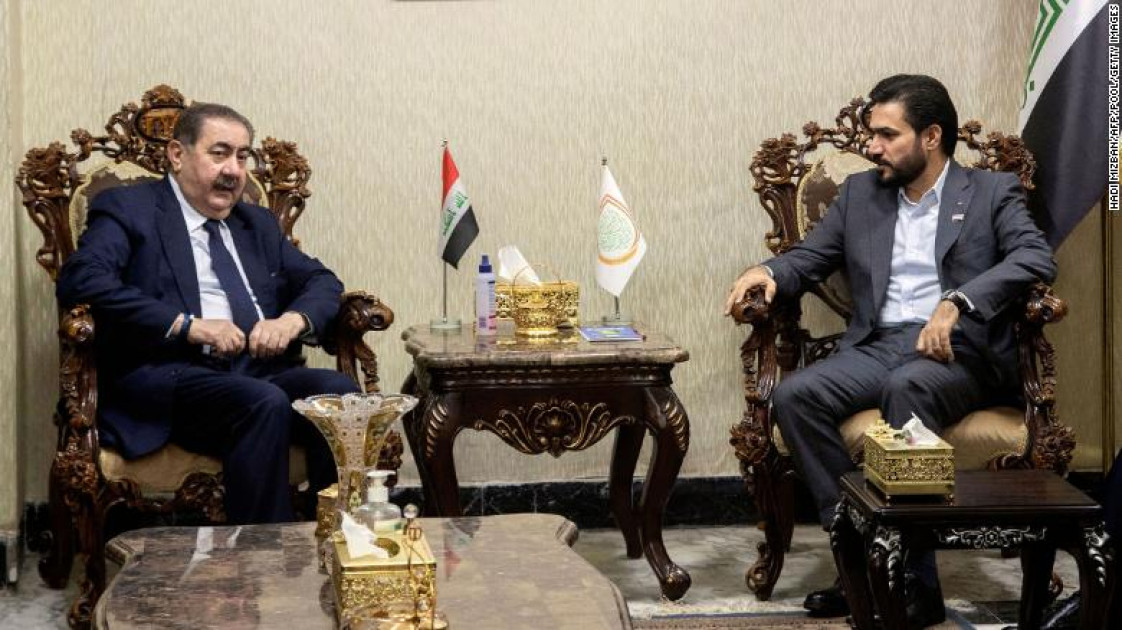
Hoshyar Zebari (L), leader of Iraq's Kurdish delegation to post-election negotiations, meets Hassan al-Adari, head of the political body of the Sadrist bloc, in Baghdad on November 5.

Audio By Vocalize
But a bid to crown his political career with a run for the presidency faced a major hurdle last week when Iraq's federal court suspended his candidacy due to past corruption charges, causing an election delay that risks exacerbating existing factional divisions.
The presidential election was indefinitely postponed on Monday, stalling the already delayed formation of a new government. The results of October's parliamentary vote, in which pro-Iran factions were dealt a significant loss, were only confirmed in December due to political bickering over the results. A new president would be tasked with asking the winning bloc to form a government.
The suspension was a blow to the ambitions of Zebari's key backer Moqtada al-Sadr, the populist Shiite Muslim cleric who has emerged as a kingmaker and is bent on pushing through a government that excludes his pro-Iran Shiite rivals.
Sixty-eight-year-old Zebari was seen as a friend of the west and was known as a successful negotiator. But his political career took a turn in 2016 when, as finance minister, he was accused of corruption and mishandling of public funds. Zebari denied the allegations.
According to the post-Saddam system of governance in Iraq, the Kurdish minority assumes the presidency, while Shiites run the premiership and the Sunnis take the position of parliament speaker.
Since 2005, the Kurdish Democratic Party (KDP)'s rival Patriotic Union of Kurdistan (PUK) has occupied the ceremonial position based on an understanding that the PUK would take Iraq's presidency while the KDP would rule the autonomous region of Iraqi Kurdistan. Zebari was running against PUK's incumbent President Barham Saleh.
But the KDP's clout in the Baghdad parliament has grown of late, emboldening the party and winning it new allies like Sadr. The revival of graft allegations has however rattled Zebari's Shiite and Sunni backers, dampening his prospects for the presidency. Sadr, who emerged as the biggest winner in the October election after having campaigned on an anti-corruption platform, had to withdraw his support. It's unclear if the KDP will field another candidate that's acceptable to Sadr or stand by Zebari.
Sadr reiterated his call for a government of national majority on Tuesday, after meeting Esmail Qaani, head of Iran 's powerful Islamic Revolutionary Guard Corps' Quds Force. "Neither eastern nor western, a government of national majority," he said on Twitter. The slogan was reminiscent of the 1979 Iranian revolution motto "Neither Eastern nor Western - Islamic Republican." Iran celebrates the 43rd anniversary of its Islamic revolution this month.
If Sadr gets his way and the bloc he leads elects a president of its liking, Iraq could have a government that has quite a different approach to Iran. But the idea of an Iraqi government devoid of Iran's Shiite allies won't sit well in Tehran, and those prospects risk a backlash from pro-Iran groups, many of whom are heavily armed.
Leave a Comment