

IPOA: Police deployed in protests did not display name tags or service numbers
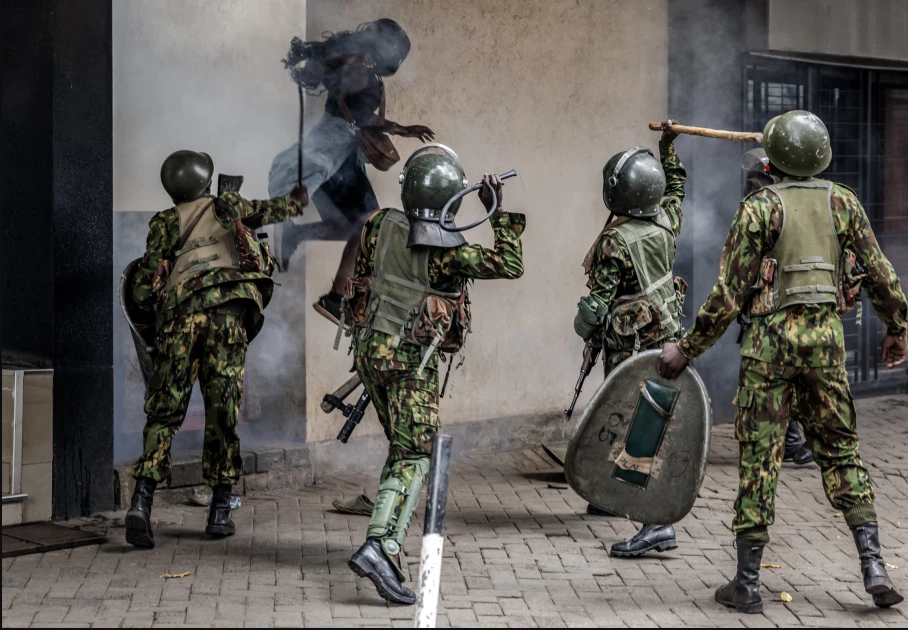
A protester jumps for safety as she emerges from a narrow alley while Kenya police officers strike her with whips and clubs during clashes in downtown Nairobi on June 25, 2025 during a planned day of protest marking the first anniversary of the storming of the parliament. Marches in Kenya to mark a year since massive anti-government demos turned violent on Wednesday, with two killed and running battles between protesters and police, who flooded Nairobi's streets with tear gas and sealed off government buildings with barbed wire. (Photo by Luis TATO / AFP)

Audio By Vocalize
A report by the
Independent Policing Oversight Authority (IPOA) has revealed that police
officers deployed during recent protests over the death of Albert Ojwang’ in
custody operated without displaying name tags or service numbers, in violation
of Kenyan law.
The July 2025
report, which covers a series of demonstrations held in June and July 2025,
raises concerns about police transparency, accountability, and the excessive
use of force in the handling of public protests.
The first protest,
held on June 12 in Nairobi, was organized to demand justice for Ojwang’, whose death in police custody remains under investigation.
Although IPOA
found no evidence that the protest organizers formally notified the Central
Police Station as required under the Public Order Act, the demonstration was
largely peaceful, with no reported injuries or arrests.
Despite this, the
National Police Service (NPS) deployed both uniformed and plainclothes officers
armed with firearms, teargas, and batons.
Officers also used
vehicles to block access to Harambee Avenue, Parliament Road, City Hall Way,
and the National Treasury.
According to the
report, IPOA observers noted that none of the deployed officers displayed
identification, contrary to Schedule Six of CAP 84 of the Laws of Kenya.
Even more
troubling was the presence of civilians in plainclothes armed with whips,
suggesting irregular or unregulated involvement in crowd control efforts.
A second wave of protests occurred on June 17 in both Nairobi and Mombasa, demanding action
against Kenya Police Service Deputy Inspector General Eliud Lagat.
According to the
IPOA, in Nairobi, officers from the General Service Unit (GSU), Critical
Infrastructure Protection Unit (CIPU), and General Duty divisions were deployed
in full riot gear, and some police vehicles had concealed number plates.
Plainclothes
officers were again observed. During this protest, Boniface Mwangi Kariuki
sustained a gunshot wound and later died in hospital.
IPOA investigated
the incident and forwarded the case to the Director of Public Prosecutions, and
one officer—Klinzy Masinde Barasa—was subsequently charged in Criminal Case No.
010 of 2025.
No police injuries
were reported, although IPOA observed individuals infiltrating the protest
wielding wooden sticks and crude weapons.
The report paints
a broader picture of escalating violence and police mismanagement across
multiple counties during protests in June and July.
As of July 23,
IPOA had documented 65 civilian deaths, 342 injuries to civilians, and 171
injuries to police officers.
However, the
police officially reported only five of these deaths to IPOA, undermining
oversight efforts and violating legal obligations.
The Authority
attended 61 autopsies and confirmed that investigations are ongoing for the
remaining cases.
Notably, the
report criticizes the police for failing to intervene in counter-protests, and
for treating most protests as riots rather than lawful assemblies protected
under Article 37 of the Constitution.
The report further
indicates widespread destruction of public and private property was observed
during the protests, including the burning of police stations in Kirinyaga,
Nyandarua, and Nairobi, and vandalism of banks, supermarkets, and government
buildings in counties such as Meru, Embu, Kiambu, Nairobi, and Nakuru.
In Meru, IPOA
reported the looting of Magunas Supermarket and the destruction of vehicles and
hospitality facilities.
In Embu, Red Cross
and KRA vehicles were destroyed, and numerous financial institutions and
businesses were looted. Similar patterns of damage were documented in Makueni,
Bungoma, Kakamega, Kisii, Kiambu, and Kajiado, with police appearing
overwhelmed in some areas.
The report also
highlights severe shortcomings in protest policing.
According to the
report, IPOA monitors found no evidence that police provided medical aid or
deployed ambulances during demonstrations, as required under the Sixth Schedule
of CAP 84.
Officers were not
supplied with meals, water, or allowances, raising welfare concerns.
The IPOA posits
that the use of unmarked vehicles, concealed license plates, and the absence of
proper identification impeded accountability.
In some instances,
police used live ammunition and excessive force while failing to prevent
looting and property destruction. Only in Mombasa did IPOA observe a relatively
professional and rights-respecting approach to crowd control.
IPOA criticized
gaps in the Public Order Act, including the lack of recognition for counter-protests
and spontaneous demonstrations, and documented cases where commanding officers
refused to receive protest notifications—contrary to the law, which mandates
written explanations for such refusals.
To mitigate this,
the Authority has called for urgent police reforms.
It recommends that
all officers deployed to public protests display their names and service
numbers and that the Inspector General of Police ensure all vehicles and assets
used during such operations are clearly marked.
IPOA is urging the
adoption of body-worn cameras and the use of video recordings during protests
to support transparent investigations and evidence-based prosecutions.
Additionally, it
calls for the deployment of medical personnel and ambulances, proper welfare support
for officers, and the creation of a Public Hospital Security Unit to protect
healthcare facilities during high-risk operations.
The report further
advises the Inspector General, in collaboration with Parliament, to develop a
comprehensive public order management policy that clarifies the legal
thresholds for lawful assembly, encourages dialogue with protest organizers,
and promotes collaboration with civil society.
It also calls for
a national civic education campaign on the right to protest, supported by
stronger community policing structures and operational County Policing
Authorities.
NPS has also been
urged to initiate transparent recruitment to address the declining
police-citizen ratio, currently at 1:600 against the recommended 1:450.
Leave a Comment