
IGAD charts new path for agricultural resilience through soil health and fertilizer reform

Audio By Vocalize
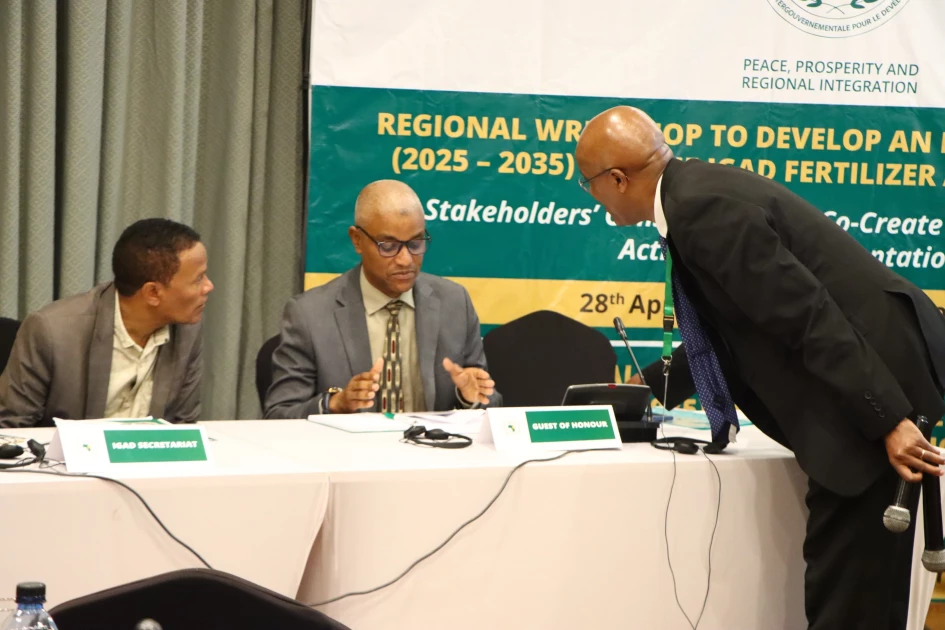
The initiative brings together agricultural experts and representatives from IGAD member states to chart a regional response to declining soil fertility and low farm productivity.
Delivering the keynote address on behalf of Kenya’s Agriculture Principal Secretary, Rashid Khator Secretary of Administration at the Ministry of Agriculture, emphasized the hub’s importance in addressing critical agricultural challenges in East Africa.
He noted that improving soil health and optimizing fertilizer use will be central to enhancing food security and agricultural productivity across the region.
“Agriculture plays an important role in the economic development of our region, contributing between 25% and 42% of national GDP and employing more than 70% of the workforce. Yet, the sector faces persistent challenges, including low farm-level productivity and limited tradable surpluses,” said Khator.
He highlighted that fertilizer application rates in Sub-Saharan Africa remain far below global standards, averaging under 20 kg per hectare compared to a global average of 135 kg. Kenya fares slightly better at 34 kg per hectare, but still lags behind the global benchmark.
“This gap underscores the urgent need to address soil fertility constraints across the continent, particularly as staple crops like maize reflect the state of national food security,” he added.
The Nairobi meeting follows the recent Africa Fertilizer and Soil Health Summit, which produced the Nairobi Declaration and a 10-Year Action Plan to tackle soil degradation, promote fertilizer production, and deliver customized agronomic recommendations tailored to diverse crops and soils across Africa.
Speaking on behalf of IGAD’s Executive Secretary Dr. Workneh Gebeyehu, Dr. Eshete Dejen, IGAD’s Environment Programme Manager and Blue Economy Coordinator, called for urgent, collective action to reverse soil degradation and promote sustainable farming practices.
“Agriculture remains the backbone of our economies, but we are steadily losing our most vital resource — our soil. This is a decisive moment to adopt responsible strategies, such as promoting organic fertilizers and precision farming, to protect soil health for future generations,” said Dr. Dejen.
Dr. Senait Regassa, IGAD’s Food Systems Resilience Programme Coordinator, explained that the write-shop builds on a commitment made at last year’s African Union Summit on fertilizer and soil health.
“The ultimate goal is to sustainably manage our soils to ensure food security for all while adapting to the region’s changing climate,” she noted.
Also weighing in, Dr. Sylvia Henga, IGAD’s Policy and Food Security Expert, emphasized the need to embrace technological innovation and strengthen regional partnerships.
“We’re not just doing this for ourselves — we’re safeguarding the future of farming in this region,” she stated.
The Fertilizer and Soil Health Hub is one of IGAD’s flagship initiatives aimed at promoting sustainable agricultural practices, climate-smart farming, and innovations in fertilizer and soil management tailored to the region’s diverse ecological zones.
By linking soil health and fertilizer use to food security and nutrition, IGAD hopes to boost agricultural productivity, improve livelihoods, and build resilience against climate shocks in East Africa.
Leave a Comment