

How Nakuru farmers overcame post-election scars to tackle climate-induced hunger
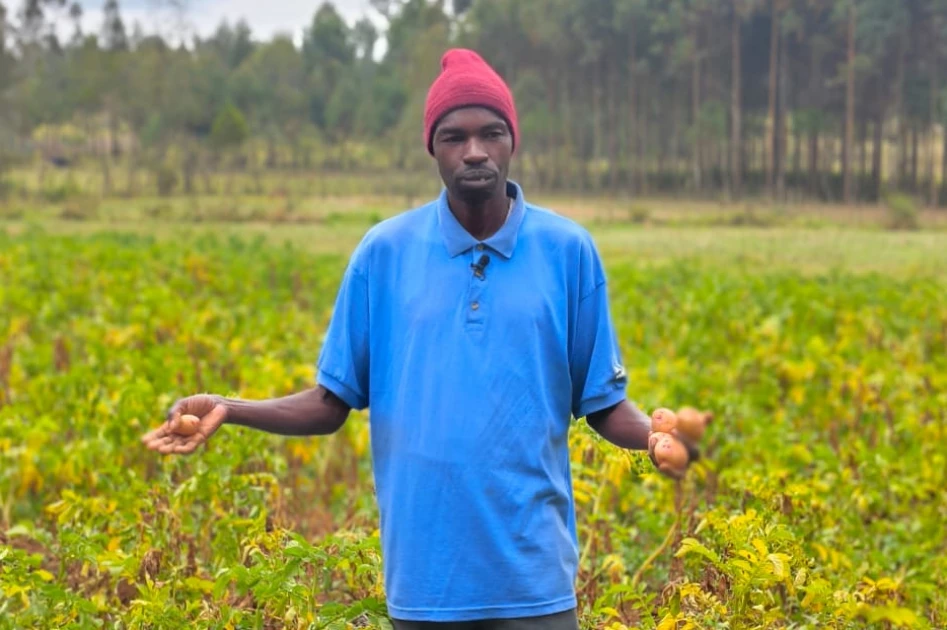
Ezekiel Kirui, an Irish potato seeds farmer in Kuresoi North, Nakuru County.

Audio By Vocalize
Nakuru County was perceived as a hotspot following the 2007-2008
a post-election skirmishes. The political unrest was largely attributed to
tribal diversity in the area.
However, 2014 came as a new dawn for the smallholder Irish
potato seed farmers of Kuresoi North, Nakuru County. With help of a hunger
relief organization, the villagers overlooked their past to deal with climate
patterns which no longer fit within their indigenous understanding, and as such
potato production significantly went down; a solution was required promptly. They
came together and formed a cooperative to enable them agree on a collective
survival tactic.
Laureen Mwikali Njuguna, General Manager of the Cooperative,
says; "After experiencing challenges with seeds access and drought, they
decided, why don’t we come together and certify our own potato seed we sell,
but our main target is producing for ourselves, for our own benefit as
smallholder farmers."
In Sigowet village, Kuresoi North, Ezekiel Kirui is mixing up
a piled heap of cow dung. It is an organic manure he uses on his Irish potato
parcels of land in the homestead. Kirui honors our visit as he leads us around
his potato seed farms. He informs us of the joint community owned 8-acre Shangi
breed new generation potato seeds farm, as he discloses the story behind the
decision to farm in unity.
"Our cooperative was born after the 2007-2008 post-election
violence, some hunger relief non-governmental organization on the ground then
advised on the need for merging all the small farmer groups in Kamara ward. We
became one and decided to form Starlight Cooperative, which then made it easy
for trainings, not only on surviving climate effects on farming but also on
coexisting with one another," he said.
Kirui says that the cooperative, with over 900 members, is a
host and a representation of almost all Kenyan tribes who have intermarried and
are now focusing on co-existing while fighting the global warming effects on
their agricultural farms. The good news is that the cooperative has since
graduated to form a members sacco.
In 2018, the farmers had a boost of resources when they onboarded
Climate Resilient Agribusiness for Tomorrow (CRAFT) project by a non-governmental
organization in partnership with the Kenya Plant Health Inspectorate Service
(KEPHIS) advocating for climate effects survival tactics in the grassroots.
Jane Kilel, a widow, is among farmers who joined the
cooperative in 2018 to partake the training resources which had just been availed.
Jane was a housewife when her husband passed on, she had to get new generation
farming skills to improve on her yields in order to take care of her children.
Up until 2018, the mother of four says she struggled to grow
potatoes the best way she learnt from her past generation; at times when the
village expected showers, it failed, leaving her confused with her ready to
plant farms. Her labour, in most cases, had no returns. It took her time to
realise that something had changed from the norm.
Inconsistencies in weather patterns, soil fertility to
emerging pests required professional scientific know-how; for a while, she
thought that someone had bewitched her farms.
"I could not provide basics like enough food and clothing
for myself and my children, leave alone provision for their studies," said
Jane.
In her homestead is a number of land subdivisions planted with
food crop varieties, from Irish potatoes, maize, kales, among others like dairy
cattle, she confirms that currently she does crop rotation as one way to
improve soil fertility and increase yields.
Jane draws our attention to an eighth of her piece of land. The
parcel is nourishing with greenery. It is her Irish potato seeds farm. The
seeds she sells to her fellow villagers.
"You see, I have divided my parcels to accommodate
various crops. Apart from this seed farm, I have another one which is specific
for Irish potatoes which I sell for food, but this one I sell myself. Remember
the cooperative only gets us buyers for the jointly owned farm. Apart from the
money shared from the joint earnings, the cash I get from my own sales helps me
with so many things. I will be clearing these stems in a week's time to pave
the way for the seed tubers to mature for another one month in readiness for
harvesting,” she says.
“This is an eighth of an acre, I am expecting roughly 20 bags of
potato seeds of 50kg each. Potato seeds sell at Ksh.4,000 per sack, compared to
the Ksh.2,400 a sack of food potatoes. The harvest will go a long away as it
will settle the loan I took at the cooperative sacco to buy my dairy cows. I
will also have money to settle my last born's school fees; if she clears her
studies, she will be the fourth doctor in my house, all my children are in the
medical field. Before I got trained, I would hardly reap even 5 bags of
potatoes from the same parcel of land."
New generation seeds have in the past faced criticisms from
various quarters in the country, with KEPHIS accused of staging roadblocks for
indigenous seed banks while adopting foreign seeds improvement technology to
exploit local farmers to benefit a few rich individuals in the country and
foreign businesses.
Cooperative General Manager Laureen Mwikali Njuguna says; "Farmers
are free to do indigenous seeds which can still do well in this soil despite
the unpredictable weather conditions and other factors, but for potatoes our
focus is on certified seeds because we have seen the benefit."
The Irish potato crop is originally from Ireland and it is not
Kenyan indigenous.
The cooperative members contributed finances and with support
from their partners, they have in place some of the best farm machines among
them, a high tech Chisel plough which is well designed to break up compacted
soil layers to promote easy water infiltration into the soil. It also offers
minimal soil disturbance hence reduced soil erosion. The machine promotes
conservation of crop residue on the surface, and it doesn’t use a lot of fuel,
hence reducing the carbon waste released into the atmosphere compared to some
plough types.
The chisel also has the ability to tackle hardpan (a
compacted, hardened layer of soil) paving way for rain water infiltration deep
into the soil. The soil will temporarily store the water for some time, making
crops to survive longer in the event of failed rains.
Also in use is a multiple use potato planter machine with the ability
to plow, plant, apply fertilizer and harvest, making potato farming much
easier.
According to Kelvin Ng'etich, a youth representative in the
cooperative, healthy soil structure with good drainage is crucial for tuber
development as poor drainage will lead to waterlogging that will result in root
rot.
Kevin advices that it is good to check soil alkalinity or
acidity as different levels affect nutrients but can be adjusted if necessary to
suit the specific needs of potato variety. Also, analysing soil health helps
them identify potential disease and pest issues that could affect the crop, allowing
advance preventive measures to be put in place.
"We prefer improved shangi potato because it can stand
different climatic strains, it can even do well in semi-arid areas as long as
you irrigate the farm; and we employ surface planting method in our Irish
potato farms. Surface planting involves placing the tubers in shallow furrows
in the soil, this method reduces labour costs and ensures minimal soil
disturbance. It also protects farms from pest spread because once planted, no
weeding is needed," explained Kelvin.
Nakuru is among Kenyan counties that supply the country's
population with Irish potatoes, due to its originally known cool climates which
favors the tubers growth.
The county is known for large scale potato production. Nevertheless,
the unpredictable weather patterns that significantly change climatic
conditions has with time greatly affected the production, rendering famers,
moreso smallholder farmers, with an option of finding ways to survive the
climate change crisis.
This has become an open call for agricultural sector in Kenya together
with partners to stand up and support sustainable initiatives at grassroot
level to curb the climate change risks posed.
Leave a Comment