
How a 1936 treaty could force Turkey to take sides in the Ukraine war
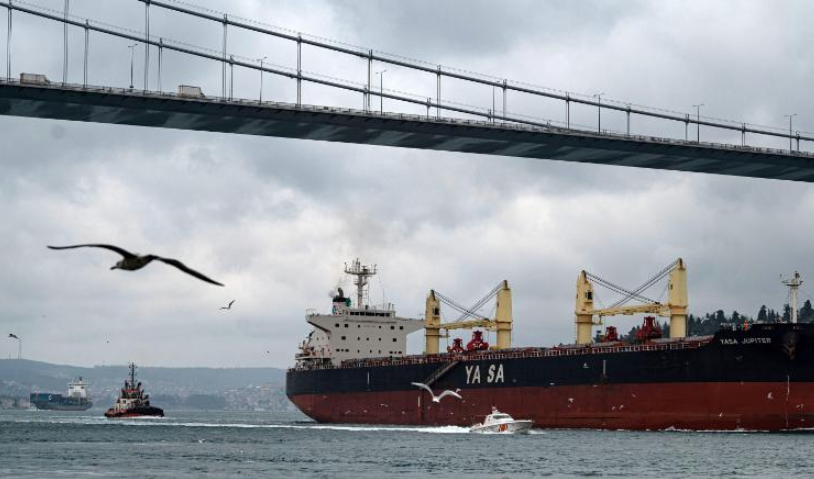
The Marshall Islands-flagged Turkish-owned Yasa Jupiter ship, which was hit by a missile off the coast of Ukraine's port city Odessa, sails on the Bosphorus in Istanbul, Turkey, on February 25.

Audio By Vocalize
Turkey
has officially labeled Russia's invasion of Ukraine as a war, in a move that experts said could potentially hinder
some of Moscow's military activities in the region.
On
Thursday, Russian forces launched a land, sea and air assault on Ukraine in the
biggest attack by one state against another in Europe since World War Two.
Ukraine's
ambassador to Turkey Vasyl Bodnar went on local television last week and
appealed for the government in Ankara to close its key straits to Russian
warships under provisions of the 1936 Montreux Convention. Turkey said it could
only do so if it officially recognized the conflict as a war, and on Sunday,
that's what it did.
Here's
how it happened and what it means for the war:
The
convention gives Turkey certain control over the passage of warships from the
Dardanelles and Bosphorus Straits that connect the Aegean, Marmara, and Black
Sea.
In
peace time, warships can pass the straits by prior diplomatic notification with
certain limitations on the weight of the ships and arms they carry -- and
depending on whether the ship belongs to a Black Sea nation or not. And at
times of war, Turkey can bar the passage of the warships of belligerent parties
from crossing.
According
to the convention, if Turkey is a party to the war or considers itself
threatened with imminent danger, it can shut down the straits to the passage of
warships.
Both
Russia and Ukraine lie on the Black Sea, along with Romania and NATO members
Bulgaria and Georgia. Turkey can limit the transit of Russian warships from the
Mediterranean to the Black Sea through its straits under the Montreux
Convention, but the pact has a caveat: belligerent states' warships can cross
if they are returning to their base of origin.
"If
the ship of the war country will return to its port, an exception is made. We
will implement all the provisions of Montreux with transparency," said
Turkish Foreign Minister Mevlut Cavusoglu, adding that the exception should not
be abused.
The
move would only be symbolic, said Mustafa Aydin, president of the International
Relations Council of Turkey.
"Russia
has enough firepower in the Black Sea that it doesn't make
sense for NATO countries to [enter]," he said. "Russia has complete
supremacy on the water."
But
if the war drags on, Moscow may feel the heat, since Russia had already
completed its naval buildup in the Black Sea by shifting units from the Baltic
Sea ahead of the start of hostilities, said Serhat Guvenc, professor of
international relations at Istanbul's Kadir Has University.
Earlier
in February, six Russian warships and a submarine transited the Dardanelles and
Bosphorus straits to the Black Sea for what Moscow called naval drills near
Ukrainian waters.
"They
[Russia] probably have enough resources to sustain their naval power in the
Black Sea for about two to three months," he said. "But if conflict
drags on, it'll be a different story."
Guvenc
said he hadn't expected Turkey to take a decision so soon, but Ukrainian
President Volodymyr Zelensky "put Ankara on the spot" by prematurely
thanking Turkey on Twitter for its support.
Turkey
has said that it has historically respected the treaty and will continue to do
so.
Guvenc
said it's in Ankara's interest to do so because the treaty supports Turkey at
times of war. Any exception made to please Russia could jeopardize the treaty's
credibility in the long run.
"The
United States is very interested in the idea of unrestricted freedom of
navigation through the Turkish straits, as is the case with other waterways
like the Suez and Panama canals," he said. A deviation from the convention
would give the US "a legitimate reason to question Turkey's status as the
watchdog of Montreux."
Turkey
has a maritime border with both Ukraine and Russia on the Black Sea and views
both countries as friendly. Ankara relies on Russia for tourism and natural gas
but also has close economic and defense ties to Ukraine and has, despite
Russian objections, sold drones to the country.
The
Soviet Union, the Russian state's predecessor, was one of the original
signatories of the Montreux Convention.
"Russia
knows the intricacies of the politics and the law and would have been prepared
for such an eventuality," said Guvenc. Moscow, however, may not have
expected Ankara to act on the treaty so soon, he added.
"Turkey
can sell this move as purely observing an obligation under international
law," he said, but the move may be an indication of where Turkey may lean if
the conflict drags on. "Turkey has decided to align more with its
traditional allies in NATO and the European Union, and a bit away from
Russia".
Join the Discussion
Share your perspective with the Citizen Digital community.
No comments yet
This discussion is waiting for your voice. Be the first to share your thoughts!