

Documents expose differences over U.S. peace drive for Ukraine
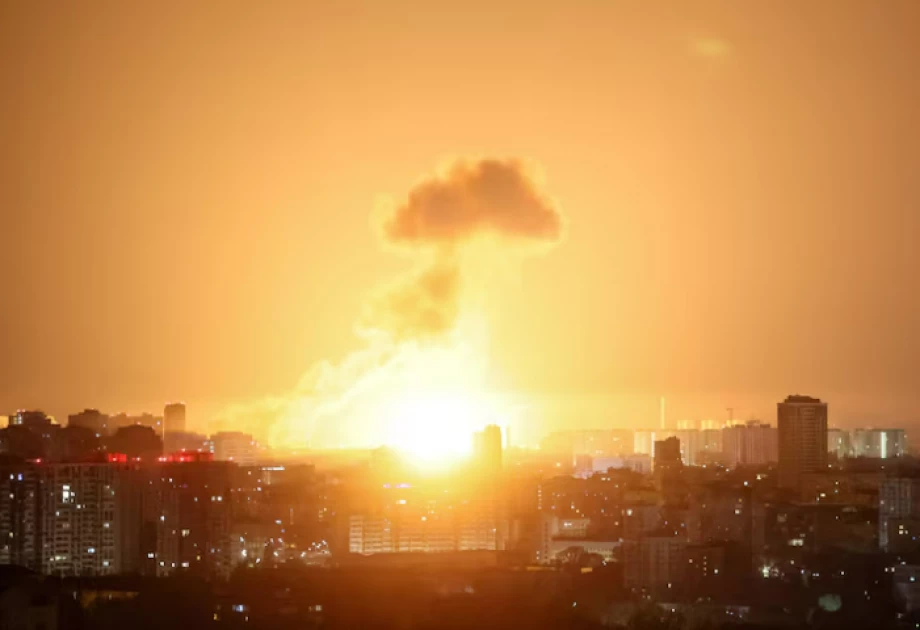
An explosion of a ballistic missile lights up the sky over the city during a Russian missile and drone strike, amid Russia's attack on Ukraine, in Kyiv, Ukraine April 24, 2025. REUTERS/Gleb Garanich/File Photo

Audio By Vocalize
Ukrainian and European officials pushed back this week
against some U.S. proposals on how to end Russia's war in
Ukraine, making counterproposals on issues from territory to sanctions,
according to the full texts of the proposals seen by Reuters.
The sets of proposals from talks between U.S., European and Ukrainian officials in Paris on April 17 and in London on April 23 laid bare the inner workings of the shuttle diplomacy underway as U.S. President Donald Trump seeks a quick end to the war.
The primary areas of difference in the two texts are over
the sequencing for resolving questions over territory, the lifting of sanctions
on Russia, security guarantees and the size of Ukraine's military.
While some of the divergences have been highlighted by
sources close to the talks, the documents seen by Reuters set out for the first
time the differences in full and explicit detail.
The first
text says it's "terms represent the final offer from the United States
to both sides". It contains proposals set out by Trump's envoy Steve
Witkoff to European officials in Paris that were passed to the Ukrainians,
according to sources close to the talks.
U.S. Secretary of State Marco Rubio described the proposals
as a "broad framework, opens new tab" to identify
differences between the sides, though U.S. Vice President JD Vance later said
the United States had issued a very explicit proposal to both sides and it was
time to agree or see Washington quit its peace efforts.
The second
text emerged this week from talks between Ukrainian and European
officials in London and has been given to the American side, the sources said.
President Volodymyr Zelenskiy said on Thursday that he
thought a document with proposals that emerged from Wednesday's talks in London
was now on Trump's desk.
On Friday, Witkoff arrived in Moscow for talks and met
Russian President Vladimir Putin.
The diplomacy is the most concerted effort to stop the
fighting since the first months of Russia's invasion in February 2022. Moscow's
forces now control nearly a fifth of Ukraine.
On territory, the Witkoff proposals called for legal U.S.
recognition of Russia's control over Crimea, the Ukrainian peninsula Moscow
seized and annexed in 2014, plus de facto recognition of Russia's hold on areas
of southern and eastern Ukraine that Moscow's forces control.
In contrast, the European and Ukrainian document defers
detailed discussion about territory until after a ceasefire is concluded, with
no mention in the document of recognising Russian control over any Ukrainian
territory.
Tensions over the Crimea issue became evident this week, as
Trump criticised Zelenskiy after the Ukrainian leader reiterated that Kyiv
would not recognise the peninsula as Russian.
Trump said in an interview with Time magazine published on
Friday that "Crimea
will stay with Russia" and that "I don't think (Ukraine will)
ever be able to join NATO."
On Ukraine's long-term security, the Witkoff document states
Ukraine will have a "robust security guarantee" with European and
other friendly states acting as guarantors. It gives no further detail on this
but says Kyiv will not seek to join NATO.
The rival document is more specific, stating there will be
no limits on Ukrainian forces and no restrictions on Ukraine's allies
stationing their military forces on Ukrainian soil -- a provision likely to irk
Moscow.
It proposes robust security guarantees for Kyiv, including
from the United States with an "Article 5-like agreement", a
reference to NATO's mutual defence clause.
On economic measures, the Witkoff proposals say that
sanctions in place on Russia since its 2014 annexation of Crimea will be
removed as part of the deal under discussion.
The counterproposals say that "US sanctions imposed on
Russia since 2014 may be subject to gradual easing after a sustainable peace is
achieved" and that they can be reinstated if Russia breaches the terms of
the peace deal.
The European and Ukrainian document also proposes that Ukraine
receive financial compensation for damage inflicted in the war from Russian
assets abroad that have been frozen. The Witkoff text says only that Ukraine
will be compensated financially, without giving the source of the money.
Both Kyiv and Moscow are trying to show Trump they are
making progress towards his goal of a rapid peace deal after the U.S.
threatened to abandon its peace push.
Zelenskiy said on Thursday the talks in London had not been
easy but were "constructive".
Three European diplomats voiced frustrations to Reuters,
saying they initially thought the talks in Paris had been constructive, a basis
to move forward and continue refining positions at the London talks before
Witkoff returned to Moscow.
But in the following days, there was a growing sense that the
U.S. negotiators were being pressured to make headway on a deal, they said. This,
they said, made them concerned that the Ukrainians and Europeans could be
backed into a corner and rushed into an agreement.
The London meeting, the diplomats said, was used to pull
together the European and Ukrainian counterposition for U.S. representative
Keith Kellogg to take back to Washington.
Leave a Comment