

Argentina top court upholds six-year prison sentence for ex-president Kirchner
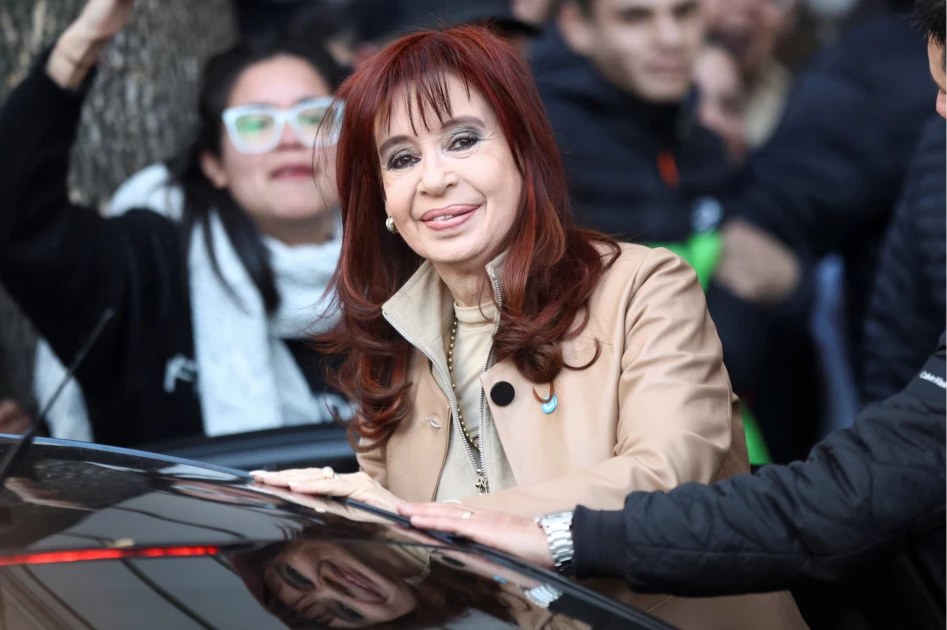
Argentina's former President Cristina Fernandez de Kirchner leaves her apartment for a meeting with lawmakers, ahead of a decision by Argentina's Supreme Court on her guilty verdict for defrauding the state, in Buenos Aires, Argentina, June 10, 2025. REUTERS/Tomas Cuesta

Audio By Vocalize
Argentina's top court
effectively banned two-term former president Cristina Fernández de Kirchner
from office and upheld a six-year jail sentence, likely drawing a curtain on
one of the country's most flamboyant and divisive political careers.
Kirchner, 72, a
polarizing opposition figure and leftist president from 2007 to 2015, was convicted by
a trial court in 2022 for a fraud scheme that steered public road work projects
in the Patagonia to a close ally while she was president.
The ruling scuppers
Kirchner's plans to run in Buenos Aires provincial legislative elections, but
could galvanize her divided Peronist opposition coalition, which has been
licking its wounds since being ousted in 2023 by current libertarian President
Javier Milei.
The Supreme Court's
three judges rejected Kirchner's appeal and left in effect an appellate court
decision that had upheld the guilty verdict. A lower court will
decide whether to grant Kirchner house arrest due to her age.
"The complaint is
dismissed," the Supreme Court said in a ruling. Kirchner has denied
wrongdoing and claims she is a victim of political persecution.
In Buenos Aires, her
supporters blocked roads across the city. Some banged on drums. Others carried
banners with the image of Evita Perón, the wife of Juan Perón, the founder of
the political movement who was known as a defender of the poor.
"A triumverate of
unpresentables," Kirchner said of the Supreme Court judges after the
ruling, speaking before thousands of supporters who rallied in downtown Buenos
Aires outside the headquarters of her Peronist Justicialista party.
Kirchner's shadow
looms large over the Peronist movement, which needs to identify a new
generation of leaders.
"The fact that
she goes to jail and can't be a candidate doesn't eliminate her political
movement," said political analyst Carlos Fara. "Obviously though it
won't be the same."
A government source
said that it could both weaken or strengthen the opposition. Peronism "can
either entrench itself or break into a thousand pieces," the person told
Reuters.
Prosecutors accused
Kirchner of directing hundreds of millions of dollars to construction magnate
Lázaro Báez. During her government and that of her late husband, Néstor
Kirchner, companies tied to Báez were awarded dozens of government contracts
for roadwork projects in Patagonia but nearly half of them were abandoned,
prosecutors said.
Báez and other
officials were sentenced to prison terms.
Peronism and
Kirchner's popularity have suffered in recent years. She served as vice
president in 2019 under President Alberto Fernández, whose government oversaw a
slide into economic crisis by overprinting pesos that led to sharp spike in
inflation.
But she has still been
able to maintain a hardcore support base, particularly from working-class
voters who relied on government subsidies under her and her husband's
governments.
"As a figure
she's not been overshadowed on the political scene by anyone," said
Carolina Barry, an expert on Peronism at the Universidad Nacional de Tres de
Febrero in Buenos Aires. "Her words resonate with many groups."
Kirchner has been
sharply critical of Milei's austerity, accusing him of cutting pensions and
defunding public education. Milei has shot back that he would "love to
bang the last nail in the coffin of Kirchnerismo, with Cristina Kirchner
inside."
"Justice," wrote
Milei on X after the verdict on Tuesday.
Alejandro Carrió, a
constitutional and criminal law expert in Buenos Aires, said that even if
Kirchner serves the sentence under house arrest, it was unclear "if with
time she'll lose the clear leadership she's held for years".
Kirchner faces charges
in several other criminal cases and is scheduled to stand trial in November on
accusations that she led a large-scale bribery scheme.
She's not the first
Argentine president to face a criminal conviction, joining, among others,
former President Carlos Menem, who was sentenced to over four years in prison
for embezzlement of public funds during his presidency in the 1990s. As a
senator, congressional immunity protected him from prison.
Leave a Comment