

Oldest-known ant preserved in 113 million-year-old Brazilian fossil
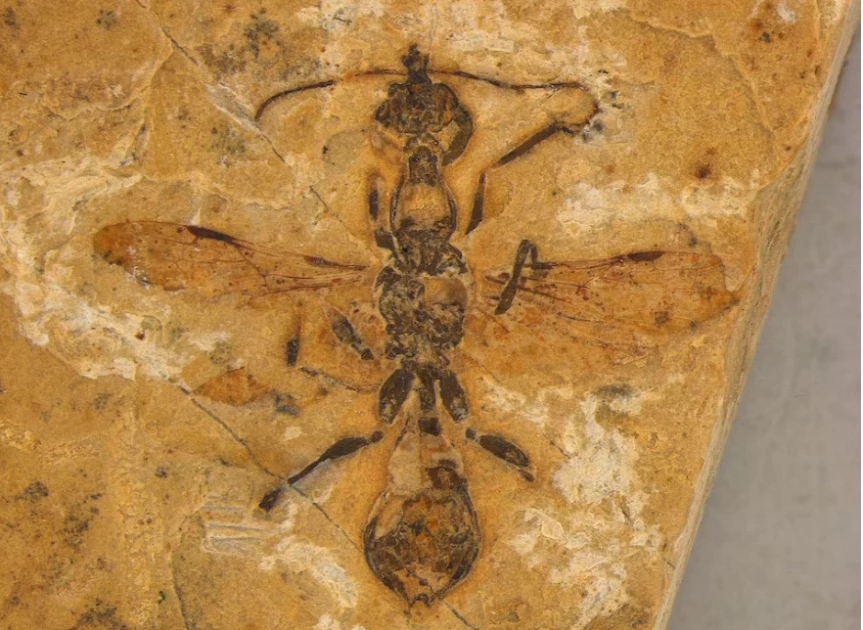
A 113-million-year-old fossilized ant preserved in limestone unearthed in northeastern Brazil, the world's oldest-known ant specimen is seen in this photograph released on April 24, 2025. Anderson Lepeco/Current Biology/Handout via REUTERS

Audio By Vocalize
Scientists have identified the fossilised remains of the
oldest-known ant -
a winged insect with fearsome scythe-like jaws that lived about 113 million
years ago during the age
of dinosaurs and was preserved in limestone unearthed in northeastern
Brazil.
The species, called Vulcanidris cratensis, is part of a lineage called hell ants - named for their demonic-looking jaws - that prospered in a wide geographical range during the Cretaceous Period but have no descendants alive today. A previously discovered Cretaceous hell ant was named Haidomyrmex in honour of Hades, the ancient Greek god of the underworld.
A medium-sized ant about a half-inch (1.35 cm) long,
Vulcanidris possessed highly specialised jaws that would have enabled it to pin
down or impale prey. Like some ants alive today, it had wings and appeared to
have been a capable flier. It also had a well-developed stinger like a wasp.
"It would probably be confused with a wasp by an untrained eye," said entomologist Anderson Lepeco of the Museum of Zoology of the University of São Paulo, lead author of the study published this week in the journal Current Biology.
"They probably used their mandibles (mouthparts) to
handle their prey in a specific way," Lepeco said.
Its mandibles moved up and down and not side to side, as
they do in today's ants.
"Currently, many odd mandible shapes can be found in
ants, but they usually articulate horizontally," Lepeco said.
This ant is roughly 13 million years older than the previous
oldest-known ants, specimens found in France and Myanmar that were preserved in
amber, which is fossilised tree sap.
The Vulcanidris anatomy is remarkably well preserved in the
limestone, which was excavated decades ago in the Crato geological formation in
the Brazilian state of Ceará, probably in the 1980s or 1990s, according to
Lepeco. It was held in a private collection before being donated to the São
Paulo museum about five years ago.
"I was looking for wasps among the fossils of the
collection and was shocked when I recognised this one as a close relative of a
hell ant previously described from Burmese amber," Lepeco said, referring
to the fossil from Myanmar.
The specialised nature of the Vulcanidris anatomy and the
fact that two hell ants lived so far from each other during this part of the
Cretaceous suggest that ants as a group emerged many millions of years before
this newly identified species existed.
"According to molecular estimates, ants originated
between 168 million and 120 million years ago. This new finding supports an
earlier age within these limits," Lepeco said.
Ants are believed to have evolved from a form of wasp. Their
closest living relatives are wasps and bees.
Vulcanidris inhabited an ecosystem teeming with life.
Fossils from the region show that Vulcanidris lived alongside other insects,
spiders, millipedes, centipedes, various crustaceans, turtles, crocodilians,
flying reptiles called pterosaurs, birds and dinosaurs, including the feathered
meat-eater Ubirajara. The ant's predators may have included frogs, birds,
spiders and larger insects.
Ants have colonised almost everywhere on Earth, and research
published in 2022 estimated that their total population is 20
quadrillion globally. That dwarfs the human population of about 8
billion.
"They are one of the most abundant groups in most
environments on Earth," Lepeco said.
"They play many roles where they occur, such as
predation and herbivory, controlling populations of other organisms. They also
have intrinsic relationships with specific plants and insects, protecting them
from other animals. Subterranean and litter ants help in soil health, and they
may also act as decomposers, feeding on dead organisms," Lepeco said.
Leave a Comment