

The overtaxed, burdened poor in Africa amid rise of the super-rich
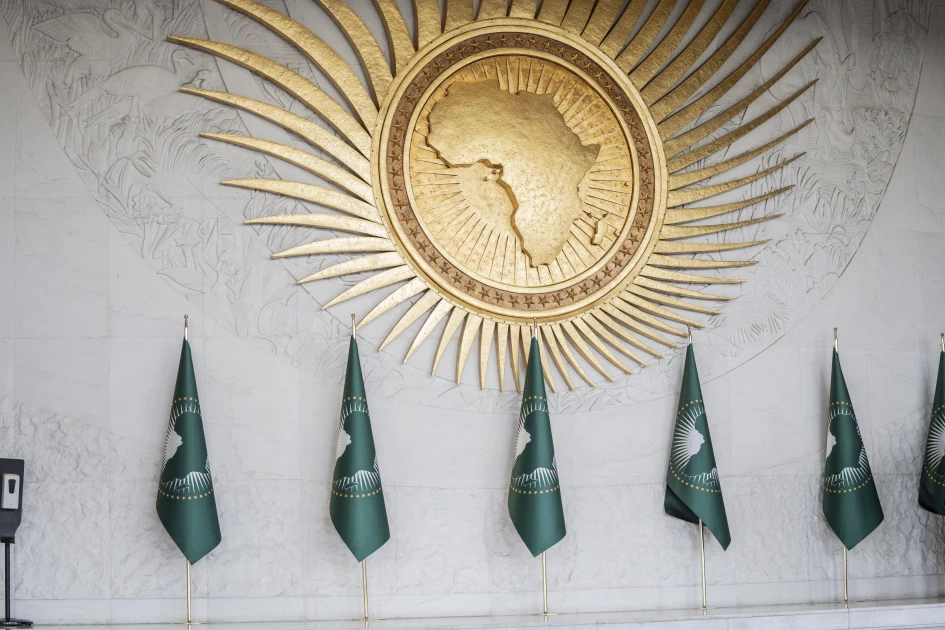
A general view of the logo and flags the African Union during the 38th African Union (AU) Summit, where leaders will elect a new head of the AU Commission, at the AU Headquarters in Addis Ababa on February 15, 2025. (Photo by Amanuel Sileshi / AFP)

Audio By Vocalize
Titled “Africa’s inequality crisis and the rise of the Super-Rich,” the report reveals that Africa is home to more than half of the fifty countries regarded as the most unequal countries in the world.
Africa, which holds the largest youth population in the world, is only second to Latin America as a place of great inequality.
It succinctly put it that “the crisis of inequality in Africa is not merely a contemporary economic challenge but a historical legacy that continues to shape our continent’s socioeconomic landscape.”
If the problem is to be put into context, the Oxfam report shows that the reality of Africa’s debilitating poverty is embedded in its skewed policy choices, systematically reinforced through its tax systems which are designed to maintain the status quo, an overtaxed and poor work force at the service of exuberantly wealthy few who either are taxed very leniently or the tax waived altogether.
Africa’s richest one percent, a population of about 14.7 million people, take home a fifth of all income (20.78%) and own a third of all wealth (33.87%) in Africa.
A burden to low-income earners
Because of their massive entire income and wealth, it is essential to ensure the high net-worth individuals (HNWI) are taxed effectively both to reduce inequality and to effectively raise government tax revenues.
A global perspective survey, claimed Africa having the highest reliance on regressive indirect taxes, and is the only continent, where more than 50% of tax revenue comes from indirect taxes.
The report lays bare a startling fact; for every dollar African countries raise through taxes on income and profits, they collect more than two dollars through regressive indirect taxes such as VAT, which disproportionately burden those with the least income.
In June 2022, on the campaign trail, President Ruto put his case forward for raising taxes; he was categorical that Kenyans have “been socialized to believe they pay the highest taxes” when in fact, he said, the overall tax burden was lower compared to some other countries in Africa and beyond.
Contrary to expectations, despite there being a flurry of new taxes, enhanced taxes and levies since the Kenya Kwanza government took power, a big majority still have to pay out-of-pocket for school fees, hospital bills, identification documents and toll for roads among others; it is, indeed, a case of double taxation across the board.
The Oxfam report found that Africans, as compared to the rest of the world, pay the highest taxes.
In Africa, it is as if the taxes levied are supposedly designed to demean and burden the majority citizens who go to work every day but instead get poorer.
The report indicates that public debt as a share of GDP in Africa has more than doubled over the last decade to sixty-seven percent in 2023. Consequently, it has eroded many African governments’ capacity for social spending, as significant resources are being diverted to service increasingly costly and unfair debts – an average of fifty-four percent of locally raised revenues. African governments expenditure on debt, on average, is one hundred and fifty percent greater than on education, healthcare and social protection combined.
Kenya’s National Tax Policy
A deep-dive into the prevailing situation in Kenya makes it look like the perfect case study into contemporary inequality in African societies, despite the noble aspirations of its Constitution 2010.
The Constitution of Kenya 2010 (Article 201), is the inspiration behind the National Tax Policy (Sessional Paper No. 02 of 2023) which is the framework for the principles of public finance.
The Policy underscores core values of equity, fairness, and the fair sharing of the tax burden as the anchors upon which taxation shall be based. While the National Tax Policy does not explicitly mention wealth tax, whether by design or omission, it has turned out to be a profoundly missed point in the fight against inequality in light of the tax burden borne by the majority of working Kenyans today.
All is not lost, however, as several tax measures introduced by the previous and the current government have sought to broaden the tax net.
Kenya has made strides in taxing aspects of wealth through capital gains tax, it has also introduced property taxes, luxury item duties, but despite all these efforts, a comprehensive approach to taxing accumulated wealth is lacking.
Anti-tax uprising
In 2024, when the youthful Gen Z-led protests arose as a direct challenge to the government-proposed Finance Bill 2024, at first, it looked like a fly on the back of a horse, but with the protests still on into 2025, how unrelenting they have turned out to be!
What began as a movement to resist unfair and regressive taxation has turned out to be the greatest tangible opposition the Kenya Kwanza Administration is facing to date. The Gen-Z protestors and other citizens remain unrelenting in demanding for good governance, accountability, the rule of law and tangible policies towards better quality of life for all.
Youthful Kenyans through street protests, strongly opposed several key proposals in the Finance Bill 2024, primarily due to concerns about increased or new tax clauses and the potential impact on citizens’ quality of life.
Despite the government fast-tracking the Finance Bill 2024 and President Ruto showering it with accolades, the protestors stormed parliament and a bloodbath ensued, many youths lost their lives. The result was a total rejection of the bill in as much as Kenya government leaning law-makers had passed it for adoption as law, President Ruto ultimately had to withdraw it.
Wealth inequality
Kenya, like other African nations, faces a double crisis of inequality against the working poor and secondly on the gender factor where women face extra difficulty as compared to their male counterparts.
The report reveals that in Africa, men own three times more wealth than women; the highest gender wealth gap of all regions of the world and is also double the world ratio. Kenya happens to be one of the jurisdictions where gender inequality is a factor that cannot be ignored any more, it calls for action.
From employment, to remuneration, business presence, inheritance and possessions, in Kenya, women are on the back burner by precedence in law, culture, traditions and dominant patriarchy.
The Oxfam report reiterates that Africa must tax the super-rich and invest the funds in public goods and services that will up that lift up whole communities on similar terms.
For instance, a huge chunk of public spending on education in Africa goes to tertiary education where only a handful of students from poor households are represented: twenty percent of 25-29 year olds from the richest households complete four years of tertiary education, as compared to just one percent from the poorest households.
In Kenya, increasing capital gains tax rates have been tough, but not impossible. The capital gains tax, a form of wealth tax, was abolished in Kenya in 1985 following pressure from the wealthy elite.
It was finally reintroduced at a low five percent rate in 2015, then tripled to fifteen percent in 2023 despite fierce resistance and lobbying. Following the increased rate introduced in 2023, the Kenyan Revenue Authority (KRA) has stated that they have seen a 49.5 percent growth in revenue collected from capital gains tax.
In November last year, a report by the National Taxpayers Association (NTA), titled” The potential and justification for taxing wealth in Kenya,” indicated that data from the World Inequality Database for Kenya released in the year 2022 specified how substantial wealth concentration in Kenya is structured.
The top ten percent HNWI owned sixty-one point nine percent of Kenya’s net personal wealth, while the bottom fifty percent struggling Kenyans owned a paltry four point two percent. This, in a country where the number of high net-worth individuals (HNWI) according to the Africa Wealth Report 2024 was at 7,200 people.
Therefore, the roll-out of wealth tax on 7,200 HNWI could generate substantial revenue according to the World Inequality Base. In the NTA report, they projected that a progressive tax system could have the potential to yield around $781 million annually, for Kenya, based on a proposed structure of 3 tiers for taxing the wealth of HNWI.
On a positive note, the NTA report noted that the Kenya Revenue Authority’s (KRA) ongoing efforts to strengthen capacity building within its Premier Tax Office (PTO) to understand financial planning and wealth management strategies of HNWI demonstrates proactive steps towards enhanced tax administration for the wealthy.
Globally, around twenty percent of government revenue is raised from the HNWI in society through progressive tax systems. Locally and regionally, many are familiar with the notion that raising taxes on the super-rich jeopardizes growth and job creation; however, to the contrary, research has proven that taxing the super-rich to fund essential social services is a catalyst to a much stronger economy, stimulates a reduction in inequality, strengthens gender justice, and provides rights and dignity to citizens.
In Kenya, a recent poll from 2024 shows that seventy percent of Kenyans support a net wealth tax on the rich.
The African Union, strategically, has recognized the negative enormity of inequality. In 2024, it set its first related target, that is, to reduce inequality by fifteen percent in the next ten years, as part of its ambitious target dubbed “Agenda 2063.” To meet this target, a drastic change of course is needed for all African governments, Kenya included, which have adopted tax policies in recent years that are more likely to increase the dangerous schism, inequality.
A precursor of poverty
The only time the number of the poor in Africa will go down is when inequality is reduced. The concentration of Africa’s HNWI is happening concurrently to when fifty-five million Africans are being pushed below the poverty line. Africa and indeed Kenya, can choose a more equitable and prosperous place for its people.
A place in which the few elite rich enjoy unimaginable concessions and African governments remain pussy-footed on policies that could deliver equality to all, is not where Kenya or Africa would want to go. There must be mainstreaming of women and the elderly at the heart of policies doled out from governments on the continent.
The push to reform taxes on employment income to exempt lower-income households, while increasing rates and enforcement on the highest earners, would have great potential in increasing the progressivity of the tax system.
Equality and social justice cannot be stored any longer, the time for its implementation is now.
Africa, Kenya included, cannot continue lamenting over worsening poverty issues, yet these very same are orchestrated by government policy, and legal failures.
Africa has the most vibrant youthful population and in the scope of economics, the factors of successful production still remain land, human resource, capital, and entrepreneurship, Africa has sufficient land and human resource as a head-start.
This vibrant and youthful population is a boon only awaiting a bit of capital and entrepreneurial touch, they are raring to go.
Leave a Comment