

Inside Equity Group's Ksh.700B stimulus package for Africa recovery and resilience plan
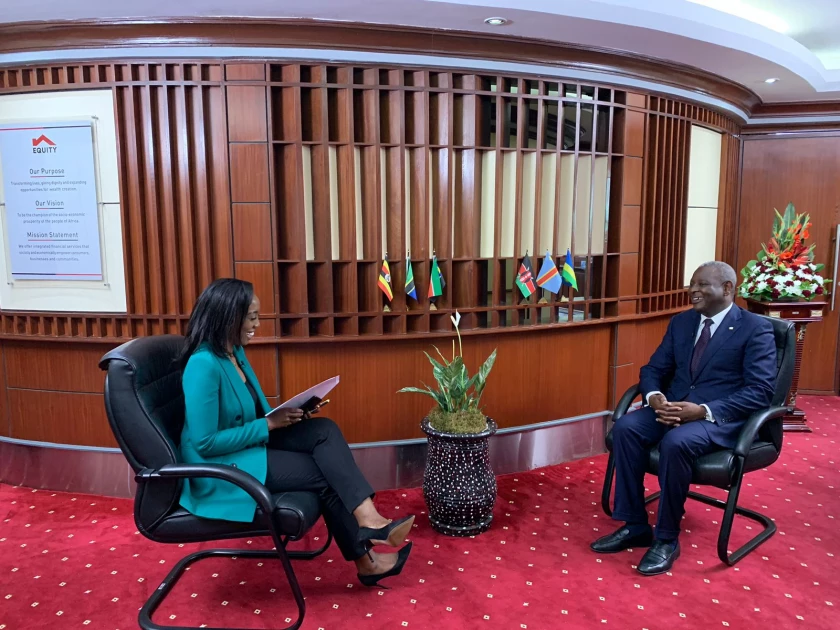
Equity Group Managing Director and CEO, Dr James Mwangi and Power Talk host Yvonne Okwara during the interview. Photo I File

Audio By Vocalize
The Africa Recovery and Resilience Plan was outlined by Equity Group Managing Director and CEO, Dr James Mwangi while appearing on Citizen TV’s Power Talk.
Dr Mwangi said the Plan looks to bring in all relevant stakeholders together, including the United Nations agencies, governments of different African countries and the private sector.
“We said let’s have a coherent plan for transforming Africa where we can collaborate and cooperate, each doing their best, bringing their capability and competitive strength to the table. And together with all our hearts on the deck, then we may move Africa,” Mwangi said.
This Plan, focusing on East and Central Africa, is intended to build regional strength and capacity against future shocks while contributing to economic recovery and growth and creating employment opportunities for young people and markets for local producers.
It envisaged providing financing of up to 2% of the combined GDP of the six economies, in which the Group operates, to the private sector in the form of blended financing of short-term overdrafts, medium-term loans and credit facilities which require long-term project and development financing.
With this Plan, Equity is striving to catalyse a social-economic transformation of the region in a socially ethical and environmentally sustainable manner.
The Plan is fully anchored on sustainability and governance. Being a purpose-driven Plan, inclusion is a centrepiece consideration to ensure nobody is left behind.
The Plan comprises six strategic pillars that are meant to ensure a systemic, coordinated and holistic framework execution.
These are hinged on the advancement of MSMEs in the private sector and empowering them to be in the driver's seat to help expand opportunities through activity enhancement in the primary sectors of Agriculture, Manufacturing, Trade and Investment and support for MSMEs.
These sectors will be a tool for integrating communities while advancing knowledge, science, technology and innovations as well as social impact investments and environmental considerations to make sure that no one is left behind and that the environment is protected.
Dr Mwangi added that it is time for Africa to take its rightful position on the world stage because it promises to determine the future.
“By 2050, Africa will have 33% of all labour force on earth, it will have 25% of the total world market in terms of population or consumer for that matter. It has 65% of all unutilised arable land. So, if you are going to solve the food security of the world Africa must be on the table,” Dr Mwangi added.
On the issue of climate change and action, he said Africa should be at the centre of the discussion because it has 60% of all the renewable energy.
“You cannot bring Africa to the table without listening to its voice, and the voice is the Plan of Africa, so it is Africa inviting the world to allow it to participate,” he further said.
Dr Mwangi said that the impact of the recovery Plan is that there will be increased income from value addition of available resources like minerals and agricultural produce, more employment opportunities for the African youth and formalisation and capacitating SMEs.
He added that adopting technological advancements will also help achieve the Plan and said Equity Group is now aligning with the budgets of African countries and it’s providing funding for the SMEs.
So far, 16 development banks have come on board to adopt the Plan, with the aim of raising at least 13 billion dollars to effect the African Recovery and Resilience Plan.
Leave a Comment