
Unseen mothers: Happy Mother’s Day to women who have experienced miscarriage
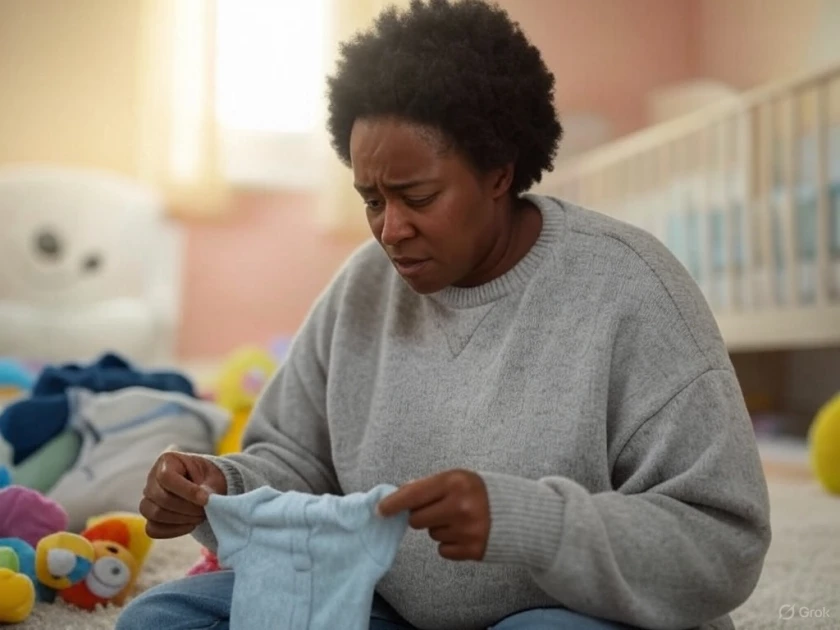
An AI-generated image depicts a woman holding an infant's cloth. Photo/ ©Grok

Audio By Vocalize
Mother’s Day is a day of joy, happiness and celebration of women who have carried and brought forth lives, where people show appreciation to mothers and mother figures.
Social media is always awash with lovely messages to moms and moms-to-be, gifts, flowers and giveaways.
Yet, for some women, this is a day that reminds them of the babies they never held, the babies that never breathed and dreams that were never realized. Mother’s day is a reminder of the silent grief they carry, every day.
Miscarriage is a lonely and personal experience. The silence that comes with it makes the pain more acute, with some women facing stigma.
According to the World Health Organization (WHO), a miscarriage is defined as the spontaneous loss of a pregnancy before its 20th week of gestation.
Data from the Kenya Demographic Health Survey (KDHS) 2022 reports that 10% of pregnancies among women aged between 15 and 49 resulted in miscarriages.
Traditionally, the loss of a pregnancy is a private affair and people rarely talk about it. The wearer of the shoe, is often left to deal with the emotional turmoil silently.
Behind quiet eyes and brave smiles, women who have experienced miscarriage mourn a deep loss. Sharing the pain and being allowed to speak about it without being judged, can be one small way of healing.
Jacinta* realized she was heavy with child two weeks after her honeymoon.
“My husband and I couldn’t contain our joy of becoming parents. We moved to a bigger house as I attended my antenatal clinics without fail. I searched all the dos and don’ts of pregnancy and even joined pregnancy groups on social media just so I don’t miss anything I needed to know as a first time mother,” narrates Jacinta, recalling how supportive her husband was.
“Unfortunately, we lost our baby at 19 weeks gestation. Our worlds came crushing down. I cried for days on end. I couldn’t eat. Or shower. The nights were long and days longer,” she says.
Their tears were wiped when Jacinta conceived not so long after her miscarriage. As the norm, she began her antenatal clinics immediately and their doctor assured them that all would be well. She even requested to work remotely and her boss was good enough to allow her work from home.
Jacinta’s second loss came silently and unexpectedly, just like the first one. One minute she was in her best mood singing her favorite praise songs and folding newborn clothes, the next minute she was in a sterile hospital room, her husband holding tight her hand.
Their eyes met, and for a moment, they stared into space, numb and mute. It’s like the world had learnt to mute itself when grief struck them. “It shall be well, Jacinta” the nurse in charge told her as she administered medication for post-miscarriage care.
“I lost my will to live. This second loss literally ground me into tiny pieces and scattered my essence out there. I rarely talked to anyone, not even my husband. I resigned from work and stayed at home,” she tells Citizen Digital.
She is grateful for her husband, who never left her side, never judged her and never uttered any mean word to her, despite her acting mean sometimes, because of the multiple loss she suffered.
Two years later, Jacinta had made progress, she wasn’t beating herself so much about the two babies she never held in her arms.
As time moved by, they had their third pregnancy. Most of her age mates and friends had one, two or three babies. News of this pregnancy gave mixed feelings. She didn’t want to talk about it, and so did her husband.
Life went on and, just like the first two, they lost it at 14 weeks.
“My body had become a graveyard. I didn’t trust my womb. This loss didn’t shock me. I didn’t cry. I kept asking God why He would bless my womb then take away the blessing before I held it,” she narrates.
Jacinta* and her husband Robert*, have been married for six years, and lost four pregnancies. People ask why they ‘don’t want to have children’, words that cut deeply through their hearts. No one knows about their loss, apart from their immediate family members.
Her friends’ baby showers and baby birthdays are unbearable reminders that she too, would be celebrating four birthdays by now.
“I whisper my babies’ names nearly every night; Leon, Leila, Louis and Lionel. I never got to know their gender, but I had names of them. My babies, that I never held in my arms,” concludes Jacinta - who still has hopes that one day she will successfully carry a pregnancy to term and get to hold her bundle of joy.
“I had 10 pregnancies. Five children who are alive, three miscarriages, one still birth and one who lived for 34 hours,” my mother tells me in our Mother’s Day conversation after I referred to her as ‘mother of five’.
“They were my babies. Those littles lives registered in my life, even if they never lived to be here,” she remembers.
She harks back to how women who lost their pregnancies back then were regarded as a bad omen to the families they got married into, adding that information about miscarriage was scanty and, in most cases, multiple miscarriages was seen as a curse.
“For us who were knowledgeable, we knew a miscarriage could be caused by some underlying health conditions of a woman, but generally, the loss was draining. We never knew about therapy. We somehow navigated our losses in our own ways, often sharing with a few close friends and mostly our mothers and siblings who walked us through the grief,” she recalls.
According to Footsteps to Fertility Centre, about 50% of miscarriages occur due to abnormal genes or chromosomes that stop the foetus from growing and developing normally.
These abnormal genes are not inherited. One common chromosomal cause, is translocation where separate chromosomes swap small segments, creating an abnormal area on each chromosome.
When a woman loses three or more consecutive pregnancies, it is referred to as Recurrent Pregnancy Loss (RPL), where medically, the pregnancy has been visualized in the first trimester.
The fertility center also notes that apart from the abnormal genes causing most miscarriages, other conditions like having abnormalities in the uterus, uterine fibroids, polyps and adhesions can cause a miscarriage.
Medical conditions such as diabetes or issues with the blood supply in the placenta, immune disorders and age among other factors, are said to increase the risks of having recurrent miscarriages.
Wamboi* suffered 6 painful miscarriages in 3 years. Each loss came with intentional stigma and mockery from her in-laws, leaving her broken and empty. Her husband grew distant and sometimes emotionally abusive.
“My mother in-law would call me ‘that woman with a plastic womb’, I’d later be told, whenever they had family meetings that I was never invited to. Wives to my brothers in law whispered how I had procured abortions when I was young, and that’s why I was unable to carry a pregnancy to term,” an emotional Wamboi shares with Citizen Digital.
After 4 years of unsuccessful pregnancies, her husband married another woman and the emotional abuse became unbearable that Wamboi decided to leave the marriage.
“I don’t hate him, nor my in-laws. I understand them. It is naturally expected that a woman brings forth children when she gets married, because children are the only guaranteed continuation of a generation” she continues.
“Unfortunately, I couldn’t give them children. So one day I woke up, left for the market to buy groceries and never went back to my matrimonial home. It’s been 10 months since I left and I am so at peace. No insults. No mockery. Just me and my God,” she shares.
Asked whether she still looks forward to having a baby, Wamboi, with hope written all over her face, says; “Yeah, I do. God is not done with me yet. I’m only 33. Someday, my child will come; at God’s time, in God’s perfect way.”
Jacinta and Wamboi’s stories are a reflection of what many women go through after miscarriages. The feeling of loss, guilt, rejection and isolation from friends and family can be overwhelming. For most women, the scars never fully fades.
It’s important to acknowledge and honor their losses and celebrate the little lives that were never fully realized.
This Mother’s Day, let us expand our love and celebration to mothers who never had the chance to hold their bundles of joy. Let us acknowledge their loss and celebrate their resilience.
To every woman who has experienced the unbearable pain and silent grief of miscarriage, you are seen, you are celebrated, you are honoured. Happy Mother’s Day.
Join the Discussion
Share your perspective with the Citizen Digital community.
No comments yet
This discussion is waiting for your voice. Be the first to share your thoughts!